












![Does ta’wīl mean interpretation or fulfilment? A Quranic reassessment [+video]](https://muslimviews.co.za/wp-content/uploads/2026/10/Tawil-Kaskas-360x180.webp)














![Why becoming a wealthy Muslim is commendable in Islam [+videos]](https://muslimviews.co.za/wp-content/uploads/2026/09/Muslim-Trade-Business-1-360x180.webp)





Beyond offering historical knowledge of the Prophet’s Makkan period, the course provided a roadmap for cultivating character, deepening faith, and building resilience in the face of life’s challenges.
By IMAM DR A RASHIED OMAR
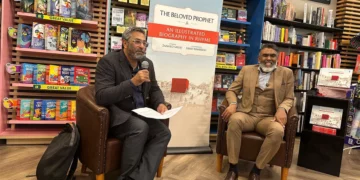
Twenty-two students successfully completed a four-week Sirah course on Saturday October 4 at the Claremont Main Road Masjid (CMRM), jointly hosted with Red Kufi Books. The course, ‘The Beloved Prophet: The Makkan Period’, was presented by Zaahied Sallie, author of the internationally acclaimed The Beloved Prophet (SAW): An Illustrated Biography in Rhyme.
Over four weekend sessions, Sallie guided participants through the formative years of the Prophet Muhammad’s (SAW) mission, blending Qur’anic insights, Prophetic teachings, and modern psychology with practical tools for personal growth. The course was supported by professional presentations and comprehensive study notes, making it accessible both in-person and online.
Qur’an at the heart of renewal
Sallie began by stressing the first Qur’anic command, Iqraʾ (Read), as the foundation of Islamic life. Even a single verse read daily with reflection, he said, can turn faith into lived reality. Reading, he argued, is not merely intellectual but a spiritual discipline that reconnects believers with their innate fitra, their original state of goodness.
He warned that the community’s decline stems from losing esteem for this commandment. ‘Reading is not just about knowledge; it is about transformation,’ Sallie said. He urged participants to make it a daily habit to strengthen their relationship with Allah, introducing what he called the ‘Prophetic paradigm’, a journey from heedlessness to awareness through the Qur’an and Sunnah, grounded in humility, willingness, and constant self-assessment.
Habits and identity formation
One of the course’s central themes was how habits shape spiritual identity. Drawing on James Clear’s Atomic Habits, Sallie showed how small, consistent actions can build powerful routines. He urged students to ground new practices in their Muslim identity, stressing that change is less about setting goals than about living one’s faith. Practices such as prayer, fasting, and dhikr, he explained, are ‘super habits’ that embed Prophetic values into daily life. ‘Real transformation,’ he said, ‘comes from living as the person you strive to be.’
Five spiritual currencies
In subsequent sessions, Sallie outlined five ‘spiritual currencies’: humility, willingness, knowledge, action, and consistency. These, he noted, are essential for navigating life’s challenges and embodying the Prophetic model. To illustrate, he contrasted Maslow’s hierarchy of needs with the Qur’anic vision, highlighting that true human flourishing begins not with self-actualisation but with trust in Allah, the Most High. This trust, Sallie explained, is exemplified in the life of Prophet Ibrahim, whose unwavering faith in moments of trial provides a timeless template for resilience.
Finding joy through adversity
Sallie also explored the Prophetic approach to hardship. He distinguished between fleeting happiness and enduring joy, explaining that joy emerges when trials are accepted as part of Allah’s plan. Citing Jalal al-Din Rumi (d. 1273), he noted that adversity, when embraced with humility and trust, becomes a source of blessing.
He described this process as ‘pegging the soul’, anchoring oneself in divine truth amidst life’s turbulence. ‘Adversity is not an enemy,’ he reminded participants, ‘it is an unwelcome guest with a message, and if received with patience and gratitude, it can be transformative.’
Reflection, accountability, and reform
The course also emphasised personal accountability. Sallie encouraged students to use habit trackers and accountability partners to measure their growth, echoing the Qur’anic call to ‘bring yourselves to account before you are brought to account.’ He reminded participants of the Prophet Muhammad’s (SAW) mission as a witness, a bearer of glad tidings, a caller to Allah, and a light-bearer. To embody these roles, Sallie insisted, believers must begin with self-reform before seeking to reform others.
More than history
You may also want to read




Students described the programme as both practical and inspiring. Beyond offering historical knowledge of the Prophet’s Makkan period, the course provided a roadmap for cultivating character, deepening faith, and building resilience in the face of life’s challenges. By weaving together Qur’anic wisdom, Prophetic teachings, and behavioural science, Sallie invited participants to recover what he called the ‘universal self’ through Prophetic engagement.

Conclusion
By weaving together Qur’anic wisdom, Prophetic teachings, and contemporary insights on habit formation, the Sirah course offered participants more than historical knowledge. It provided a practical roadmap for cultivating character, deepening faith, and finding joy in adversity.
CMRM expressed its gratitude to Zaahied Sallie for his inspirational teaching and to the students for their dedication to learning and their commitment to embodying the Prophetic example in daily life.
For more information about the course, email: course@thebelovedprophetbook.com