








![Does ta’wīl mean interpretation or fulfilment? A Quranic reassessment [+video]](https://muslimviews.co.za/wp-content/uploads/2026/10/Tawil-Kaskas-360x180.webp)
















![Why becoming a wealthy Muslim is commendable in Islam [+videos]](https://muslimviews.co.za/wp-content/uploads/2026/09/Muslim-Trade-Business-1-360x180.webp)






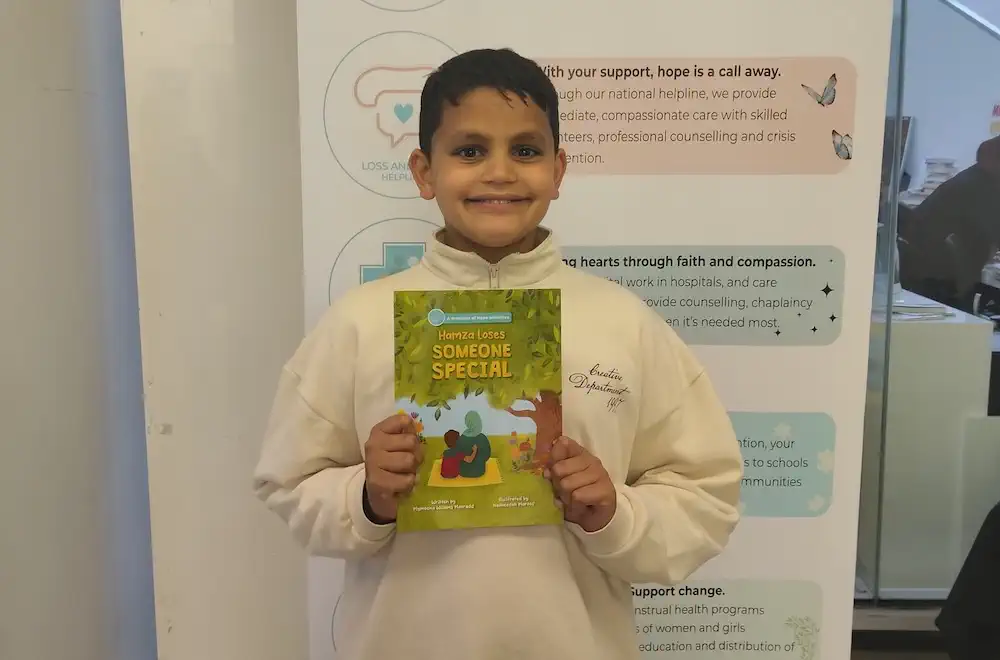

When Hamza Hoosen’s mother quietly told him that his great-aunt, Aisha Nani, was sick, the then nine-year-old went somewhere quiet. His teacher at Wynberg Boys’ Junior School later called his mother to say Hamza was upset and worried because Aisha Nani was in hospital.
By YASEEN BARDIEN
Aisha Nani was known for her baking, which Hamza says made the best “bollas in the whole universe”.
Even while she was sick, she gave Hamza a box labelled “Hamza’s bollas”.
His grandmother, Zeenat Parker, said he became withdrawn after Aisha Nani’s death. At times, he would scream or retreat to a room and cover himself.
“He didn’t know what to do with his feelings,” Parker said.
Hamza also asked questions about whether the grave was small, whether there would be light and how Aisha Nani would be fed.
During one iftar, he put falooda into the ground.
When Parker asked him why, he said it was in case there was no food for Aisha Nani.
You may also want to read


Photo: Yaseen Bardien
These experiences became the basis for Hamza Loses Someone Special, a book about a child trying to understand the death of someone close to him.
Parker, founder of Warriors of Hope, began talking to Hamza about his grief. They also used drawing and other ways for him to express what he was feeling.
“Your grief matters, even if it looks different,” Parker said.
Hamza is neurodivergent, and Parker said his grief did not always come through words.
Children do not always grieve in ways adults expect, Parker said. They may become clingy, angry or fearful when grieving. They may also struggle at school or have difficulty sleeping.
She said children move in and out of grief, becoming deeply sad before returning to play or laughter. This does not mean they have stopped grieving, but it can be a way of processing difficult emotions in smaller amounts.
Dr Sadeeka Williams, who gave a presentation on neurodiversity at the launch, said neurodivergent children can experience the same emotions as other children but may respond more intensely or for longer.
Signs can include changes in eating and sleeping, difficulty concentrating, a drop in schoolwork or unusual anger towards teachers or classmates, she said.
“Sometimes it’s not that obvious,” Williams said.
Williams, who is a paediatrician, said children should not be shielded from difficult subjects such as death.
Stories can introduce children to uncomfortable experiences and give them tools to cope when they encounter them in real life, she said.
At the launch, held at the Academia Library on September 12, Parker read the book to an audience of parents and children before Hamza gave his own remarks.
“I hope that this book will help other people and that it’s okay to have big feelings,” he said.
The book was written by Mymoena Williams Mooradd and illustrated by Natheefah Maroof.
For book purchases, contact Warriors of Hope on 069 823 1700.