



![Does ta’wīl mean interpretation or fulfilment? A Quranic reassessment [+video]](https://muslimviews.co.za/wp-content/uploads/2026/10/Tawil-Kaskas-360x180.webp)








![Why becoming a wealthy Muslim is commendable in Islam [+videos]](https://muslimviews.co.za/wp-content/uploads/2026/09/Muslim-Trade-Business-1-360x180.webp)





Hendricks’ testimony not only details the personal risks faced by humanitarian workers but also provides a rare insight into the systematic oppression faced by Palestinians and activists in Israeli detention.
By SHAKIR ACHMAT
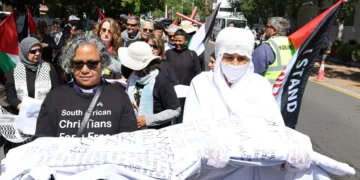
SOUTH African humanitarian and activist, Dr Fatima Hendricks, has provided an extensive account of her detention by Israeli forces while participating in the Global Sumud Flotilla, a mission carrying humanitarian aid to Gaza.
In an interview with Muslim Views, Hendricks detailed the interception at sea, the conditions aboard her vessel, the dehumanising treatment in Ashdod, and the lasting psychological effects of her ordeal.
Hendricks explained that the flotilla faced threats even before reaching Gaza. She said that attacks occurred near Tunisia and in Greek waters, as part of ongoing attempts by the Israeli Occupation Forces (IOF) to prevent aid from reaching Gaza. She noted that mechanical issues forced several vessels to drop out or return to land, and the remaining fleet continued under increasingly hostile conditions.
Hendricks reported that her vessel, the Amsterdam, was surrounded by Israeli boats for approximately ten hours. She said the soldiers repeatedly sprayed water cannons on four separate occasions and eventually demanded that the vessel stop.
She emphasised that passengers repeatedly informed the soldiers that they were humanitarian workers operating in international waters. To demonstrate their non-violence, Hendricks and the others placed their hands in front of them rather than above their heads, showing they carried no weapons.
The soldiers boarded the Amsterdam and conducted exhaustive searches of passengers and belongings while ransacking the vessel. Hendricks recalled that the captain had to show the soldiers, under duress, how to operate the older boat. Passengers were then held hostage, sitting on the hull and holding railings for hours as the sun rose, before being taken to Ashdod port.
Upon arrival, Hendricks described being held by two soldiers, forced to remove her hijab, and made to remove a T-shirt featuring Maryam Abu Daqqa, a photojournalist who had inspired her.
Soldiers conducted multiple searches, forced her to wear an undergarment taken from her belongings, mocked her body shape — she is a breast cancer survivor — and cut up her shoes. All her personal belongings, including medication, Quran, and other books, were confiscated. Only the clothes she had been wearing at the time were returned.
Hendricks described harsh prison conditions. She reported blood-spattered walls and writings from previous detainees, and said that access to toilets, food, and water was denied for 24 hours. Food later provided was withheld until consular authorities applied pressure. Despite the conditions, she found solace in spirituality, noticing a triangle marking the Qibla (direction of prayer) in her cell and praying for those who had previously occupied the space. Hendricks emphasised the continuous purification of her niyah (intention) and the responsibility of fulfilling the amaanah (trust) of delivering humanitarian aid.
You may also want to read


She described engaging in group sessions with fellow prisoners, including a French sister, a Tunisian sister, and a man from Oman. Together, they read testimonies in Arabic, learning about the experiences of detainees, including children in administrative detention with no charges or parental knowledge, and prisoners in solitary confinement. One particularly vivid moment involved blood-stained fingerprints in the prison quad, which she assumed belonged to a martyr. Hendricks performed two rakahs (units of prayer) and made dua for martyrs, prisoners, and children held in captivity.
Hendricks expressed frustration with the international response to Gaza and the recently announced ceasefire. She said that the so-called peace plan failed to address the occupation, war crimes, or the liberation of the Palestinian people, and noted that billions of dollars had been spent by multiple countries supporting Israel while no naval ships accompanied the flotilla to deliver aid. She highlighted the complicity of the international community in allowing the humanitarian crisis and ongoing siege to continue.
Despite the ordeal, Hendricks stressed the importance of continued activism. She highlighted the boycott, divestment, and sanctions (BDS) movement as a vital tool to hold Israel accountable and bring political and economic pressure to bear. Hendricks warned that Zionism remains active in South Africa, particularly in the Western Cape, and called on citizens to remain aware and engaged.
She also disclosed the psychological impact of her detention, reporting ongoing PTSD triggered by visual and sensory reminders of the prison, flotilla, and harassment at sea. She said that even mundane objects, colours, or situations can trigger memories of her time in captivity, underscoring the long-lasting effects of her experience.
Hendricks’ testimony not only details the personal risks faced by humanitarian workers but also provides a rare insight into the systematic oppression faced by Palestinians and activists in Israeli detention. She highlighted the courage, resilience, and solidarity required to endure such conditions, as well as the role of faith in sustaining hope.
Her account serves as a stark reminder of the ongoing humanitarian crisis in Gaza and the importance of global awareness, advocacy, and action. Hendricks’ detailed recollections offer a window into the dehumanising treatment endured by activists and civilians, the ongoing violence and occupation, and the spiritual and emotional strength required to persevere under extreme adversity.