










![Does ta’wīl mean interpretation or fulfilment? A Quranic reassessment [+video]](https://muslimviews.co.za/wp-content/uploads/2026/10/Tawil-Kaskas-360x180.webp)
















![Why becoming a wealthy Muslim is commendable in Islam [+videos]](https://muslimviews.co.za/wp-content/uploads/2026/09/Muslim-Trade-Business-1-360x180.webp)






Goolam Hoosain Abed (August 11, 1934 – June 20, 2026), former rugby fly-half and cricket all-rounder, leaves behind a remarkable sporting legacy spanning South Africa and England.
By MOGAMAD ALLIE
After a well-played innings of 91, Goolam Abed finally became the last wicket to fall in his fabled family’s innings that made such a massive contribution to South African sport.
The former rugby fly-half and cricket all-rounder passed away at the Rochdale Infirmary in England on June 20 after a short illness.
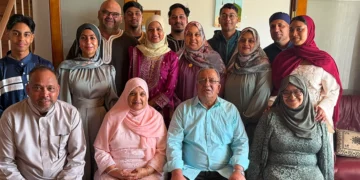
In a family of six brothers and three sisters, four of the Abed brothers achieved national honours in rugby and cricket, while a fifth, Sulaiman, captained the Netherlands at the 1982 ICC Trophy tournament in England. ‘Dik’, as he was better known, was also voted by Enfield as their Player of the Century on the occasion of the Lancashire League’s centenary in 1998 ahead of West Indian legends Sir Clyde Walcott and Everton Weekes.
Following in the footsteps of eldest brother Abduraghmaan, better known as ‘Babu’, who played on the wing for the SA Coloured Rugby Football Board (SACRFB) team in their ‘test’ against the SA Bantu Rugby Board (SABRB) side on October 7, 1950, Goolam ran out at fly-half for the SACRFB side in the 1957 and 1959 tests, which were played on a biennial basis. He was a shoo-in for the 1961 test but had by then packed his bags to play rugby league for Leeds in England.
Elder brothers Gesant ‘Tiny’ and Salie ‘Lobo’ were both members of Basil D’Oliveira’s SA Cricket Board of Control (SACBOC) side that whitewashed the Kenya Asians in their three-test series in Nairobi and Mombasa in 1958. Tiny was vice-captain and Lobo, who excelled as wicketkeeper and also played in the home series in 1956, was regarded by D’Oliveira as the best in the world in that era.
Despite being shortlisted for the tour to Kenya, Goolam, who finished sixth in the national batting averages at the 1958 inter-race tournament in Cape Town, narrowly missed out on selection.
Ebrahim was the only one of the Abed brothers who did not play any sport, but he was a brilliant Islamic art calligrapher whose work adorns many mosques and homes in Cape Town.
Goolam’s rugby career started with Roslyns, a District Six-based rugby and cricket club formed in 1882. He debuted for the WP Rugby Union side at the age of 18.
It was while playing for the WP side in the 1959 Rhodes Cup, the SACRFB’s biennial national tournament that was held in Cape Town, that Goolam was spotted by former Springbok centre Dr Louis Babrow, who recommended him to Jim Windsor, the well-known Yorkshire rugby league talent scout who was a frequent visitor to Cape Town in the 1950s and 1960s.
Windsor managed to secure a contract for Abed, along with Louis Neumann, a tough loose-forward, with top English side Leeds for the 1961–62 season.
‘I was a little apprehensive because I was young and sceptical to travel so far from home to a completely new and different environment. Rugby league was also slightly different to the traditional game of rugby that I was used to,’ Abed related in an interview a few years ago.
The pair sought the counsel of Basil D’Oliveira, who had made the historic move to Central Lancashire League side Middleton the previous year. ‘Windsor said he would like me to come to England and try my hand at rugby league because he had been told by Dr Louis Babrow that I was good enough.
‘He said I would have to come over as an amateur since I was an unknown because we didn’t get any publicity in those days. I basically had to play to be put in the shop window.’
While Abed was pulling the strings from his fly-half position for the WP side, his teammate Noor ‘Guppy’ Daniels, who played on the wing for the 1959 SACRFB national team, moved to England a few months earlier to become the first black rugby player to secure a move overseas.
You may also want to read



After the initial moves of Daniels, Abed and Neumann, others like Duncan Pikoli, Vernon Petersen, Enslin Dlambulo, Dawid Barends and Green Vigo followed the same route from Cape Town’s bumpy rugby fields to the lush green and manicured turfs on which rugby league was played in England.
Coming from an apartheid environment in which they were consigned to life as second-class citizens, Neumann and Abed initially struggled to adapt to their new environment in England.
‘The first time Louis and I went into the Leeds dressing room – that was the first game after they’d won the league the previous season – we were a little shy, probably due to an inferiority complex that apartheid left with us. We wanted people to be talking to us before we talked to them. That’s how we grew up.
‘We found ourselves in a corner of the dressing room but the guy who was very nice with us was Wilf Rosenberg – he was great because he knew what went on in South Africa.’
The calming influence of former Springbok centre Rosenberg on Abed extended to the playing arena when he made his debut for Leeds against Hunslet in front of a crowd of 28 000 at Headingley.
‘Wilf helped calm my jitters and in the weeks that followed he went out of his way to help Louis and me to settle into our new surroundings,’ said Abed.
The fly-half was honest enough to admit that he wasn’t quite good enough to cut the mustard at a top-notch Leeds side that featured ten internationals.

Fortunately, Windsor managed to secure a move for him to Bradford Northern on a five-year deal worth £1 000 a season, which, according to Abed, was good money at the time. The move took the pressure off the former Roslyns pivot, and he flourished in his new environment. In four seasons with the club he made 46 appearances, all starts, scoring five tries and nailing 55 conversions.
This was followed by a further two seasons with Batley RLFC where he played 36 matches (33 starts), scoring four tries and 46 goals, before his eventual retirement in 1968 due to an injured shoulder.
Neumann, on the other hand, proved a great success at Leeds with whom he spent five productive seasons. The former Thistle and Walmers loose-forward would go on to make 123 appearances for the club in his six-year stay in Yorkshire.
Neumann moved to Sydney in February 1967 on the recommendation of Australia international and Leeds teammate Ken Thornett. Such was the impression he made that two years later he was appointed captain-coach of Eastern Suburbs (who became known as the Sydney Roosters in 2000), taking over from Jack Gibson, who was regarded as one of the greatest-ever rugby league coaches.
While his primary focus was on rugby because his contracts paid the bills, Abed’s love for cricket continued to burn brightly. So much so that he grabbed the chance to play in the Bradford League for six seasons during his rugby league stints with Bradford Northern and Batley.
After successful spells with Yeadon and Laisterdyke, Abed realised an ambition to play in the Central Lancashire League (CLL), where fellow Capetonians D’Oliveira, Cecil Abrahams and Coetie Neethling had already performed with distinction.
In fact, it was Abrahams who played a key role in enabling Abed to fulfil his ambition of playing in the CLL. ‘Cecil got me the job as a pro at Rochdale in 1967 – it wasn’t for a lot of money but it was okay.’
But the highly coveted move nearly didn’t materialise. ‘Shortly before I came over to be interviewed by Rochdale I hurt my arm in a rugby league game playing for Batley against Bradford Northern so I couldn’t go. I went two days later with my arm in a sling to sign the contract with Rochdale.’
Abed made an impact in the league, being the only professional to record a century in the 1969 season, the first by a Rochdale player in 11 seasons, when he finished fifth on the batting averages.
After three years as Rochdale’s professional, Abed moved to Castleton Moor and later played a season with Nelson in the Lancashire League before moving back to Rochdale and thence to Walshaw in the Bolton Association.
He had two more years at Castleton Moor and finally retired at the ripe old age of 55, playing in the Rochdale second team.
At Castleton Moor, Abed twice won the Sir Frank Worrell Trophy for the leading amateur run-scorer in the CLL – 805 runs in 1970 and 685 runs in 1972.
A lucky break saw him spending the 1971 season with Nelson as the club’s professional, taking over from top Australian Test fast bowler Neil Hawke.
Jim Standen, who won the county championship with Worcestershire in 1964 and was a former Arsenal, West Ham and Luton goalkeeper, pulled out of his contract with Nelson after having joined Portsmouth in the 1970 season.
That season with Nelson gave Abed the privilege of playing against a young Dennis Lillee (Haslingden), who would go on to become one of the game’s greatest fast bowlers. He also had the opportunity of playing as an amateur for Rochdale against Sir Garfield Sobers in the 1975 season when the legendary all-rounder was signed by Littleborough.
His association with Rochdale turned out to be a long and fruitful one, spanning three decades into the 1990s when he served as team manager at the request of South Africa international all-rounder Dave Callaghan, who was the club’s professional between 1988 and 1992 and again in 1995.
The pair developed a close bond and Callaghan was moved to post the following tribute to Abed on Instagram: ‘Goolam was blessed with exceptional talent on both the rugby and cricket fields. Sadly, he never received the opportunities his ability deserved in South African sport. Yet what set him apart was that he never carried bitterness or resentment. He accepted those injustices with dignity and humility, choosing to enjoy the game simply for the love of it.
‘His wisdom, calm presence, and unwavering support were invaluable. He was far more than a manager; he was a mentor, a confidant, and a sincere friend.’
During his stay in Cape Town between 2003 and 2012 with his late wife Jean, Abed was awarded a Springbok blazer in 2003 as part of the SA Rugby Union’s Yesterday’s Heroes programme that recognised players who were capped by the various national bodies before unity in March 1992.
Mogamad Allie is a freelance journalist and author of More Than a Game: History of the Western Province Cricket Board, 1959-1991, the stirring story of a community of cricketers whose spirit and determination to play the game saw them triumph over apartheid.