







































From Kashmir to Yemen and the imprisonment of Imran Khan, three distinct struggles converge around a shared challenge to Pakistan’s establishment, raising questions about sovereignty, legitimacy and who may speak for the governed.
By PROFESSOR JUNAID S AHMAD
Pakistan’s ruling establishment has accomplished something decades of revolutionary organising might have struggled to achieve – it has helped bring Kashmiri protesters, Yemen’s Ansarallah, and Pakistanis rallying around the imprisoned Imran Khan into an extraordinary convergence of resistance.
Three distinct constituencies are discovering a common adversary in an establishment that claims to represent them while denying their political agency. More than an exchange of solidarity, this signals an incipient transnational counter-legitimacy, challenging Rawalpindi’s monopoly over sovereignty, political representation and the definition of legitimate resistance.
For an establishment accustomed to confusing control with consent, this is an unpleasant discovery: populations can recognise one another’s political authority without permission from their self-appointed guardians.
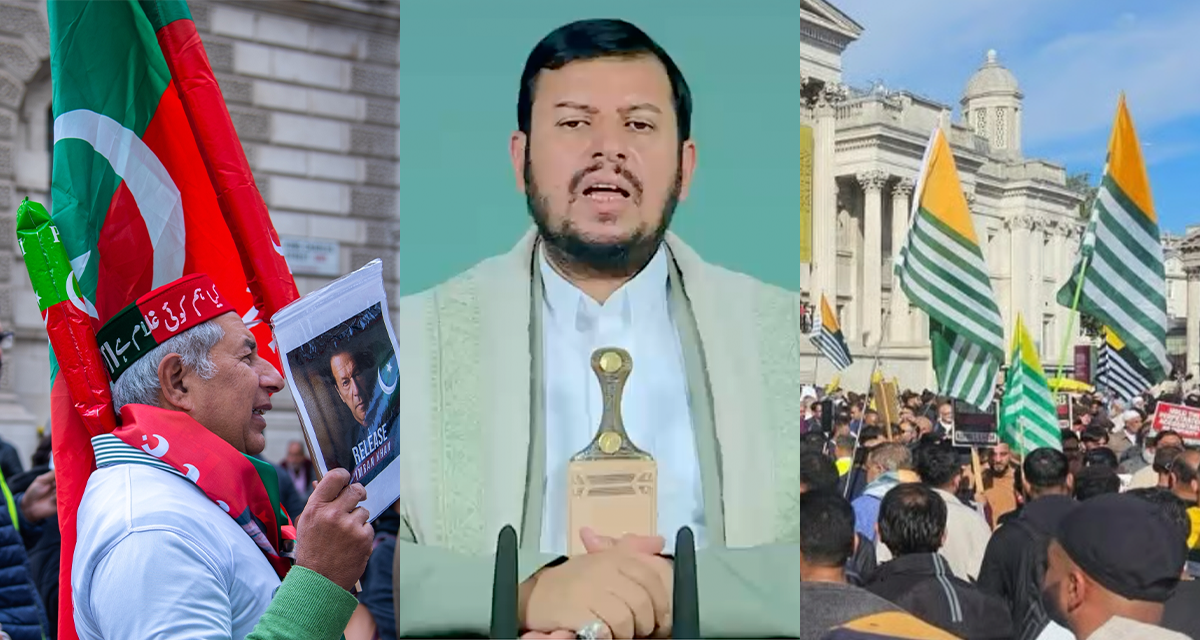
Consider the convergence. In Pakistan-administered Kashmir, the Joint Awami Action Committee (JAAC) mobilises against political exclusion, entrenched privileges and repression. Across Khyber Pakhtunkhwa, Khan’s supporters, led by Chief Minister Sohail Afridi, demand the release of a leader whose refusal to submit has become an enduring indictment of military domination. Meanwhile, Ansarallah confronts renewed Saudi military operations against Yemen, as Pakistan and Türkiye move to implement collective defence commitments under the Mecca Agreement.
Different struggles, certainly. But each exposes the same political fraud: an establishment appropriating sovereignty while disregarding the governed.
Kashmir supplies the most spectacular contradiction. For generations, Islamabad has sanctified Kashmiri self-determination, celebrated resistance to Indian rule and denounced political repression. Yet when Kashmiris under Pakistani administration organise independently, challenge privileged political arrangements and demand accountability, the vocabulary undergoes a miraculous transformation. Resistance becomes sedition. Self-determination becomes disorder. Popular sovereignty becomes a security emergency.
Apparently, Kashmiri resistance is sacred when directed towards Delhi and criminally inconvenient when directed towards Rawalpindi.
The Joint Awami Action Committee’s significance extends beyond exposing hypocrisy. Its mobilisation challenges Islamabad’s appropriation of Kashmiri political agency. Kashmiris refuse to remain decorative beneficiaries of a sovereignty they are discouraged from exercising.
Yemenis distinguish Pakistan’s people from its military establishment; Kashmiris express solidarity with Yemen independently of Islamabad.
Their solidarity with Yemen introduces something more subversive: Kashmiris are asserting that they can articulate the conscience of Pakistanis against Pakistan’s own rulers. They challenge not merely Islamabad’s authority to speak for Kashmir, but its claim to represent Pakistan’s moral position internationally.
Ansarallah’s reported expressions of gratitude towards Pakistanis opposing intervention supply the reciprocal dimension. Yemenis distinguish Pakistan’s people from its military establishment; Kashmiris express solidarity with Yemen independently of Islamabad. Political recognition begins circulating between movements rather than descending from governments.
This is the extraordinary development: constituencies claimed by the state increasingly recognise one another as more authentic expressions of political conscience than their supposed representatives.
When Gaza faced annihilation, Islamabad perfected the ceremonial vocabulary of Muslim solidarity. When Saudi Arabia came under attack, collective security suddenly acquired operational urgency.
The Mecca defence commitments sharpen this confrontation. In 2015, Pakistan’s parliament rejected direct participation in Saudi Arabia’s Yemen war. Eleven years later, renewed military commitments amid regional hostilities raise troubling questions about the boundary between territorial defence and offensive involvement. The constitutional question is elementary: who authorised another potential regional entanglement without comparable parliamentary scrutiny?
You may also want to read




The moral contradiction is equally damning. When Gaza faced annihilation, Islamabad perfected the ceremonial vocabulary of Muslim solidarity. When Saudi Arabia came under attack, collective security suddenly acquired operational urgency. Apparently, some Muslim lives warrant declarations of concern; others activate military agreements.
Khan supplies the third dimension of this emerging counter-legitimacy. His significance transcends partisan loyalty. Relentlessly persecuted by an establishment wielding overwhelming coercive power, he has become a symbol of resistance precisely because he refuses submission. His imprisonment dramatizes the gulf between political legitimacy derived from popular support and authority maintained through institutional coercion.
The contrast with sections of Pakistan’s conventional ideological leadership is particularly embarrassing. Much of the reactionary religious right excels at revolutionary rhetoric while accommodating entrenched power. Sections of the organised left celebrate heroic sacrifice, preferably performed by someone else. Martyrdom, apparently, remains an admirable political principle provided the invoice goes elsewhere.
Khan’s defiance connects domestic resistance to military domination with Kashmiri political agency and Yemeni opposition to external aggression. Their political programmes need not coincide. Their shared principle is that coercive power cannot manufacture legitimacy merely by criminalising those who refuse obedience.
This is the essence of the tripartite convergence: not a formally coordinated revolutionary organisation, but a transnational challenge to the establishment’s monopoly over representation. Kashmiris contest its authority to define their aspirations. Khan’s supporters contest its authority to determine Pakistan’s leadership. Yemenis recognising Pakistani popular solidarity challenge its presumed authority to commit the country internationally against popular opposition.
Each struggle reinforces the others by exposing the same governing pathology: sovereignty proclaimed publicly, appropriated by elites and denied to the governed. Their emerging solidarity threatens something more profound than political embarrassment: the establishment’s claim to be the indispensable interpreter of the national will.
Rawalpindi may retain its armies, diplomatic credentials and machinery of state. What it cannot indefinitely assume is that possession of these instruments constitutes ownership of the national conscience.
For generations, Pakistan’s establishment celebrated resistance abroad while demanding submission at home. Now Kashmiris, Yemenis and Khan’s supporters are reclaiming that principle without consulting its appointed custodians.
The generals may yet discover that their greatest political miscalculation was not teaching the language of resistance.
It was assuming they would forever control its translation.
Prof. Junaid S. Ahmad teaches Law, Religion, and Global Politics and is the Director of the Center for the Study of Islam and Decolonization (CSID), Islamabad, Pakistan.


