


























![The market-builder who restrained the market [Part 2]](https://muslimviews.co.za/wp-content/uploads/2026/08/PHOTO-2026-08-25-17-16-32-360x180.jpg)
![The merchant preceding the Prophetic mission [Part 1]](https://muslimviews.co.za/wp-content/uploads/2026/08/01-360x180.jpg)



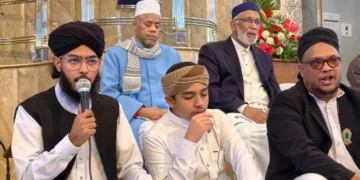








Pakistan’s response to the Iran war reveals how political dissent is reframed as sectarian conflict, masking deeper alliances with global power structures.
By PROFESSOR JUNAID S. AHMAD
The first instinct of a discredited regime is not to answer dissent but to police it through classification. Name the dissenter. Isolate the constituency. Reduce the grievance. In Pakistan, that machinery is once again being deployed with calculated hostility: mass outrage at imperial war is being recoded as sectarian agitation, and a security state structurally aligned with Washington and the House of Saud is posturing as the guardian of national coherence.
The message reportedly delivered to Shia clerics was blunt: if your sympathies lie with Iran, then go to Iran. It was not merely crude; it was revealing. It exposed a ruling elite so intellectually bankrupt and politically insecure that it cannot distinguish between dissent and disloyalty. Opposition to war is treated as treason. Political outrage is reduced to a test of belonging. Citizenship, in this formulation, is conditional upon silence.
What is at stake here is not theology. It is power in its most unambiguous form: who governs, in whose interests, and under whose direction. Pakistan’s rulers understand this, which is precisely why they are attempting to obscure it. They are not confronting a sectarian disturbance. They are confronting the far more destabilising prospect of political recognition — of Shia and Sunni alike identifying the same patterns of subordination, the same external dependencies, and the same internal cowardice presented as strategic necessity.
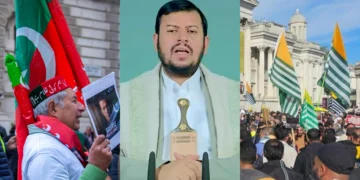
The events outside the U.S. consulate in Karachi stripped away any remaining pretence. When anti-war protestors are gunned down by American marines on Pakistani soil, the fiction of distance collapses. The line between foreign aggression and domestic repression disappears. Empire operates; the local security state administers. That is the arrangement. The Pakistani state does not confront power abroad; it disciplines its own population at home on behalf of it.
And that discipline requires ideological distortion. Outrage can be contained. Politics cannot. Politics identifies structures, patrons, and clients. Politics exposes alignment. It asks why a state that performs sovereignty in public behaves with deference in private. It reveals that the same generals who sermonise about dignity are functionally enforcers of dependency. This is precisely what the ruling elite cannot allow to crystallise.
Since 1979, the strategic objective of regional ruling elites has been
to ensure that the Iranian Revolution is not understood as a political rupture
but as a sectarian anomaly.
Sectarianisation, therefore, becomes the preferred instrument of control. Since 1979, the strategic objective of regional ruling elites has been to ensure that the Iranian Revolution is not understood as a political rupture but as a sectarian anomaly. It terrified monarchies and military regimes not because it was Shia, but because it dismantled a regime sustained by foreign power. It demonstrated that sovereignty could be claimed by populations rather than granted by patrons. That was the threat. Sectarian framing was the containment strategy.
You may also want to read





So a revolution was recast as a sectarian expansion. Anti-imperial resistance was reframed as theological deviation. Regime preservation was presented as communal balance. This was not an intellectual achievement; it was a coordinated campaign of repetition enforced by states, clerical establishments, intelligence services, and Gulf-funded networks. Over time, the political was buried beneath the sectarian.
Trump’s favourite field marshal is now reproducing that same exhausted script. General Asim Munir’s reported attempt to force Pakistani Shias into a false binary — submit without question or leave the country — is not governance. It is coercion in the language of sect. It is the posture of a military ruler who knows that opposition to the US-Israeli war on Iran is not sect-bound and therefore must be artificially fragmented before it consolidates into a political challenge.
The Pakistani security state wants this moment to be interpreted as a Shia-Sunni issue because it cannot survive it being understood as a political confrontation between an illegitimate, collaborationist ruling structure and a population that increasingly refuses to accept it. The issue is not sectarian identity. It is widespread opposition to Zionist war, Western hegemony, Gulf-backed reaction, and the domestic apparatus that enforces these alignments.
Pakistan’s rulers are not protecting cohesion. They are protecting their patrons, their privileges, and their impunity. They are converting a political indictment into a sectarian disturbance because sectarian disturbances can be surveilled, fragmented, and suppressed. Political clarity cannot.
This is the underlying fear. Not Iran. Not sect. Not protest in isolation. The fear is that Pakistanis may recognise the unity between war abroad and repression at home — that both are sustained by the same structure of power, and that structure rests not on legitimacy, but on force and subservience.
Prof. Junaid S. Ahmad teaches Law, Religion, and Global Politics and is the Director of the Center for the Study of Islam and Decolonization (CSID), Islamabad, Pakistan. He is a member of the International Movement for a Just World (JUST), Movement for Liberation from Nakba (MLN), and Saving Humanity and Planet Earth (SHAPE).