





![Does ta’wīl mean interpretation or fulfilment? A Quranic reassessment [+video]](https://muslimviews.co.za/wp-content/uploads/2026/10/Tawil-Kaskas-360x180.webp)









![Why becoming a wealthy Muslim is commendable in Islam [+videos]](https://muslimviews.co.za/wp-content/uploads/2026/09/Muslim-Trade-Business-1-360x180.webp)




PROFESSOR YASIEN MOHAMED
Our journey from Cape Town to Kuala Lumpur unfolded as a richly layered experience, shaped by intimate family gatherings, cherished reunions, and stimulating intellectual encounters. That summer, my family and I travelled to Kuala Lumpur, with a brief yet unforgettable layover in Istanbul that set the tone for what would become a deeply memorable journey.
We visited IRCICA in Istanbul’s historic Fatih district, a leading centre for the archiving and translation of rare Islamic manuscripts. In partnership with AWQAF South Africa, it has co-hosted four conferences on Islam in Southern Africa.
As we strolled down a lively shopping street, my sister-in-law Somaya unexpectedly noticed Hanife, an old Turkish friend I had first met years ago in Frankfurt while pursuing my PhD. We had not seen each other in two decades, so it was a real surprise to see her in Istanbul. We agreed to meet at the Bukhara restaurant, where we shared a truly memorable meal. Hanife spoke with glowing affection and deep admiration for my late wife Zaida.
The wedding of my son Khalid and his wife, Marwa, the true reason for our journey, was held at the Concorde Hotel in Kuala Lumpur. I attended with my children, alongside members of my late wife’s family, sharing a moment that felt both joyful and quietly poignant. Marwa comes from a Yemeni background, and in keeping with long-cherished custom, the celebrations unfolded in separate spaces for men and women. The women gathered in their own lively sanctuary, where hijabs were set aside and the air filled with song and dance, as Naema and Wasiela later recounted to us.
The men gathered in a separate section of the hotel, where we were warmly received by Marwa’s father and brother. Conversations unfolded easily, and my son Tawfiq and Uncle Malik soon joined Marwa’s father in an animated discussion on Middle Eastern politics, a subject he clearly relished. As the evening wore on, we moved toward a generous buffet laid out under the hotel’s soft lights. Yet I found myself returning to the simplest dishes: freshly made roti canai, broken by hand and savoured with a bowl of fragrant dhal.
The next morning, we moved to the Majestic Residence near KLCC, in the shadow of the iconic Petronas Towers. From the thirty-first floor, the view was striking. Standing by the swimming pool, I looked out at the Towers and the surrounding skyscrapers dominating the skyline, their imposing presence eclipsing much of the city’s greenery. The relentless spread of urban development had turned Kuala Lumpur into a concrete jungle, stirring a quiet longing for the lush landscapes that once defined tropical Malaysia.
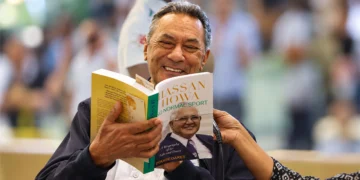
I was honoured to be invited by the Centre for Advanced Studies on Islam, Science, and Civilisation (CASIS). The lecturers and students greatly admire the work of Professor Naquib al-Attas, the Malaysian philosopher and former director of the International Institute of Islamic Thought and Civilization (ISTAC). My talk on The Art of Cultivating Noble Character inspired thoughtful questions, including how Islamic virtue ethics differs from modern ethics and whether it can address the challenges posed by artificial intelligence. One of the CASIS professors, Muhammad Zainiy Uthman, gifted me a copy of his latest book, al-Attas’ Psychology. Dr Zainiy is an expert on Nuruddin al-Raniri, the seventeenth-century Islamic Sufi scholar from Aceh, Indonesia, who influenced Shaykh Yusuf of Makassar, later exiled to Cape Town.
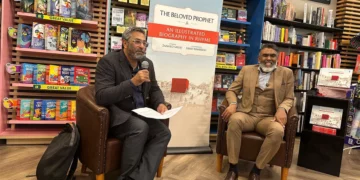
My son Nabil and I were invited to speak at the library of the Research Centre for Ummatic Thought and Civilization. Nabil shared insights from his book Ghazālī’s Epistemology, while I spoke on The Art of Cultivating Noble Character. The attendees were deeply engaged, posing thoughtful and probing questions, and the modest library fostered an atmosphere of intimacy and meaningful dialogue. At the close of the event, a female academic gifted Ilham a beautiful two-piece Malaysian outfit, which she received with evident excitement.
During our visit, we were privileged to meet several distinguished Islamic scholars. Dr Olsi Jazexhi, an Albanian historian at the International Islamic University of Malaysia (IIUM), invited Nabil and me to lecture on ‘The Rise and Fall of Islamism in Egypt.’ Afterwards, Olsi drove us through the bustling streets of Kuala Lumpur to ISTAC, where we met Jasser Auda, celebrated for his writings on the maqāṣid. ISTAC stirred memories of my own semester lecturing there. We were struck by Auda’s monumental eight-volume Tafsīr Maqāṣidī, each around 800 pages in Arabic. Auda founded the Maqāṣid Programme at IPSA, where Nabil had once been his student. Later, Imam Afroz Ali, a Fiji-born Muslim intellectual, joined us. All three scholars spoke warmly of Cape Town’s Muslim community, admired globally for its hospitality and steadfast faith.
Professor Osman Bakar, rector of IIUM, welcomed us to his serene lakeside home. I remembered his thoughtful visit while I was recovering from a heart procedure in Kuala Lumpur. His wife served fragrant mint tea alongside golden fried piesang, a Malay term now part of Afrikaans, and the simple ritual added a human warmth to our conversation. Bakar shared his vision for IIUM, moving beyond the Islamization of Knowledge toward Tawhidi Epistemology. He serves as an advisor to Prime Minister Anwar Ibrahim, whose book Rethinking Ourselves was largely shaped during his imprisonment and inspired, in no small measure, by Nelson Mandela’s memoirs.
Sociology Professor Farid al-Attas welcomed us into his gracious home, its walls lined with an impressive library—a quiet testament to a lifetime of learning. His sister, Mastura, gifted me her book The Life in the Writing, which I read on the flight back to Istanbul. Through her prose, the life and intellect of their father, Professor Hussein al-Attas, vividly emerged. She reflects on his landmark work, The Myth of the Lazy Native, which brought him wide recognition and was acknowledged by Edward Said as a major scholarly contribution. The book exposes a neglected truth: Malays were industrious farmers and fishermen, yet systematically excluded from the colonial capitalist economy. Mastura writes with clarity and grace, blending rigorous scholarship with a subtle creativity that renders the past immediate and alive.
Our stay in Istanbul was pleasant, with crisp air and a gentle chill that made each breath feel fresh. But on the night we were to leave for Cape Town, the city was drenched in heavy rain, the kind that bounced off cobblestones and glimmered under streetlights, turning the narrow lane outside our hotel into a shining ribbon of puddles. Our hotel, tucked away in Karaköy, was inaccessible by car, its lane lined with lively cafés and bustling restaurants, their awnings struggling to shield patrons from the downpour.
You may also want to read



As we prepared to leave, everyone grabbed their luggage and stepped into the street. In the commotion, I missed the group by a few minutes. Instead of turning right, I walked straight down the lane, my shoes splashing through the rivulets of rain. I stood there, drenched, as umbrellas bobbed by and taxis rushed along the street. Through the shadows, my daughter Ilham spotted me, her face lighting up as she called out, ‘Daddy!’ Despite being soaked and momentarily lost, it was a vivid and memorable final moment in Istanbul, a fitting farewell before we set off for Cape Town.
Yasien Mohamed is Emeritus Professor of Arabic and Islamic Philosophy at the University of the Western Cape.