















![The market-builder who restrained the market [Part 2]](https://muslimviews.co.za/wp-content/uploads/2026/08/PHOTO-2026-08-25-17-16-32-360x180.jpg)
![The merchant preceding the Prophetic mission [Part 1]](https://muslimviews.co.za/wp-content/uploads/2026/08/01-360x180.jpg)







As masaajid mark Khateeb-e-A’zam Day, this article explores how Hazrat Maulana Muhammad Shafee Okarvi’s maqasid-based leadership shaped Muslim identity, unity and institutional strength in South Africa and beyond.
By SAYED RIDHWAAN MOHAMED
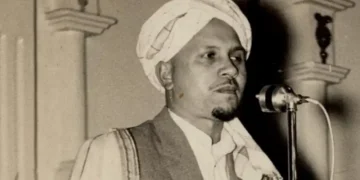
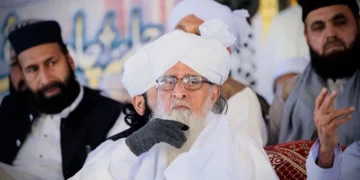
On Friday, January 9, 2026, a remarkable phenomenon will unfold across the global Muslim landscape. From the minarets of Karachi to the community masaajid of the Cape Flats, pulpits will echo with a singular tribute. Masaajid and organisations across the world are observing the 43rd Annual Khateeb-e-A’zam Day, with Jumu’ah discourses dedicated to the life and legacy of Hazrat Maulana Muhammad Shafee Okarvi (1930–1984).
In South Africa, where local congregations have sustained this commemoration year after year, it is more than a ritual of remembrance. It is an exercise in deep reflection on a methodology that preserved the scholarly dignity of the Ahl al-Sunnah wa’l-Jama’ah.

As this important anniversary is marked, many may wish to remember Maulana Okarvi only as the ‘Khateeb-e-A’zam’, the Great Orator. To confine his legacy to words alone would be a historical error. For the South African Muslim community, his life offers a blueprint for survival – a lived expression of the goals of the Shari’ah (Maqasid al-Shari’ah) that placed the success of the Din above individual acclaim.
Maulana Okarvi worked in an era shaped by the violent partition of India and the later fragmentation of the Muslim world. Yet, where others erected walls, he built pathways for the propagation of Sunni aqeedah. His methodology was not reactionary, but reconstructionist. He understood that the preservation of religion (Hifz al-Din) required not only the defence of doctrine, but also generosity of spirit.
Perhaps the most powerful example of this leadership style – and one that offers a stark lesson for contemporary organisations – is his role in the genesis of Dawat-e-Islami. In the early 1980s, when this now-global movement was a fledgling group with limited resources, Maulana Okarvi did not view them as competitors. In an act of profound ‘institutional charity’, he opened the doors of his own centre, Masjid Gulzar-e-Habib in Karachi, to host their weekly gatherings.
He did not attempt to absorb them, brand them, or dilute their identity to inflate his own standing. His intention was clear: if the Din was being served, the banner under which it occurred was secondary. Today, as Dawat-e-Islami operates across multiple continents, it stands as a testament to a leader who planted trees under whose shade he never expected to sit.
This ethos of preservation extended to the protection of life (Hifz al-Nafs). In 1962, Maulana Okarvi survived a brutal assassination attempt in Karachi, sustaining multiple stab wounds while leading prayer. In a city already volatile with sectarian tension, his response was extraordinary. He publicly forgave his attackers and forbade his followers from seeking revenge.
By choosing forgiveness over bloodshed, he prioritised public welfare (Maslahah ‘Ammah) over personal retribution, imparting a vital lesson: that the true strength of a believer lies in restraint, not retaliation.
For South African Muslims, Maulana Okarvi’s legacy is not distant history but a lived reality. His seminal tour of South Africa in 1976 came at a critical juncture. The community, navigating the twin pressures of apartheid and cultural assimilation, found in his oratory a confident articulation of Sunni identity. He did not merely preach; he established. The Anjuman Ahl-e-Sunnat wa Jama’at in Durban stands as a direct outcome of his vision.
Equally significant was his emphasis on safeguarding intellect (Hifz al-‘Aql). In a world increasingly polarised between extremes, Maulana Okarvi championed what may be described as a ‘total Sunni identity’. He taught that one could be a resolute defender of the Sahaba while simultaneously being a devoted lover of the Ahlul Bayt.
His literary work, Sham-e-Karbala, remains a seminal Sunni text on the tragedy of Imam Husain (RA), grounded firmly in authentic sources. In doing so, it safeguarded communities against both Nasibi dilution and extremist reinterpretations. This balance resonates deeply in Cape Town, where love for the Ahlul Bayt, expressed through Moulood and Urs traditions, forms part of the city’s spiritual fabric.
You may also want to read


Crucially, the Okarvi legacy endures through the preservation of lineage and mission (Hifz al-Nasl). The transition of his work to his son, Allamah Dr Kaukab Noorani Okarvi, represents a rare and successful intergenerational transfer of religious leadership. Dr Kaukab has not only sustained the intellectual fortress built by his father, but has also adapted it for the digital age.
Through the Okarvi Academy and extensive international engagements, Dr Kaukab has maintained strong institutional ties with South Africa. His strategic counsel to bodies such as the Sunni Ulama Council and Darul Uloom Pretoria, alongside his patronage of the Cape Town Islamic Educational Centre (CTIEC) and Grassy Park Mosque, has ensured continuity of theological balance.
Whether through high-quality digital content celebrating the wiladat of the Ahlul Bayt or through direct mentorship of local ulama, the Okarvi influence remains a stabilising force within the community.
As masaajid across South Africa dedicate their Jumu’ah khutbahs today to this towering scholar, the enduring lesson is clear: true leadership is selfless. It is about building institutions that outlive you, forgiving those who harm you, and nurturing successors who surpass you. Hazrat Maulana Muhammad Shafee Okarvi left behind more than books and speeches – he bequeathed a methodology of balance, mercy and open-heartedness that is perhaps even more urgently needed today than in his own lifetime.
Sayed Ridhwaan is a researcher and Honours graduate in Islamic Studies whose work focuses on Ahl al-Sunnah and Tasawwuf. He serves as Secretary of the Cape Town Ulama Board, an Exco member of the Sunni Ulama Council (Cape), and is co-founder of the Ahlus Sunnah Media Network.