













![The market-builder who restrained the market [Part 2]](https://muslimviews.co.za/wp-content/uploads/2026/08/PHOTO-2026-08-25-17-16-32-360x180.jpg)
![The merchant preceding the Prophetic mission [Part 1]](https://muslimviews.co.za/wp-content/uploads/2026/08/01-360x180.jpg)



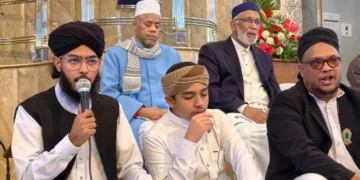




The 1500 Legacy Essay Challenge showcased young South Africans engaging deeply with the Prophetic legacy, combining ethical reflection, intellectual rigour and a call for inclusive leadership.
By ADNAAN ADAMS
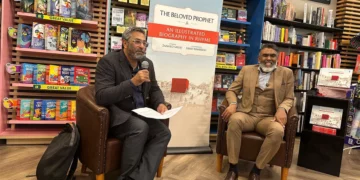
A few weeks ago, I had the privilege of serving as MC for one of the flagship initiatives of the 1500 Legacy Project — the Legacy Essay Challenge Awards Ceremony — held on Saturday, November 22, 2025, at the SABC Auditorium in Sea Point.
My involvement with this project stretches back to its inception in June 2025, when we launched it at the Academia Library with the chairpersons of various MSA chapters present. I was entrusted with presenting the purpose of the Essay Challenge, its criteria and requirements, and the broader vision of reconnecting our youth with the Prophetic legacy in a meaningful and intellectually rigorous way. MSAs across the country became key partners in promoting the challenge. We appointed student ambassadors, hosted a banquet at UCT, produced short promotional videos, and visited several campuses during Jumu’ah to share the vision and encourage participation.
In his opening address, Dr Elias Parker reminded us that this project is not merely an academic exercise; it is a revival of the Prophetic command Iqra — to read, reflect, write and transform. He framed the students’ essays as part of a lineage of Islamic scholarship that once illuminated the world, where writing was an act of worship, truth-seeking and service. This resonated deeply with what unfolded on stage: young people reconnecting with knowledge as a sacred trust.
The keynote address by Professor Aslam Fataar further anchored this vision. He articulated the ethics of the pen — that true scholarship is not only about technical clarity or proper referencing but about unveiling understanding that centres justice, moral purpose and communal responsibility. His explanation of the rigorous assessment process, combining quantitative scoring with qualitative deliberation, underscored that intellectual integrity is non-negotiable, especially in an age shaped by artificial intelligence and post-plagiarism writing.
However, the heart of the event emerged through the voices of the finalists themselves. Their essays demonstrated that the Prophetic legacy is not a distant history to admire but a living ethic that demands self-interrogation and moral courage.
You may also want to read


This was most evident in the contribution of Sisipho Zingitwa, our winner. Her reflections echoed themes I explored earlier this year in Muslim Views, in my piece, ‘Rethinking global Islamic leadership from the ground up’. She argued that for South African Muslims to occupy a meaningful space in global Muslim thought, we must first know ourselves, challenge our internal silences and build institutions rooted in integrity. With honesty and dignity, she spoke about conversion, race, subtle exclusion and how Ubuntu shaped her understanding of Islam. Her narrative did not accuse; it invited reflection. She held up a mirror to a community that celebrates diversity in theory yet often struggles to embody it in lived reality.
In her words:
‘The same community that celebrated your shahadah now flinches at the idea of real integration — of marriage, of family ties, of equal belonging. “Yes, MashaAllah, it’s beautiful that she became Muslim,” they say. “But marriage? Into our family? That’s… complicated. Will she even be able to understand our culture?” Complicated means: she’s not one of us. It means she’s Black. It means her parents aren’t Muslim.
‘What is praised as “beautiful” from afar becomes “problematic” up close — a hypocrisy the Prophet (PBUH) would not stand for.’
Her presence on that stage challenged us to rethink leadership itself. If we struggle to embrace difference within our own minority community — across race, school of thought or culture — how can we meaningfully claim to champion justice beyond our borders? This ceremony showed that intellectual life does not belong only to academia; it belongs wherever people think deeply, question sincerely and write with integrity.
The rigour of the marking process, guided with exceptional clarity and fairness by Professor Fataar and a team of committed markers, affirmed that our community has the capacity to cultivate serious scholarship. Their dedication ensured that each essay received the respect and objectivity it deserved.

Ultimately, the Essay Challenge Awards Ceremony was not the end of a project; it demonstrated that our youth are ready to think critically, imagine courageously and engage the Prophetic legacy not as a static memory but as a living philosophy. If we nurture these voices, encourage them, challenge them and take them seriously, we may yet cultivate a new generation of Muslim thinkers who can guide our community towards more just, inclusive and compassionate futures.A heartfelt thank you to our sponsors, Wholesome Breads and World of Travel, for your generous support, including the Umrah ticket awarded to the overall winner. May your companies be blessed with continued growth, barakah and success. Our deep appreciation also goes to all those who contributed quietly and selflessly behind the scenes. Your unseen efforts carried this project; may you be rewarded in ways known only to Allah.