

















![The market-builder who restrained the market [Part 2]](https://muslimviews.co.za/wp-content/uploads/2026/08/PHOTO-2026-08-25-17-16-32-360x180.jpg)
![The merchant preceding the Prophetic mission [Part 1]](https://muslimviews.co.za/wp-content/uploads/2026/08/01-360x180.jpg)










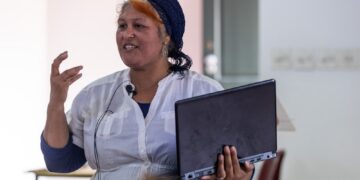
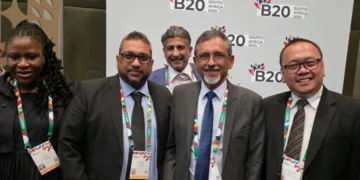
On August 28, Dr Naledi Pandor, former South African Minister of International Relations, addressed an audience at SOAS University in London. FARZEEN SANGLAY analyses her speech on Israel’s genocide in Gaza.
History will judge and condemn the horrors unfolding in Gaza, though such condemnation will be as belated and ceremonial as ever. This offers scant consolation to the two million Gazans subjected to a tyrannical genocide over the past two years, perpetrated by the United States and its client state, Israel.
Dr Pandor delivered a compelling, emotionally charged speech with precise eloquence, rooted in comparative association with South Africa’s struggle against apartheid. She specifically denounced the lack of mobilisation—especially from the international community—in exerting sufficient pressure on Israel’s government to act morally. This was a tool particularly effective in toppling South Africa’s apartheid regime through globally adopted economic sanctions and political exile.
Pandor attributed this inadequacy to several reasons: the West’s flagrant disregard for its complicity in the plight of Palestinians, an arrogance that extends beyond Palestine to the global East and South, and even parts of Europe where colonial rule resigned ethnic populations to centuries of plunder and degeneracy.
Another reason cited was the West’s hijacking of international legal structures, applying them subjectively and undermining their credibility and legitimacy. If genuine accountability were the objective, the West would not act with such immoral impunity generation after generation. From King Leopold and Henry VIII to Hitler and modern neocons, Western powers have fuelled barbarism through bloodshed, pillage, rape, murder, slavery, and subjugation—confident not only of impunity but of their right to do so. This is more than arrogance; it is perversion.
Pandor also highlighted the media’s role in maliciously propagating narratives that serve Western imperial interests. As Noam Chomsky notes in Understanding Power, media control by corporate elites perpetuates imperial rule within the framework of allowable discourse. In both totalitarian and free-market systems, those who comprise mass media are propagandised and vetted—meaning dissent is allowed only if it remains docile and performative, masquerading as ‘progressive’ tolerance.
This was exemplified by Western media’s favourable coverage of anti-apartheid demonstrations once apartheid was no longer good for business. As South Africa transitioned from colonial extraction to industrial production, Western corporations ratified the anti-apartheid movement—an economically driven decision, not a moral awakening.

You may also want to read


This evidences that resistance to oppressive systems should not aim for placid reform but for total discard, replacing it with a system that champions economic sovereignty, political independence, and decolonisation of the mind. This requires upholding our epistemological sovereignty: understanding and defining morality, beliefs, and values through independent thought—not Western imposition. It involves re-educating ourselves about history, our prevailing condition, and the broader context of our existence. Even the most ardent deniers among us are influenced by Western values, living by unquestioned assumptions that set the parameters of our world.
Pandor’s final point addressed the role of Palestine’s neighbours—the wider Gulf region. She invoked apartheid South Africa’s neighbours, who displayed resolute resistance and facilitated armed solidarity, despite facing militarised insurgence from the apartheid regime and its allies, the US and Israel. While morally admirable and a natural reflex of moral adherence, modern geopolitics requires a deeper understanding of power structures and diplomacy beyond simplistic diagnosis.
Gaza is the worst humanitarian catastrophe of our lifetime—a collective stain on humanity and a stark reminder of the perverse evil we confront. It underscores the importance of epistemological sovereignty for the ummah as a means of protection and advancement. Practical and critical thought is needed to identify optimal methods of resistance.
History unfolds daily, and its lessons can be lost in binary understandings. But when we analyse events from a practical perspective, we identify levers to affect historical course—the most fundamental being economics. Israel is in economic turmoil. Objectively, its economy, politics, and social situation are dismal. From the perspective of a neoliberal predator—an economic hitman, or investor—Israel appears as a wounded animal strayed from the herd. While we focus on its ability to kill, we may fail to notice its diminishing ability to live.
Netanyahu has sacrificed Israel’s long-term sustainability for short-term political gain. Genocide destroys a state—it does not sustain it. This is inevitable, despite most Israelis believing American aid will perpetually prop them up—a reward for depravity. This illusion of an indefinite contract with America has prevented Israel from building an independent economy. It has always been a client state, dependent from inception, and mistakenly believed this model sustainable. But dependency thrives only as long as the dependent remains useful—the moment it ceases, dependency becomes a liability. The sun is setting for Israel.
The genocide in Gaza has blown a gaping hole in Israel’s economy. National debt mounts toward unsustainable levels. Credit ratings fall, incurring exorbitant borrowing costs—traditionally when a country accepts terms it otherwise would not. The Bank of Israel forecasts a 2025 budget deficit of -4.9% of GDP (compared to +0.6% in 2022). Debt is projected at 70–71% of GDP in 2025–2026 (up from 60–61% in 2022). These are significant numbers that will dictate capital flow and financialisation.
Israel’s problems compound with severe labour shortages as reservists are called up, the Palestinian workforce is lost, and hundreds of thousands of Israelis flee to Europe and the US. Estimates suggest a deficit of c.100,000 positions across agriculture, construction, and caregiving.
The layperson may mobilise opposition through protests, boycotts, hashtags, and slogans. But at higher strata, with state capital and resources, resistance operates differently—sometimes appearing as its opposite to those unaware of economic insurgency. We boycott—we don’t buy. But an economic hitman or predatory investor does buy—at a level that purchases dependence and disempowerment.
From this perspective, control means supplying manpower to Israel’s labour-short market—controlling 25–30% of the migrant labour pipeline into Israel, creating dependency. This is the Bretton Woods system of economic enslavement imposed as a return favour. You identify a weakness and become the solution—on contract terms favourably weighted to ensure the weakness is never solved.
Thus, while we ask, ‘Why supply workers to Israel?’—wanting its workforce to disintegrate and industries to shut down—GCC investors sign MOUs with Israel guaranteeing investment and regional stability, including Palestine’s liberation. Any savvy investor would impose these levers of control—contrary to the historical position of the American military-industrial complex, which depended on regional destabilisation to maintain the façade of Israel’s security, funded by American taxpayers.
Every Israeli industrial and economic sector will be ripe for economic conquest by the GCC, BRICS, and China. Though our resource wealth surpasses the West’s, they have exploited us for generations through financialised control—over extraction, processing, and export. Now, the same is being set up regionally to subordinate Israel’s logistics, ports, healthcare, construction, desalination, and sanitation sectors.
It is understandable to want to see Israelis fleeing Tel Aviv as it burns. But we must understand how conquest works in the 21st century—how the world operates relative to wealth and power. Critical thought, not visceral reaction, will guide us toward true liberation.
Farzeen Sanglay is a South African chartered accountant working in London.