



Muslim Views
No Result
View All Result
  • News
    • All
    • Local
    • National
    • World
    Cape Town art exhibition explores untold histories through art and archives

    Cape Town art exhibition explores untold histories through art and archives

    Operation Ubuntu march calls for arrests and action against xenophobia

    Operation Ubuntu march calls for arrests and action against xenophobia

    Honouring our Huffadh as Cape Town celebrates guardians of the Qur’an

    Honouring our Huffadh as Cape Town celebrates guardians of the Qur’an

    Moslem Cemetery Board ordered to pay R250 000 after confidential bank review

    Moslem Cemetery Board ordered to pay R250 000 after confidential bank review

    Radio 786 launches inaugural Cape Town High School Quiz

    Radio 786 launches inaugural Cape Town High School Quiz

    A conversation about ‘the women who made us’

    A conversation about ‘the women who made us’

    Hind Rajab screening raises funds to rebuild Gaza school

    Hind Rajab screening raises funds to rebuild Gaza school

    Application for access to Mowbray cemetery bank records fails

    Application for access to Mowbray cemetery bank records fails

    Court resets Mowbray Cemetery nomination rules days before deadline

    Court resets Mowbray Cemetery nomination rules days before deadline

    Gaza ER screening panel calls for action to support healthcare workers

    Gaza ER screening panel calls for action to support healthcare workers

    • National
    • World
    • Local
  • Opinion
    • All
    • Columnists
    • Discussions with Dangor
    • Editorial
    • Guest Writer
    Mecca pact signals move against fading US security order

    Mecca pact signals move against fading US security order

    Dr Mofokeng goes out on top – despite attempts to distract her

    Dr Mofokeng goes out on top – despite attempts to distract her

    Where empire struck North Africa’s freedom struggle

    Where empire struck North Africa’s freedom struggle

    The treason of Pakistan’s intellectuals

    The treason of Pakistan’s intellectuals

    Spain’s defiance and the geopolitics of Ceuta

    Spain’s defiance and the geopolitics of Ceuta

    Marking 140 years since the closure of the Tana Baru

    Marking 140 years since the closure of the Tana Baru

    The day Pakistan lost Kashmir

    The day Pakistan lost Kashmir

    Data centres pose greater risks than we thought

    Data centres pose greater risks than we thought

    Organised labour in South Africa’s class struggle

    Organised labour in South Africa’s class struggle

    Gen Z cockroaches and the end of political obedience

    Gen Z cockroaches and the end of political obedience

  • Features
    • All
    • 1500 Years of Prophetic Legacy
    • AWQAF SA
    • General Features
    • Imam Haron
    • Tributes
    Ummah bids farewell to global luminary Pir Sayed Hasin ud Deen Shah (RA)

    Ummah bids farewell to global luminary Pir Sayed Hasin ud Deen Shah (RA)

    Marking 140 years since the closure of the Tana Baru

    Marking 140 years since the closure of the Tana Baru

    Abbas Rumaney remembered for his faith, wisdom, humour and generosity

    Abbas Rumaney remembered for his faith, wisdom, humour and generosity

    Grappling with Apartheid labels

    Grappling with Apartheid labels

    The scholar who refused to turn Islam into an enemy: The legacy of John Esposito

    The scholar who refused to turn Islam into an enemy: The legacy of John Esposito

    The greatest monuments are not in stone, but in lives transformed

    The greatest monuments are not in stone, but in lives transformed

    Legacy of educator Haji Mogamat Rashad Jedaar lives on

    Legacy of educator Haji Mogamat Rashad Jedaar lives on

    Reclaiming agency: From ritual to action Part 3

    Reclaiming agency: From ritual to action Part 3

    June 16, the Call of Islam, and the many rivers of liberation

    June 16, the Call of Islam, and the many rivers of liberation

    Reclaiming agency: From ritual to action Part 2

    Reclaiming agency: From ritual to action Part 2

    Reclaiming agency: From ritual to action Part 1

    Reclaiming agency: From ritual to action Part 1

    Goolam Hoosain Abed: The last of the famous sporting family departs

    Goolam Hoosain Abed: The last of the famous sporting family departs

    Abdullah Ibrahim crafted a magnificent new culture for South Africa

    Abdullah Ibrahim crafted a magnificent new culture for South Africa

    The hidden heritage of racial ‘passing’

    The hidden heritage of racial ‘passing’

    The Commonwealth war graves at the Mowbray Muslim Cemetery

    The Commonwealth war graves at the Mowbray Muslim Cemetery

  • Lifestyle
    • All
    • Arts
    • Books
    • Education
    • Food
    • Health
    • Motoring
    • Sport
    • Technology
    Cape Town art exhibition explores untold histories through art and archives

    Cape Town art exhibition explores untold histories through art and archives

    Choritz captures a fierce new dystopia in The Sound of Ice

    Choritz captures a fierce new dystopia in The Sound of Ice

    Languages of Care: Extending worship through art

    Languages of Care: Extending worship through art

    Cape Town musicians rally behind displaced Palestinian composer

    Cape Town musicians rally behind displaced Palestinian composer

    More than a game, or the Clash of Titans

    More than a game, or the Clash of Titans

    Help Ruqaya Ismail represent SA at the Commonwealth Fencing Championship

    Help Ruqaya Ismail represent SA at the Commonwealth Fencing Championship

    Goolam Hoosain Abed: The last of the famous sporting family departs

    Goolam Hoosain Abed: The last of the famous sporting family departs

    Abdeyah da Costa and the dihlīz of Dorp Street

    Abdeyah da Costa and the dihlīz of Dorp Street

    A mother’s taweez and the Cape’s interfaith traditions [+ video]

    A mother’s taweez and the Cape’s interfaith traditions [+ video]

    Inaugural Islamic Expo to be hosted in Cape Town

    Inaugural Islamic Expo to be hosted in Cape Town

  • Finance
    • All
    • Islamic Finance
    When the halal investment label becomes a weapon for financial deception

    When the halal investment label becomes a weapon for financial deception

    Don’t leave your family with your janazah and a legacy of problems

    Don’t leave your family with your janazah and a legacy of problems

    When Shariah-compliant investments finance oppression and injustice today

    When Shariah-compliant investments finance oppression and injustice today

    How Islamic finance is rebuilding Africa’s economic grid

    How Islamic finance is rebuilding Africa’s economic grid

    Islamic finance’s green promise for a sustainable future

    Islamic finance’s green promise for a sustainable future

    First Abu Dhabi Bank’s African opportunity could reshape Islamic finance

    First Abu Dhabi Bank’s African opportunity could reshape Islamic finance

    Family takaful’s research boom exposes an industry failing the underserved

    Family takaful’s research boom exposes an industry failing the underserved

    Can AI and blockchain save takaful from exclusion and a crisis of trust?

    Can AI and blockchain save takaful from exclusion and a crisis of trust?

    The sacred journey is now a marketplace that prices out the poor

    The sacred journey is now a marketplace that prices out the poor

    Why Shariah compliance alone cannot guarantee sound investment returns

    Why Shariah compliance alone cannot guarantee sound investment returns

  • Islam
    • All
    • Eid
    • Faith and Practice
    • Family
    • Hajj and Umrah
    • Moulood
    • Quran
    • Ramadaan
    When Sipho asked me to make duʿa

    When Sipho asked me to make duʿa

    A sound heart in a world of strangers

    A sound heart in a world of strangers

    Can our mosques become the heart of the Ummah?

    Can our mosques become the heart of the Ummah?

    Karbala – between obligation and inability

    Karbala – between obligation and inability

    16 June 1976: Qibla’s call to conscience

    Reclaiming our future – drawing lessons from Karbala and Soweto 1976

    Karbala, Gaza and xenophobia: Why history still matters today

    Karbala, Gaza and xenophobia: Why history still matters today

    Adnaan Adams (right) addressing the congregation at Masjidut Taqwa in Newfields Estate, Cape Town, on Friday, June 12. (Photo: Supplied)

    Reflecting on a khutbah and the community it seeks to serve

    The panellists at the Muslim Personal Law symposium at the University of Cape Town on June 8, clockwise from top right: Professor Fatima Seedat, Ayesha Royker, Rehema Namukose and Khensani Motlhante. (Photos: Anwar Omar)

    Advancing gender justice in Muslim Personal Law

    What do we owe the Earth?

    What do we owe the Earth?

    Hajj, human frailty and the compassion of Allah

    Hajj, human frailty and the compassion of Allah

  • Archives
  • Donate
Muslim Views
  • News
    • All
    • Local
    • National
    • World
    Cape Town art exhibition explores untold histories through art and archives

    Cape Town art exhibition explores untold histories through art and archives

    Operation Ubuntu march calls for arrests and action against xenophobia

    Operation Ubuntu march calls for arrests and action against xenophobia

    Honouring our Huffadh as Cape Town celebrates guardians of the Qur’an

    Honouring our Huffadh as Cape Town celebrates guardians of the Qur’an

    Moslem Cemetery Board ordered to pay R250 000 after confidential bank review

    Moslem Cemetery Board ordered to pay R250 000 after confidential bank review

    Radio 786 launches inaugural Cape Town High School Quiz

    Radio 786 launches inaugural Cape Town High School Quiz

    A conversation about ‘the women who made us’

    A conversation about ‘the women who made us’

    Hind Rajab screening raises funds to rebuild Gaza school

    Hind Rajab screening raises funds to rebuild Gaza school

    Application for access to Mowbray cemetery bank records fails

    Application for access to Mowbray cemetery bank records fails

    Court resets Mowbray Cemetery nomination rules days before deadline

    Court resets Mowbray Cemetery nomination rules days before deadline

    Gaza ER screening panel calls for action to support healthcare workers

    Gaza ER screening panel calls for action to support healthcare workers

    • National
    • World
    • Local
  • Opinion
    • All
    • Columnists
    • Discussions with Dangor
    • Editorial
    • Guest Writer
    Mecca pact signals move against fading US security order

    Mecca pact signals move against fading US security order

    Dr Mofokeng goes out on top – despite attempts to distract her

    Dr Mofokeng goes out on top – despite attempts to distract her

    Where empire struck North Africa’s freedom struggle

    Where empire struck North Africa’s freedom struggle

    The treason of Pakistan’s intellectuals

    The treason of Pakistan’s intellectuals

    Spain’s defiance and the geopolitics of Ceuta

    Spain’s defiance and the geopolitics of Ceuta

    Marking 140 years since the closure of the Tana Baru

    Marking 140 years since the closure of the Tana Baru

    The day Pakistan lost Kashmir

    The day Pakistan lost Kashmir

    Data centres pose greater risks than we thought

    Data centres pose greater risks than we thought

    Organised labour in South Africa’s class struggle

    Organised labour in South Africa’s class struggle

    Gen Z cockroaches and the end of political obedience

    Gen Z cockroaches and the end of political obedience

  • Features
    • All
    • 1500 Years of Prophetic Legacy
    • AWQAF SA
    • General Features
    • Imam Haron
    • Tributes
    Ummah bids farewell to global luminary Pir Sayed Hasin ud Deen Shah (RA)

    Ummah bids farewell to global luminary Pir Sayed Hasin ud Deen Shah (RA)

    Marking 140 years since the closure of the Tana Baru

    Marking 140 years since the closure of the Tana Baru

    Abbas Rumaney remembered for his faith, wisdom, humour and generosity

    Abbas Rumaney remembered for his faith, wisdom, humour and generosity

    Grappling with Apartheid labels

    Grappling with Apartheid labels

    The scholar who refused to turn Islam into an enemy: The legacy of John Esposito

    The scholar who refused to turn Islam into an enemy: The legacy of John Esposito

    The greatest monuments are not in stone, but in lives transformed

    The greatest monuments are not in stone, but in lives transformed

    Legacy of educator Haji Mogamat Rashad Jedaar lives on

    Legacy of educator Haji Mogamat Rashad Jedaar lives on

    Reclaiming agency: From ritual to action Part 3

    Reclaiming agency: From ritual to action Part 3

    June 16, the Call of Islam, and the many rivers of liberation

    June 16, the Call of Islam, and the many rivers of liberation

    Reclaiming agency: From ritual to action Part 2

    Reclaiming agency: From ritual to action Part 2

    Reclaiming agency: From ritual to action Part 1

    Reclaiming agency: From ritual to action Part 1

    Goolam Hoosain Abed: The last of the famous sporting family departs

    Goolam Hoosain Abed: The last of the famous sporting family departs

    Abdullah Ibrahim crafted a magnificent new culture for South Africa

    Abdullah Ibrahim crafted a magnificent new culture for South Africa

    The hidden heritage of racial ‘passing’

    The hidden heritage of racial ‘passing’

    The Commonwealth war graves at the Mowbray Muslim Cemetery

    The Commonwealth war graves at the Mowbray Muslim Cemetery

  • Lifestyle
    • All
    • Arts
    • Books
    • Education
    • Food
    • Health
    • Motoring
    • Sport
    • Technology
    Cape Town art exhibition explores untold histories through art and archives

    Cape Town art exhibition explores untold histories through art and archives

    Choritz captures a fierce new dystopia in The Sound of Ice

    Choritz captures a fierce new dystopia in The Sound of Ice

    Languages of Care: Extending worship through art

    Languages of Care: Extending worship through art

    Cape Town musicians rally behind displaced Palestinian composer

    Cape Town musicians rally behind displaced Palestinian composer

    More than a game, or the Clash of Titans

    More than a game, or the Clash of Titans

    Help Ruqaya Ismail represent SA at the Commonwealth Fencing Championship

    Help Ruqaya Ismail represent SA at the Commonwealth Fencing Championship

    Goolam Hoosain Abed: The last of the famous sporting family departs

    Goolam Hoosain Abed: The last of the famous sporting family departs

    Abdeyah da Costa and the dihlīz of Dorp Street

    Abdeyah da Costa and the dihlīz of Dorp Street

    A mother’s taweez and the Cape’s interfaith traditions [+ video]

    A mother’s taweez and the Cape’s interfaith traditions [+ video]

    Inaugural Islamic Expo to be hosted in Cape Town

    Inaugural Islamic Expo to be hosted in Cape Town

  • Finance
    • All
    • Islamic Finance
    When the halal investment label becomes a weapon for financial deception

    When the halal investment label becomes a weapon for financial deception

    Don’t leave your family with your janazah and a legacy of problems

    Don’t leave your family with your janazah and a legacy of problems

    When Shariah-compliant investments finance oppression and injustice today

    When Shariah-compliant investments finance oppression and injustice today

    How Islamic finance is rebuilding Africa’s economic grid

    How Islamic finance is rebuilding Africa’s economic grid

    Islamic finance’s green promise for a sustainable future

    Islamic finance’s green promise for a sustainable future

    First Abu Dhabi Bank’s African opportunity could reshape Islamic finance

    First Abu Dhabi Bank’s African opportunity could reshape Islamic finance

    Family takaful’s research boom exposes an industry failing the underserved

    Family takaful’s research boom exposes an industry failing the underserved

    Can AI and blockchain save takaful from exclusion and a crisis of trust?

    Can AI and blockchain save takaful from exclusion and a crisis of trust?

    The sacred journey is now a marketplace that prices out the poor

    The sacred journey is now a marketplace that prices out the poor

    Why Shariah compliance alone cannot guarantee sound investment returns

    Why Shariah compliance alone cannot guarantee sound investment returns

  • Islam
    • All
    • Eid
    • Faith and Practice
    • Family
    • Hajj and Umrah
    • Moulood
    • Quran
    • Ramadaan
    When Sipho asked me to make duʿa

    When Sipho asked me to make duʿa

    A sound heart in a world of strangers

    A sound heart in a world of strangers

    Can our mosques become the heart of the Ummah?

    Can our mosques become the heart of the Ummah?

    Karbala – between obligation and inability

    Karbala – between obligation and inability

    16 June 1976: Qibla’s call to conscience

    Reclaiming our future – drawing lessons from Karbala and Soweto 1976

    Karbala, Gaza and xenophobia: Why history still matters today

    Karbala, Gaza and xenophobia: Why history still matters today

    Adnaan Adams (right) addressing the congregation at Masjidut Taqwa in Newfields Estate, Cape Town, on Friday, June 12. (Photo: Supplied)

    Reflecting on a khutbah and the community it seeks to serve

    The panellists at the Muslim Personal Law symposium at the University of Cape Town on June 8, clockwise from top right: Professor Fatima Seedat, Ayesha Royker, Rehema Namukose and Khensani Motlhante. (Photos: Anwar Omar)

    Advancing gender justice in Muslim Personal Law

    What do we owe the Earth?

    What do we owe the Earth?

    Hajj, human frailty and the compassion of Allah

    Hajj, human frailty and the compassion of Allah

  • Archives
  • Donate
Muslim Views
Advertisement

SA Muslims must pivot from compliance to accountability

7 May 2026 - Updated on 8 May 2026
in OPINION
Reading Time: 8 mins read
A A
SA Muslims must pivot from compliance to accountability

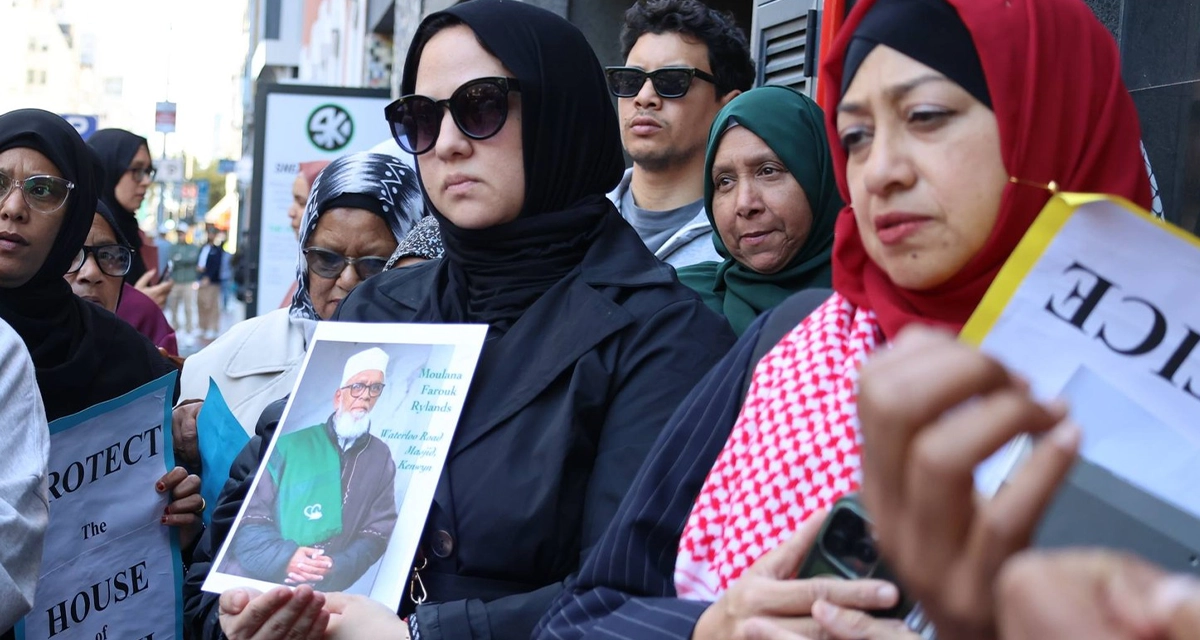
Members of the public outside the Labour Court in Cape Town on Thursday, April 30, showing their support for Moulana Farouk Rylands, who was served a court interdict by the trustees of the Waterloo Road Masjid in Kenwyn. The writer points out that this exposed something far deeper than a dispute between an imam, trustees and a mosque committee. (Photo: Anwar Omar)

Share on TwitterShare on FacebookShare on Whatsapp

As disputes within South African Muslim institutions increasingly reach the courts, this analysis points that this should be a wake-up for South African Muslims to replace clerical authority with Qur’anic accountability

By MADINY DARRIES

The recent arrest of Moulana Mogamat Farouk Rylands, the former imam of the Waterloo Road Mosque in Kenwyn, has exposed something far deeper than a dispute between an imam, trustees and a mosque committee. Reports state that Moulana Rylands was arrested after allegedly breaching a court interdict, following a long-running dispute linked to his dismissal from the mosque where he had served for about two decades. How did he breach the interdict? He was invited by the presiding imam to make a dua after the Jumu’ah salaah.

But the greater crisis is not merely legal. It is moral, communal and Qur’anic.

The article titled ‘Why South Africa’s Muslims are trading the ulama councils for the courtroom’ by Sayed Ridhwaan Mohamed in Muslim Views, dated April 30, 2026, correctly identifies a painful trend: Muslim communal disputes are increasingly moving from ulama councils, mosque committees and internal mediation structures into secular courts, police action and public spectacle.

It argues that this reflects a crisis of leadership, trust and communal conflict resolution, where institutions that were once expected to preserve dignity are now perceived by many as opaque, partisan or unable to resolve disputes with justice.

However, the issue goes even deeper.

The crisis is not only that Muslims are going to court. The crisis is that many Muslims no longer know how to stand up Islamically before they are forced to stand up legally.

For too long, South African Muslims have been conditioned to believe that questioning an alim, an ulama body, a mosque committee or a religious institution is equivalent to questioning Islam itself.

This is a dangerous distortion.

Islam does not demand blind obedience to religious personalities. Islam demands submission to Allah, justice, truth, evidence, consultation and moral courage.

The Qur’an did not come to produce passive religious followers. It came to produce morally and intellectually awake human beings.

The problem: We outsourced our intellect and conscience to the ulama class

One of the most damaging habits that has developed in sections of the Muslim community is the outsourcing of religious thinking.

Highly educated Muslims – doctors, engineers, lawyers, accountants, academics and professionals – apply rigorous critical thinking in every area of life, yet suspend that intellect when religion is discussed.

In business, they demand governance.

In medicine, they demand evidence.

In engineering, they demand structural integrity.

In law, they demand due process.

But in the mosque, they are often told: ‘Do not question. The ulama know best.’ Or the most famous question: ‘Waar het jy geleer?’(‘Where did you study’?)

This has created a culture of compliance rather than conviction.

The Qur’an repeatedly calls human beings to think, reflect, reason and verify. It asks: ‘Will you not reason?’

It challenges people who follow inherited authority without examination.

It condemns those who say, in effect, ‘We found our forefathers upon a way, and we are following them.’

‘When it is said to them, “Follow what Allah has revealed,” they say, “Rather, we follow what we found our forefathers upon.” Even if their forefathers understood nothing and were not guided?’ (Sura Al Baqarah, 2:170)

This verse is not only about ancient idolaters. It is a permanent warning against inherited religious passivity.

It speaks to any community that replaces revelation with culture, accountability with reputation, and truth with institutional loyalty.

Respect for scholars is not surrender to scholars

There is a difference between respecting scholarship and surrendering one’s conscience.

The Muslim community needs scholars. It needs serious learning. It needs people trained in Qur’an, Arabic, fiqh, history and ethics.

But scholarship in Islam is not priesthood.

There is no clerical caste that stands between the believer and Allah.

The Qur’an warns against turning religious leaders into unquestionable authorities:

‘They took their rabbis and monks as lords besides Allah…’ (Sura At Tawbah, 9:31)

This verse should unsettle every religious institution.

To ‘take as lords’ does not only mean worshipping someone physically. It includes granting people the authority to make lawful what Allah has made unlawful, to make unlawful what Allah has permitted, or to demand obedience when they act outside divine justice.

When an ulama council, mosque committee, trustee body or religious leader operates without transparency, without consultation, without accountability and without Qur’anic ethics, the community has not only the right to question – it has the duty to question.

The Qur’an does not support institutional bullying

A mosque is not private property in the ordinary sense.

It is not a political branch office.

It is not a family business.

It is not a platform for factional control.

It is a sacred trust.

Where mosque committees or trustees act with arrogance, secrecy or harshness, they may still be operating within legal structures, but they may be violating Qur’anic ethics.

The Qur’an does not reduce justice to paperwork. It demands moral substance.

‘Indeed, Allah commands you to render trusts to whom they are due, and when you judge between people, judge with justice.’ (Sura An Nisa, 4:58)

This verse applies directly to mosque governance.

A masjid committee holds an amanah.

A trustee body holds an amanah.

An imam holds an amanah.

An ulama council holds an amanah.

The question is not only, ‘Who has legal authority?’

The deeper question is, ‘Who has discharged the trust with justice?’

The Qur’an also says:

‘O you who believe, stand firmly for justice, as witnesses for Allah, even against yourselves, your parents and relatives…’ (Sura An Nisa, 4:135)

This is the pivot South African Muslims must make.

Justice must no longer be selective.

We cannot condemn injustice when it comes from the state, politicians or non-Muslim institutions, but remain silent when injustice appears inside our own mosques, councils and religious structures.

A community that only speaks truth outwardly but remains silent inwardly is not principled.

It is tribal.

The culture of fear must end

Many ordinary Muslims are afraid to challenge ulama bodies or mosque committees because they fear being labelled disrespectful, deviant, modernist, anti-ulama or divisive.

This fear has become one of the main tools through which unhealthy religious authority sustains itself.

But the Qur’an does not teach fear of men. It teaches moral courage before Allah.

‘Do not fear people, but fear Me.’ (Sura Al Ma’idah, 5:44)

This does not mean rudeness.

It does not mean public humiliation.

It does not mean mob rule.

But it does mean that no scholar, committee, imam, trust or council should be beyond principled scrutiny.

Muslims must recover the Qur’anic art of respectful confrontation.

Nabi Musa confronted Pharaoh.

The prophets confronted corrupt elites.

The Qur’an repeatedly condemns those who conceal truth, distort religion or use authority to protect privilege.

Silence in the face of religious abuse is not adab.

Sometimes it is cowardice dressed as manners.

The missing institution – accountable shura

The article by Sayed Ridhwaan Mohamed calls for community-led mediation and a return to shura.

That is important.

But shura cannot simply mean a few senior men sitting behind closed doors deciding what is best for everyone.

That is not Qur’anic consultation.

You may also want to read

The twilight of a superpower: Civilisations that build are the future

The twilight of a superpower: Civilisations that build are the future

7 April 2026
Tunisia and the criminalisation of parliament

Tunisia and the criminalisation of parliament

3 February 2026
Honouring a chess giant: The legacy of Dr Shabier Bhawoodien

Honouring a chess giant: The legacy of Dr Shabier Bhawoodien

30 May 2026 - Updated on 31 May 2026

The people must rise

2 June 2017 - Updated on 29 August 2022
Gen Z cockroaches and the end of political obedience

Gen Z cockroaches and the end of political obedience

28 July 2026 - Updated on 30 July 2026
Tunisia’s democratic collapse: from Arab Spring hope to authoritarian rule

Tunisia’s democratic collapse: from Arab Spring hope to authoritarian rule

6 January 2026

That is paternalism.

The Qur’an praises those whose affairs are conducted by mutual consultation:

‘…and whose affairs are conducted by consultation among themselves…’ (Sura Ash Shura, 42:38)

True shura must be structured, transparent and accountable.

In the South African Muslim context, this means mosque constitutions should be public.

Trustee decisions should be recorded.

Financial statements should be accessible.

Grievance processes should be clear.

Terms of office should be defined.

Conflicts of interest should be declared.

Women, youth, professionals and ordinary congregants should not be treated as spectators in their own religious spaces.

If a mosque committee can remove an imam, discipline a member, control access, manage funds, appoint contractors or litigate in the name of the community, then that committee must answer to the community.

Anything less is not shura.

It is control.

The ulama councils must also be held accountable

The Muslim Judicial Council (MJC) describes its functions as including religious guidance, education, fatawa, da’wah, halaal certification and social development.

These are significant public functions in the life of South African Muslims.

Anybody who exercises this kind of moral influence must expect scrutiny.

The issue is not whether the MJC, or any other ulama body, has done good work.

Of course, religious institutions often provide valuable services.

The issue is whether good work exempts them from accountability.

It does not.

When institutions are repeatedly associated in the public mind with controversy, silence, defensiveness or internal politics, the community begins to lose trust.

And when trust collapses, people do not stop looking for justice.

They look elsewhere.

That is when courts become the new qiblah of dispute resolution.

This is not because secular courts are ideal for resolving mosque matters.

It is because internal religious mechanisms have lost credibility.

The solution is not to shame people for going to court.

The solution is to rebuild institutions so people do not feel court is the only place where they may be heard.

Returning to the Qur’an is not anti-ulama

Some will say that calling Muslims back to the Qur’an undermines the ulama.

That is false.

A genuine alim should welcome a Qur’an-conscious community.

Only weak authority fears an informed congregation.

The Qur’an is not a decorative text for Ramadan recitation.

It is a living criterion – furqan – by which truth is separated from falsehood.

‘O you who believe, if you are conscious of Allah, He will grant you a criterion…’ (Sura Al Anfal, 8:29)

The Muslim community must stop treating the Qur’an as a ceremonial book and start treating it as the constitutional foundation of Muslim public life.

The Qur’an must judge our mosque politics, our institutional behaviour, our leadership disputes, our treatment of imams, our handling of women, our financial governance, our public statements and our conflict resolution.

The question should never be: ‘Which personality do you support?’

The question should be: ‘What does justice require?’

The pivot we need

The necessary pivot is not from ulama to courts.

It is from clerical dependency to Qur’anic agency.

This requires five shifts.

First, Muslims must reclaim personal responsibility before Allah.

No believer can say, ‘I merely followed the committee,’ or ‘I merely followed the moulana,’ when injustice was clear.

The Qur’an repeatedly holds individuals accountable for their own moral choices.

Second, mosques must move from personality-based authority to principle-based governance.

A masjid cannot be governed by ego, family influence, factional loyalty or backroom decisions.

It must be governed by amanah, shura, justice and transparency.

Third, ulama bodies must submit themselves to independent accountability.

The community cannot be expected to trust institutions that investigate themselves, defend themselves and declare themselves innocent.

Fourth, Muslim professionals must bring their intellect back into the mosque and not leave it on the ‘shoe rack’.

Lawyers, auditors, governance specialists, mediators, psychologists, educators and ethical business leaders should not be passive donors.

They should help build transparent governance models rooted in Qur’anic values.

Fifth, ordinary congregants must stop confusing politeness with piety.

Respect is required.

Blind compliance is not.

The Qur’an commands justice even when it is uncomfortable.

A community held together by truth

The arrest of a respected former imam, the public dispute around a mosque, the involvement of courts and police, and the wider loss of confidence in religious institutions should be treated as a warning.

Not a spectacle.

Not gossip.

Not another factional battle.

It is a mirror.

It shows us what happens when sacred institutions lose trust.

It shows us what happens when Muslims are trained to obey but not to think.

It shows us what happens when ulama bodies and mosque committees operate without sufficient transparency.

It shows us what happens when the Qur’an is recited beautifully but not applied courageously.

The future of the South African Muslim community will not be secured by defending institutions at all costs.

It will be secured by reforming them before they collapse under the weight of their own contradictions.

The Qur’anic community is not a silent community.

It is not a servile community.

It is not a community that bows before titles, committees or inherited authority.

It is a community that stands for truth.

‘O you who believe, stand firmly for Allah, as witnesses with justice, and do not let hatred of a people cause you to be unjust. Be just; that is nearer to taqwa.’ (Sura Al Ma’idah, 5:8)

That is the pivot.

Not rebellion against religion.

Not disrespect toward scholars.

Not the destruction of institutions.

But a return to the Qur’an as the supreme moral authority – and the rebuilding of Muslim communal life based on justice, accountability, consultation and courage.

Madiny Darries is an IT consultant and entrepreneur. He is also a social activist who regularly contributes to public discourse within the South African Muslim community, with a particular focus on accountability, justice, Qur’anic thinking and institutional reform.

Subscribe to our Newsletters

* indicates required
Choose the newsletters you'd like to receive
Advertisement

You may also want to read

Mecca pact signals move against fading US security order
OPINION

Mecca pact signals move against fading US security order

11 August 2026
Dr Mofokeng goes out on top – despite attempts to distract her
OPINION

Dr Mofokeng goes out on top – despite attempts to distract her

6 August 2026
Where empire struck North Africa’s freedom struggle
OPINION

Where empire struck North Africa’s freedom struggle

4 August 2026 - Updated on 6 August 2026
The treason of Pakistan’s intellectuals
OPINION

The treason of Pakistan’s intellectuals

4 August 2026
Spain’s defiance and the geopolitics of Ceuta
OPINION

Spain’s defiance and the geopolitics of Ceuta

3 August 2026 - Updated on 6 August 2026
Marking 140 years since the closure of the Tana Baru
FEATURES

Marking 140 years since the closure of the Tana Baru

1 August 2026 - Updated on 4 August 2026
July 2026

July 2026

FILE SIZE : 9 MB
Download
Advertisement

Latest News

Cape Town art exhibition explores untold histories through art and archives

11 August 2026

Mecca pact signals move against fading US security order

11 August 2026

When the halal investment label becomes a weapon for financial deception

11 August 2026

Operation Ubuntu march calls for arrests and action against xenophobia

11 August 2026

Don’t leave your family with your janazah and a legacy of problems

11 August 2026

When Shariah-compliant investments finance oppression and injustice today

11 August 2026
Advertisement
Advertisement
Next Post
A brief history of 50 years of TV in South Africa

A brief history of 50 years of TV in South Africa

Why indigenous languages matter for da’wah in South Africa

Why indigenous languages matter for da’wah in South Africa

International law ‘under siege’, says Iranian ambassador to SA [+ videos]

International law ‘under siege’, says Iranian ambassador to SA [+ videos]

Anti-imperialism, Gaza and the global order

Anti-imperialism, Gaza and the global order

ABOUT MUSLIM VIEWS
About Us
Archives
Terms & Conditions
Privacy Policy
Contact Us
Donate to Muslim Views
NEWS
Local
National
World
OPINION
Columnists
Discussion with Dangor
Editorial
Guest Writers
FEATURES
AWQAF SA
Imam Haroon
Tributes
FINANCE
Islamic Finance
ISLAM
Eid
Faith and Practice
Family
Hajj and Umrah
Moulood
Quraan
Ramadaan
FEATURES
Arts
Books
Education
Food
Health
Motoring
Sport
Technology

© Muslim Views 2026. All Rights Reserved

Design by: theimagehouse

Loading...
No Result
View All Result
  • NEWS
    • Local
    • National
    • World
  • OPINION
    • Columnists
    • Discussions with Dangor
    • Editorial
    • Guest Writer
  • FEATURES
    • AWQAF SA
    • Imam Haron
    • Tributes
    • 1500 Years of Prophetic Legacy
  • LIFESTYLE
    • Arts
    • Books
    • Education
    • Food
    • Health
    • Motoring
    • Sport
    • Technology
  • FINANCE
    • Islamic Finance
  • ISLAM
    • Eid
    • Faith and Practice
    • Family
    • Hajj and Umrah
    • Moulood
    • Quran
    • Ramadaan
  • ARCHIVES
  • DONATE