

Muslim Views
No Result
View All Result
  • News
    • All
    • Local
    • National
    • World
    Muslim Views Zamzam investigation wins national Story of the Year award

    Muslim Views Zamzam investigation wins national Story of the Year award

    Voting glitches trigger extension for Mowbray Cemetery elections

    Voting glitches trigger extension for Mowbray Cemetery elections

    Mowbray Cemetery elections: Competing narratives and an unverified candidate list

    Mowbray Cemetery elections: Competing narratives and an unverified candidate list

    New judge takes Mowbray Cemetery case as 53 nominees cleared for ballot

    New judge takes Mowbray Cemetery case as 53 nominees cleared for ballot

    Beyond charity: Rethinking the economic potential of waqf in South Africa

    Beyond charity: Rethinking the economic potential of waqf in South Africa

    Read our Moulood-un-Nabi edition online

    Read our Moulood-un-Nabi edition online

    Primary school nasheed competition rewards dedication

    Primary school nasheed competition rewards dedication

    Cape Town art exhibition explores untold histories through art and archives

    Cape Town art exhibition explores untold histories through art and archives

    Operation Ubuntu march calls for arrests and action against xenophobia

    Operation Ubuntu march calls for arrests and action against xenophobia

    Honouring our Huffadh as Cape Town celebrates guardians of the Qur’an

    Honouring our Huffadh as Cape Town celebrates guardians of the Qur’an

    • National
    • World
    • Local
  • Opinion
    • All
    • Columnists
    • Discussions with Dangor
    • Editorial
    • Guest Writer
    Why Gaza’s kites demand urgent global solidarity

    Why Gaza’s kites demand urgent global solidarity

    Another hatchet job on Choritz — but is this fair and balanced journalism?

    Another hatchet job on Choritz — but is this fair and balanced journalism?

    Reading the Prophet: knowing the sīrah, reading ourselves

    Reading the Prophet: knowing the sīrah, reading ourselves

    The immigration debate: class, race and South Africa’s unresolved crisis

    The immigration debate: class, race and South Africa’s unresolved crisis

    Moulood – When love stands

    Moulood – When love stands

    SADC’s “old wine in new bottles” model unlikely to transform political economy

    SADC’s “old wine in new bottles” model unlikely to transform political economy

    Independence interrupted: Pakistan’s unfinished passage from colony to country

    Independence interrupted: Pakistan’s unfinished passage from colony to country

    Keep your eyes on the victims of genocide, Mr President

    Keep your eyes on the victims of genocide, Mr President

    President Ramaphosa meeting IDF soldier’s family raises crucial questions

    President Ramaphosa meeting IDF soldier’s family raises crucial questions

    Mecca pact signals move against fading US security order

    Mecca pact signals move against fading US security order

  • Features
    • All
    • 1500 Years of Prophetic Legacy
    • AWQAF SA
    • General Features
    • Imam Haron
    • Tributes
    Reading the Prophet: knowing the sīrah, reading ourselves

    Reading the Prophet: knowing the sīrah, reading ourselves

    The living heritage of Moulood traditions at Zandvliet

    The living heritage of Moulood traditions at Zandvliet

    Ummah bids farewell to global luminary Pir Sayed Hasin ud Deen Shah (RA)

    Ummah bids farewell to global luminary Pir Sayed Hasin ud Deen Shah (RA)

    Marking 140 years since the closure of the Tana Baru

    Marking 140 years since the closure of the Tana Baru

    Abbas Rumaney remembered for his faith, wisdom, humour and generosity

    Abbas Rumaney remembered for his faith, wisdom, humour and generosity

    Grappling with Apartheid labels

    Grappling with Apartheid labels

    The scholar who refused to turn Islam into an enemy: The legacy of John Esposito

    The scholar who refused to turn Islam into an enemy: The legacy of John Esposito

    The greatest monuments are not in stone, but in lives transformed

    The greatest monuments are not in stone, but in lives transformed

    Legacy of educator Haji Mogamat Rashad Jedaar lives on

    Legacy of educator Haji Mogamat Rashad Jedaar lives on

    Reclaiming agency: From ritual to action Part 3

    Reclaiming agency: From ritual to action Part 3

    June 16, the Call of Islam, and the many rivers of liberation

    June 16, the Call of Islam, and the many rivers of liberation

    Reclaiming agency: From ritual to action Part 2

    Reclaiming agency: From ritual to action Part 2

    Reclaiming agency: From ritual to action Part 1

    Reclaiming agency: From ritual to action Part 1

    Goolam Hoosain Abed: The last of the famous sporting family departs

    Goolam Hoosain Abed: The last of the famous sporting family departs

    Abdullah Ibrahim crafted a magnificent new culture for South Africa

    Abdullah Ibrahim crafted a magnificent new culture for South Africa

  • Lifestyle
    • All
    • Arts
    • Books
    • Education
    • Food
    • Health
    • Motoring
    • Sport
    • Technology
    Reading the Prophet: knowing the sīrah, reading ourselves

    Reading the Prophet: knowing the sīrah, reading ourselves

    Cape Town art exhibition explores untold histories through art and archives

    Cape Town art exhibition explores untold histories through art and archives

    Choritz captures a fierce new dystopia in The Sound of Ice

    Choritz captures a fierce new dystopia in The Sound of Ice

    Languages of Care: Extending worship through art

    Languages of Care: Extending worship through art

    Cape Town musicians rally behind displaced Palestinian composer

    Cape Town musicians rally behind displaced Palestinian composer

    More than a game, or the Clash of Titans

    More than a game, or the Clash of Titans

    Help Ruqaya Ismail represent SA at the Commonwealth Fencing Championship

    Help Ruqaya Ismail represent SA at the Commonwealth Fencing Championship

    Goolam Hoosain Abed: The last of the famous sporting family departs

    Goolam Hoosain Abed: The last of the famous sporting family departs

    Abdeyah da Costa and the dihlīz of Dorp Street

    Abdeyah da Costa and the dihlīz of Dorp Street

    A mother’s taweez and the Cape’s interfaith traditions [+ video]

    A mother’s taweez and the Cape’s interfaith traditions [+ video]

  • Finance
    • All
    • Islamic Finance
    Beyond charity: Rethinking the economic potential of waqf in South Africa

    Beyond charity: Rethinking the economic potential of waqf in South Africa

    Islamic banking in South Africa: why interest-free finance matters

    Islamic banking in South Africa: why interest-free finance matters

    When AI becomes your financial adviser, who protects the vulnerable?

    When AI becomes your financial adviser, who protects the vulnerable?

    Why a professionally drafted will can better protect your family and legacy

    Why a professionally drafted will can better protect your family and legacy

    When the halal investment label becomes a weapon for financial deception

    When the halal investment label becomes a weapon for financial deception

    Don’t leave your family with your janazah and a legacy of problems

    Don’t leave your family with your janazah and a legacy of problems

    When Shariah-compliant investments finance oppression and injustice today

    When Shariah-compliant investments finance oppression and injustice today

    How Islamic finance is rebuilding Africa’s economic grid

    How Islamic finance is rebuilding Africa’s economic grid

    Islamic finance’s green promise for a sustainable future

    Islamic finance’s green promise for a sustainable future

    First Abu Dhabi Bank’s African opportunity could reshape Islamic finance

    First Abu Dhabi Bank’s African opportunity could reshape Islamic finance

  • Islam
    • All
    • Eid
    • Faith and Practice
    • Family
    • Hajj and Umrah
    • Moulood
    • Quran
    • Ramadaan
    Reading the Prophet: knowing the sīrah, reading ourselves

    Reading the Prophet: knowing the sīrah, reading ourselves

    The living heritage of Moulood traditions at Zandvliet

    The living heritage of Moulood traditions at Zandvliet

    Moulood – When love stands

    Moulood – When love stands

    Moulood-un-Nabi: A beacon of mercy, love and unyielding courage

    Moulood-un-Nabi: A beacon of mercy, love and unyielding courage

    When Sipho asked me to make duʿa

    When Sipho asked me to make duʿa

    A sound heart in a world of strangers

    A sound heart in a world of strangers

    Can our mosques become the heart of the Ummah?

    Can our mosques become the heart of the Ummah?

    Karbala – between obligation and inability

    Karbala – between obligation and inability

    16 June 1976: Qibla’s call to conscience

    Reclaiming our future – drawing lessons from Karbala and Soweto 1976

    Karbala, Gaza and xenophobia: Why history still matters today

    Karbala, Gaza and xenophobia: Why history still matters today

  • Archives
  • Donate
Muslim Views
  • News
    • All
    • Local
    • National
    • World
    Muslim Views Zamzam investigation wins national Story of the Year award

    Muslim Views Zamzam investigation wins national Story of the Year award

    Voting glitches trigger extension for Mowbray Cemetery elections

    Voting glitches trigger extension for Mowbray Cemetery elections

    Mowbray Cemetery elections: Competing narratives and an unverified candidate list

    Mowbray Cemetery elections: Competing narratives and an unverified candidate list

    New judge takes Mowbray Cemetery case as 53 nominees cleared for ballot

    New judge takes Mowbray Cemetery case as 53 nominees cleared for ballot

    Beyond charity: Rethinking the economic potential of waqf in South Africa

    Beyond charity: Rethinking the economic potential of waqf in South Africa

    Read our Moulood-un-Nabi edition online

    Read our Moulood-un-Nabi edition online

    Primary school nasheed competition rewards dedication

    Primary school nasheed competition rewards dedication

    Cape Town art exhibition explores untold histories through art and archives

    Cape Town art exhibition explores untold histories through art and archives

    Operation Ubuntu march calls for arrests and action against xenophobia

    Operation Ubuntu march calls for arrests and action against xenophobia

    Honouring our Huffadh as Cape Town celebrates guardians of the Qur’an

    Honouring our Huffadh as Cape Town celebrates guardians of the Qur’an

    • National
    • World
    • Local
  • Opinion
    • All
    • Columnists
    • Discussions with Dangor
    • Editorial
    • Guest Writer
    Why Gaza’s kites demand urgent global solidarity

    Why Gaza’s kites demand urgent global solidarity

    Another hatchet job on Choritz — but is this fair and balanced journalism?

    Another hatchet job on Choritz — but is this fair and balanced journalism?

    Reading the Prophet: knowing the sīrah, reading ourselves

    Reading the Prophet: knowing the sīrah, reading ourselves

    The immigration debate: class, race and South Africa’s unresolved crisis

    The immigration debate: class, race and South Africa’s unresolved crisis

    Moulood – When love stands

    Moulood – When love stands

    SADC’s “old wine in new bottles” model unlikely to transform political economy

    SADC’s “old wine in new bottles” model unlikely to transform political economy

    Independence interrupted: Pakistan’s unfinished passage from colony to country

    Independence interrupted: Pakistan’s unfinished passage from colony to country

    Keep your eyes on the victims of genocide, Mr President

    Keep your eyes on the victims of genocide, Mr President

    President Ramaphosa meeting IDF soldier’s family raises crucial questions

    President Ramaphosa meeting IDF soldier’s family raises crucial questions

    Mecca pact signals move against fading US security order

    Mecca pact signals move against fading US security order

  • Features
    • All
    • 1500 Years of Prophetic Legacy
    • AWQAF SA
    • General Features
    • Imam Haron
    • Tributes
    Reading the Prophet: knowing the sīrah, reading ourselves

    Reading the Prophet: knowing the sīrah, reading ourselves

    The living heritage of Moulood traditions at Zandvliet

    The living heritage of Moulood traditions at Zandvliet

    Ummah bids farewell to global luminary Pir Sayed Hasin ud Deen Shah (RA)

    Ummah bids farewell to global luminary Pir Sayed Hasin ud Deen Shah (RA)

    Marking 140 years since the closure of the Tana Baru

    Marking 140 years since the closure of the Tana Baru

    Abbas Rumaney remembered for his faith, wisdom, humour and generosity

    Abbas Rumaney remembered for his faith, wisdom, humour and generosity

    Grappling with Apartheid labels

    Grappling with Apartheid labels

    The scholar who refused to turn Islam into an enemy: The legacy of John Esposito

    The scholar who refused to turn Islam into an enemy: The legacy of John Esposito

    The greatest monuments are not in stone, but in lives transformed

    The greatest monuments are not in stone, but in lives transformed

    Legacy of educator Haji Mogamat Rashad Jedaar lives on

    Legacy of educator Haji Mogamat Rashad Jedaar lives on

    Reclaiming agency: From ritual to action Part 3

    Reclaiming agency: From ritual to action Part 3

    June 16, the Call of Islam, and the many rivers of liberation

    June 16, the Call of Islam, and the many rivers of liberation

    Reclaiming agency: From ritual to action Part 2

    Reclaiming agency: From ritual to action Part 2

    Reclaiming agency: From ritual to action Part 1

    Reclaiming agency: From ritual to action Part 1

    Goolam Hoosain Abed: The last of the famous sporting family departs

    Goolam Hoosain Abed: The last of the famous sporting family departs

    Abdullah Ibrahim crafted a magnificent new culture for South Africa

    Abdullah Ibrahim crafted a magnificent new culture for South Africa

  • Lifestyle
    • All
    • Arts
    • Books
    • Education
    • Food
    • Health
    • Motoring
    • Sport
    • Technology
    Reading the Prophet: knowing the sīrah, reading ourselves

    Reading the Prophet: knowing the sīrah, reading ourselves

    Cape Town art exhibition explores untold histories through art and archives

    Cape Town art exhibition explores untold histories through art and archives

    Choritz captures a fierce new dystopia in The Sound of Ice

    Choritz captures a fierce new dystopia in The Sound of Ice

    Languages of Care: Extending worship through art

    Languages of Care: Extending worship through art

    Cape Town musicians rally behind displaced Palestinian composer

    Cape Town musicians rally behind displaced Palestinian composer

    More than a game, or the Clash of Titans

    More than a game, or the Clash of Titans

    Help Ruqaya Ismail represent SA at the Commonwealth Fencing Championship

    Help Ruqaya Ismail represent SA at the Commonwealth Fencing Championship

    Goolam Hoosain Abed: The last of the famous sporting family departs

    Goolam Hoosain Abed: The last of the famous sporting family departs

    Abdeyah da Costa and the dihlīz of Dorp Street

    Abdeyah da Costa and the dihlīz of Dorp Street

    A mother’s taweez and the Cape’s interfaith traditions [+ video]

    A mother’s taweez and the Cape’s interfaith traditions [+ video]

  • Finance
    • All
    • Islamic Finance
    Beyond charity: Rethinking the economic potential of waqf in South Africa

    Beyond charity: Rethinking the economic potential of waqf in South Africa

    Islamic banking in South Africa: why interest-free finance matters

    Islamic banking in South Africa: why interest-free finance matters

    When AI becomes your financial adviser, who protects the vulnerable?

    When AI becomes your financial adviser, who protects the vulnerable?

    Why a professionally drafted will can better protect your family and legacy

    Why a professionally drafted will can better protect your family and legacy

    When the halal investment label becomes a weapon for financial deception

    When the halal investment label becomes a weapon for financial deception

    Don’t leave your family with your janazah and a legacy of problems

    Don’t leave your family with your janazah and a legacy of problems

    When Shariah-compliant investments finance oppression and injustice today

    When Shariah-compliant investments finance oppression and injustice today

    How Islamic finance is rebuilding Africa’s economic grid

    How Islamic finance is rebuilding Africa’s economic grid

    Islamic finance’s green promise for a sustainable future

    Islamic finance’s green promise for a sustainable future

    First Abu Dhabi Bank’s African opportunity could reshape Islamic finance

    First Abu Dhabi Bank’s African opportunity could reshape Islamic finance

  • Islam
    • All
    • Eid
    • Faith and Practice
    • Family
    • Hajj and Umrah
    • Moulood
    • Quran
    • Ramadaan
    Reading the Prophet: knowing the sīrah, reading ourselves

    Reading the Prophet: knowing the sīrah, reading ourselves

    The living heritage of Moulood traditions at Zandvliet

    The living heritage of Moulood traditions at Zandvliet

    Moulood – When love stands

    Moulood – When love stands

    Moulood-un-Nabi: A beacon of mercy, love and unyielding courage

    Moulood-un-Nabi: A beacon of mercy, love and unyielding courage

    When Sipho asked me to make duʿa

    When Sipho asked me to make duʿa

    A sound heart in a world of strangers

    A sound heart in a world of strangers

    Can our mosques become the heart of the Ummah?

    Can our mosques become the heart of the Ummah?

    Karbala – between obligation and inability

    Karbala – between obligation and inability

    16 June 1976: Qibla’s call to conscience

    Reclaiming our future – drawing lessons from Karbala and Soweto 1976

    Karbala, Gaza and xenophobia: Why history still matters today

    Karbala, Gaza and xenophobia: Why history still matters today

  • Archives
  • Donate
Muslim Views
Advertisement

How colonial capital is using the DA to keep South Africa managed

3 July 2026
in Guest Writer, OPINION
Reading Time: 10 mins read
A A
How colonial capital is using the DA to keep South Africa managed

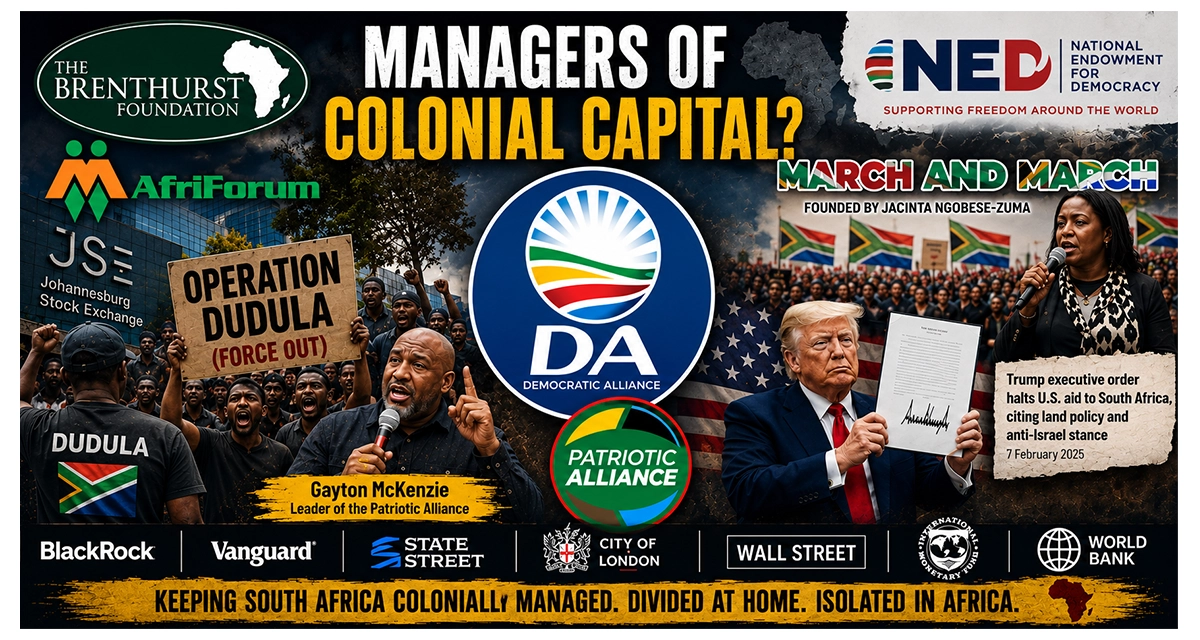
The writer argues the DA is the key political player, supported by other actors, ensuring the ‘colonial capital keeps South Africa managed’. (Image: MV Design / AI)

Share on TwitterShare on FacebookShare on Whatsapp

This analysis argues that South Africa’s contemporary political tensions, anti-immigration protests and geopolitical pressures cannot be understood in isolation, but must be viewed through the continuing influence of colonial capital, the country’s strategic role within BRICS, and the global transition towards a multipolar world.

By FARZEEN SANGLAY

South Africa’s social environment has descended into turmoil, with xenophobia re-emerging as a prominent feature of national discourse and regional embarrassment. Yet this latest wave appears markedly different. Beneath the scenes of hostility towards foreign nationals lies a more complex set of political, economic and ideological dynamics. To understand these intricacies, a deeper dive is required into understanding what South Africa represents geopolitically, and how its geopolitical position has the potential to shape and influence the wider African region.

South Africa is unique among African nations in one critical respect: the colonial power never actually departed after apartheid formally ended. In other African nations – Burkina Faso, Senegal and Algeria, for instance – the foreign colonial establishment eventually succumbed to the internal domestic struggle for freedom and independence, with indigenous populations taking control. What happened in South Africa in 1994 was categorically different: the white minority lost formal political control but retained the vast majority of everything else – the land, the mines, the banks, the corporations, the financial markets and the media. Upon Madiba’s release from prison, roughly eight per cent of the population still owned the overwhelming majority of the economy. Thirty-two years later, there has been scant change.

This matters because of who that eight per cent represent. Unlike the wealthy classes in China, Russia, India or the Gulf states – whose capital, identities and futures are structurally bound to their nations – the white South African economic elite is oriented elsewhere entirely. Their networks, board memberships, second passports, lobbying connections and cultural references are tied to the West: London, New York, Washington, Sydney and Toronto. They are aligned with the same international capital class that controls BlackRock, Vanguard, State Street, the City of London, Wall Street, the International Monetary Fund (IMF), and the World Bank. They are, in the truest sense, a-national. As far as South Africa is concerned, it is where they are located, not what they are. It is a means of extraction, akin to a foreign military base embedded in sovereign territory, designed for exploitation but disguised as benevolent capital.

In every other major BRICS nation, this a-national class operates as a guest, subject to state authority. In South Africa, they remain the host. The colonial architecture is intact.

The global transition and why South Africa cannot be allowed to decolonise

We are living through a civilisational transition. The post-World War II order – organised around American power, the dollar and Western financial institutions – is ending rapidly. BRICS economies now represent a larger share of global GDP than the G7. The dollar’s share of global reserves is in decline, and the petrodollar is becoming redundant. For most of the Global South, China is now the largest trading partner. Options exist that simply did not exist before.

The owners and controllers of global financialised capital are not fighting this transition – they understand its inevitability. What they are fighting for is the management of it: repositioning their assets and institutional influence into the new multipolar order before it arrives. The challenge is that across China, Russia, India, the Gulf, and increasingly the broader Global South, the private sector operates under state authority. The a-national capital class can operate there only as guests, on terms set by local power structures.

South Africa is the exception. The financial system, the courts, the media and the political class all remain substantially subordinate to a-national capital. That makes South Africa not just a prize, but a beachhead: the one place on the continent where this class still operates as host rather than guest.

If South Africa were to truly decolonise – through meaningful land redistribution, real capital restructuring, and integration with BRICS on terms set by South Africans for the benefit of South Africans – it would become a country where a-national capital is subject to national rules. Given South Africa’s industrial base, ports, resources, financial institutions, BRICS membership and historical prestige, a genuinely sovereign South Africa would be a continental hegemon – one that sets the terms for everyone operating in its sphere of influence.

That is the cold, rational incentive to keep South Africa colonised. It is the logic of capital in the context of a historic transition, perpetuated by the same colonial class that brought us apartheid, the transatlantic slave trade, Zionism and even the Holocaust.

Africa as the last open contest

The multipolar world being built is not a world of independent nations but rather a world of spheres of influence. East and Southeast Asia sit within China’s orbit, Eurasia within Russia’s, the Middle East and much of North and East Africa within the Gulf Cooperation Council’s (GCC) sphere, while India anchors South Asia. The Western Hemisphere remains within America’s sphere, predominantly through predatory subordination – the great Western ‘free market’ philosophy.

Africa is the last genuinely open contest and arguably the most important one. By the end of this century, Africa will represent approximately 40 per cent of the world’s population. It holds the majority of the world’s most critical minerals – cobalt, lithium, platinum and rare earths – the very materials upon which the AI revolution and clean energy transition are being built. It has the largest underdeveloped agricultural land on earth, the youngest population, two major maritime chokepoints connecting the Mediterranean to the Indian Ocean, and the natural resources every industrialising power will need for the coming century.

Three African countries have the population, economic mass, institutional depth and resource base to become continental hegemons: Egypt, Nigeria and South Africa. Egypt is the least likely candidate – protected by its military state, Gulf backing worth hundreds of billions, and a structural political culture thousands of years old. What remains is Nigeria and South Africa – and both are, not coincidentally, under coordinated external pressure simultaneously.

The machine: From Oppenheimer to the streets

Understanding what is happening on South Africa’s streets requires a nuanced perspective that cuts through the noise meant to distract attention and examines the structures that influence policy and discourse.

Take, for instance, the Brenthurst Foundation – a Johannesburg think tank run by the Oppenheimer family. This organisation had the former chairman of the US Joint Chiefs of Staff, the former UK Chief of Defence, and the former UK Secretary of State for International Development on its advisory board. Yet this foundation is presented as operating in the best interests of South Africa. For years it produced polling data, electoral strategy and policy papers for the South African opposition. It was consistently accused of being a neo-liberal entity pushing policies aligned with mining and other private-sector trade interests. It officially closed in July 2025, having achieved its objectives – political and economic influence.

Another such organisation is AfriForum, which presents itself as an Afrikaner civil rights organisation but functions, according to the author, as a foreign lobbying operation. Its leadership has made repeated trips to Washington – to think tanks, conservative media and congressional staff – promoting the narrative of white South African persecution and so-called ‘white genocide’. The language of President Donald Trump’s February 2025 executive order halting US foreign aid to South Africa echoed arguments that AfriForum had promoted in the United States over several years.

The National Endowment for Democracy, described by the author as a regime-change institution, has also maintained networks inside South Africa since the apartheid era, funding civil society organisations, media outlets and opposition political parties.

The Democratic Alliance

And then there is the Democratic Alliance (DA). Historically the party of white South Africa, it now performs ceremonial racial diversity through black figureheads in prominent positions. The author argues that the DA is anti-BRICS, pro-Israel, aligned with the West, opposed to land redistribution, Black Economic Empowerment (BEE), and the National Health Insurance (NHI). In this analysis, it functions as the political vehicle of the colonial management class.

Through a series of political manoeuvres, the DA entered government as part of the Government of National Unity (GNU) with the ANC. Within it, the party secured the Ministry of Home Affairs, currently headed by Leon Schreiber.

According to government figures cited by the author, deportations increased by 30 per cent during the 2024/25 financial year, followed by a further 12 per cent increase during 2025/26. Over the two financial years, deportations rose by a cumulative 46 per cent, reaching 109 344 by March 31, 2026, with more immigration enforcement operations conducted in nine months than the previous administration undertook in five years. Operation New Broom, a nationwide immigration enforcement campaign targeting undocumented migrants in urban centres, was subsequently launched.

The author argues that the symbolism of the operation is difficult to ignore, describing it as a white Home Affairs minister wielding a broom – a tool intended to sweep away what is deemed unwanted – while fellow Africans are removed from African soil.

At street level, Operation Dudula – meaning ‘force out’ in isiZulu – blockades clinics, confronts migrant shop owners and organises in paramilitary-style uniforms. Although the movement received fewer than 4 000 votes (0,2 per cent) in the 2024 elections, it continues to receive extensive media coverage. The author argues that such prominence reflects editorial decisions shaped by ownership interests.

The Patriotic Alliance, led by Gayton McKenzie, also forms part of the governing coalition. The article notes his anti-immigration rhetoric, including comments regarding access to healthcare by Zimbabwean and Mozambican nationals, as well as his public support for Israel based on religious convictions.

Most recently, a movement called March and March was founded by Jacinta Ngobese-Zuma, who lost her radio contract in 2025. Within weeks, the movement was organising marches across multiple cities while receiving significant political support and media attention. The author argues that such rapid national mobilisation would not have been possible without strategic coordination, financial backing and the exploitation of genuine public grievances.

Political asphyxiation: The trap the ANC is in

The external pressure from Washington is not simply punishment for South Africa’s BRICS membership, its International Court of Justice (ICJ) genocide case against Israel, or its non-aligned foreign policy. The author argues that its actual function is to amplify the Democratic Alliance’s (DA) leverage inside government.

The ANC – already politically weakened by the loss of its parliamentary majority – appears to operate on the assumption that South Africa cannot afford to dispense with the economic lifelines extended by the West. In a global economy increasingly shaped by financialisation, sovereign states have become ever more vulnerable to the judgments of Western credit-rating agencies and financial markets. This dependence is further reinforced by the West’s capacity to threaten the withdrawal of preferential trade arrangements such as the African Growth and Opportunity Act (AGOA), life-preserving programmes such as the US President’s Emergency Plan for AIDS Relief (PEPFAR), and other forms of development assistance. Such dynamics are especially striking given that the wealth sustaining these interventions is often generated through the extraction of resources from the very regions that subsequently become dependent upon them.

The DA positions itself as the party Western investors trust, the one that can restore normal relations. The author’s argument is that the ANC’s belief that there is no alternative to Western patronage represents an entrapment of the mind – the very belief that causes it to lose sight of the alternatives that do exist. Burkina Faso is cited as an example of a nation attempting to resist this Western imperialist model.

The real target: Continental solidarity

The author contends that those subjected to the current political onslaught are fellow Africans – not random foreigners. These are Zimbabweans, Mozambicans, Nigerians, Somalis and Congolese: the children and grandchildren of the Liberation Alliance.

Viewed through that lens, one is reminded that the ANC’s armed struggle was conducted largely from exile in countries including Zambia, Angola, Tanzania, Mozambique and Zimbabwe. Those countries sheltered and trained South African liberation fighters while the apartheid regime subjected them to bombing campaigns, destabilisation and proxy warfare. Despite bearing those costs, they stood in solidarity with South Africa.

Now, the author argues, Zimbabwean pregnant women are allegedly being turned away from clinics, Mozambicans are being deported, and politicians describe Nigerians as criminals. Every viral video showing Africans mistreated in South Africa reinforces a narrative across the continent that South Africa is not for fellow Africans, and therefore cannot legitimately claim continental leadership.

According to the author, this serves a precise strategic purpose.

South Africa’s ability to anchor the continent and serve as the institutional foundation of a genuinely African pole within a multipolar world depends upon being recognised as politically African – committed to African solidarity rather than Western appeasement. The author argues that the current xenophobia campaign is eroding that credibility in real time.

Divide and conquer – but we must be better

The author argues that what is happening in South Africa is not unique. The global economic transition has been accompanied by capital flight and, with it, the gradual withdrawal of the United States – and, by extension, Europe – from global dominance towards a more regionally concentrated form of hegemony.

Across much of the West, the white working class has been hollowed out by decades of deindustrialisation, wage stagnation and economic insecurity – developments the author attributes to an extractive economic system. Yet the resulting anger has been redirected towards immigrants, minorities and other vulnerable communities rather than towards the capital-owning class whose policies dismantled industries and working-class prosperity.

The author argues that Western civilisation has long operated as a zero-sum system. As wealth accumulates among a small elite, many ordinary people are left searching for dignity and economic security through increasingly nostalgic forms of nationalism, while the structural causes of their hardship remain obscured.

In South Africa, black working-class communities have every reason to be angry. Thirty-two years after liberation, land redistribution remains incomplete. Ownership of the mines, banks and the Johannesburg Stock Exchange remains largely unchanged. Many continue to live in conditions of poverty while wealth remains concentrated elsewhere.

Their grievances are real, the author argues.

You may also want to read

Lines of hope

Lines of hope

8 May 2025
Lessons drawn from the Marikana Massacre

Lessons drawn from the Marikana Massacre

25 August 2022 - Updated on 28 August 2024
From Pakistan to Gaza: Why Senator Mushtaq Ahmad Khan terrifies power and Zionism

From Pakistan to Gaza: Why Senator Mushtaq Ahmad Khan terrifies power and Zionism

9 January 2026
Beyond origins: Genetic testing, colonial history and the ethics of belonging

Beyond origins: Genetic testing, colonial history and the ethics of belonging

18 December 2025
From Queens, with no apology

From Queens, with no apology

7 November 2025
Why was Naledi Pandor’s US visa revoked? Examining claims of Zionist lobby influence

Why was Naledi Pandor’s US visa revoked? Examining claims of Zionist lobby influence

25 November 2025

But so too is the exploitation of those grievances, with anger being redirected towards Somali shopkeepers, Zimbabwean nurses and Nigerian traders rather than towards the political and economic structures that continue to shape inequality.

The author concludes that South Africans must reconcile their anger with careful political organisation so that legitimate frustrations are directed constructively rather than becoming self-destructive.

Whether South Africa enters the emerging multipolar world as a genuinely sovereign nation or remains, in the author’s words, ‘a colonially managed territory’, will depend on whether it allows itself to become isolated from the African continent and from alternative global partnerships that could strengthen its independence.

Farzeen Sanglay is a chartered accountant working in London.

Sources

[1] Shahid Bolsen, Who Set South Africa on Fire?, Middle Nation.

[2] https://ourworldindata.org/region-population-2100

[3] https://southafrica-info.com/people/south-africa-population

[4] https://www.statista.com/statistics/1412425/gdp-ppp-share-world-gdp-g7-brics/

[5] https://ourworldindata.org/data-insights/china-is-the-top-import-partner-for-most-countries-in-the-world

[6] https://ourworldindata.org/region-population-2100

[7] https://www.thebrenthurstfoundation.org/people/

[8] https://afriforum.co.za/en/washington-memorandum/

[9] https://www.gov.za/news/media-statements/home-affairs-launches-operation-new-broom-and-biometric-verification-combat

[10] https://results.elections.org.za/home/NPEPublicReports/1335/Results%20Report/National.pdf

Subscribe to our Newsletters

* indicates required
Choose the newsletters you'd like to receive
Advertisement

You may also want to read

Why Gaza’s kites demand urgent global solidarity
OPINION

Why Gaza’s kites demand urgent global solidarity

24 August 2026
Another hatchet job on Choritz — but is this fair and balanced journalism?
OPINION

Another hatchet job on Choritz — but is this fair and balanced journalism?

21 August 2026
Reading the Prophet: knowing the sīrah, reading ourselves
Books

Reading the Prophet: knowing the sīrah, reading ourselves

21 August 2026
The immigration debate: class, race and South Africa’s unresolved crisis
OPINION

The immigration debate: class, race and South Africa’s unresolved crisis

20 August 2026
Moulood – When love stands
OPINION

Moulood – When love stands

19 August 2026
SADC’s “old wine in new bottles” model unlikely to transform political economy
OPINION

SADC’s “old wine in new bottles” model unlikely to transform political economy

17 August 2026
August 2026

August 2026

FILE SIZE : 15 MB
Download
Advertisement

Latest News

Muslim Views Zamzam investigation wins national Story of the Year award

24 August 2026

Why Gaza’s kites demand urgent global solidarity

24 August 2026

Voting glitches trigger extension for Mowbray Cemetery elections

24 August 2026

Another hatchet job on Choritz — but is this fair and balanced journalism?

21 August 2026

Mowbray Cemetery elections: Competing narratives and an unverified candidate list

21 August 2026

Reading the Prophet: knowing the sīrah, reading ourselves

21 August 2026
Advertisement
Advertisement
Next Post
Mendelsohn-Choritz: Why this vindictive action?

Mendelsohn-Choritz: Why this vindictive action?

The ultimate Shariah Wealth Report: A free Islamic inheritance calculator

The ultimate Shariah Wealth Report: A free Islamic inheritance calculator

The $6 trillion shift in global Islamic Finance

The $6 trillion shift in global Islamic Finance

Amaanat chief must account for R646m of payments in civil claims

Amaanat chief must account for R646m of payments in civil claims

ABOUT MUSLIM VIEWS
About Us
Archives
Terms & Conditions
Privacy Policy
Contact Us
Donate to Muslim Views
NEWS
Local
National
World
OPINION
Columnists
Discussion with Dangor
Editorial
Guest Writers
FEATURES
AWQAF SA
Imam Haroon
Tributes
FINANCE
Islamic Finance
ISLAM
Eid
Faith and Practice
Family
Hajj and Umrah
Moulood
Quraan
Ramadaan
FEATURES
Arts
Books
Education
Food
Health
Motoring
Sport
Technology

© Muslim Views 2026. All Rights Reserved

Design by: theimagehouse

Loading...
No Result
View All Result
  • NEWS
    • Local
    • National
    • World
  • OPINION
    • Columnists
    • Discussions with Dangor
    • Editorial
    • Guest Writer
  • FEATURES
    • AWQAF SA
    • Imam Haron
    • Tributes
    • 1500 Years of Prophetic Legacy
  • LIFESTYLE
    • Arts
    • Books
    • Education
    • Food
    • Health
    • Motoring
    • Sport
    • Technology
  • FINANCE
    • Islamic Finance
  • ISLAM
    • Eid
    • Faith and Practice
    • Family
    • Hajj and Umrah
    • Moulood
    • Quran
    • Ramadaan
  • ARCHIVES
  • DONATE