


















A unique interfaith gathering at Cape Town’s Claremont Main Road Mosque brought Jews and Muslims together to reflect on Gaza’s ecocide, honour its victims and explore the links between environmental destruction, justice and faith.
By ANWAR OMAR
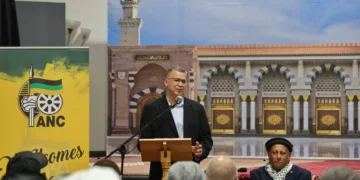
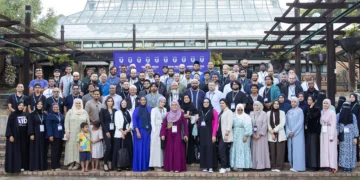
On Friday, November 6, South African Jews for a Free Palestine (SAJFP) held a Shabbat service at Claremont Main Road Mosque (CMRM) in Cape Town.
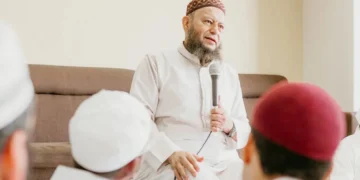
Earlier that day, the mosque’s Imam A Rashied Omar, who hosted the Shabbat, delivered his Jumu’ah khutbah, “Gaza Ecocide and Our Sacred Trust to Care for the Earth.”
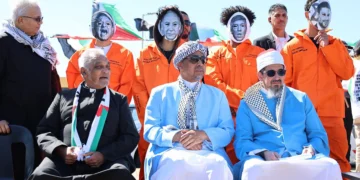
At sunset, SAJFP welcomed the Sabbath with “Shabbat against Genocide in Palestine”, its fourth annual service at the mosque, joined this year by Mothers for Gaza.
Two faith traditions, one mosque, one theme. The pairing was deliberate. Earlier SAJFP services focused on loss of life and the right of return. This year’s siddur, or prayer book, turned to what war does to the environment: wells, aquifers, olive groves and the sea.
The prelude: a khutbah beneath a shroud
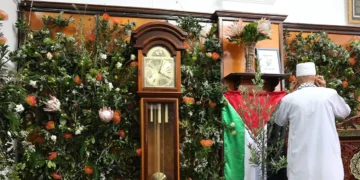
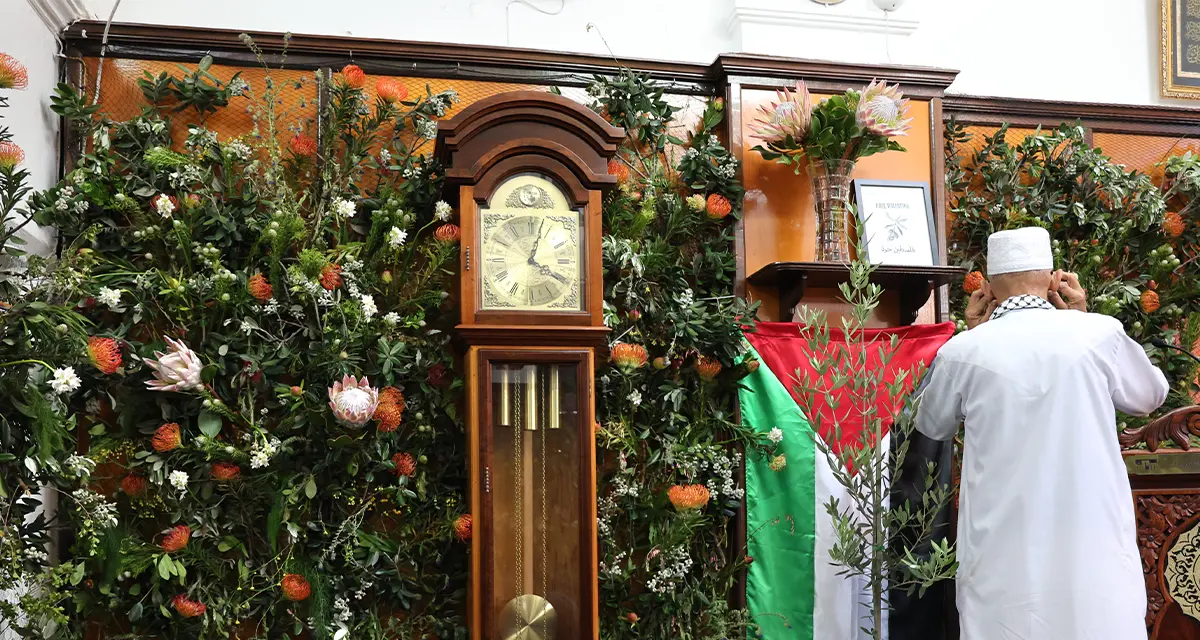
At Jumu’ah, Imam Omar used his khutbah to open the day of prayer that ended with the Shabbat at sunset. His sermon was delivered beneath a kafan, a burial shroud, hung on the masjid’s wall and inscribed with the names of Gaza’s children. Around him, the masjid was transformed into a “grieving garden” of living plants and olive saplings.

The garden was the work of Cape Town artist Thania Petersen. She works across photography, installation and performance, exploring Islam, her Cape Malay heritage and the legacy of colonialism in Africa. Trained at Central Saint Martins in London and with masters in Zimbabwe and South Korea, she is represented in collections including the Smithsonian National Museum of African Art and Zeitz MOCAA.
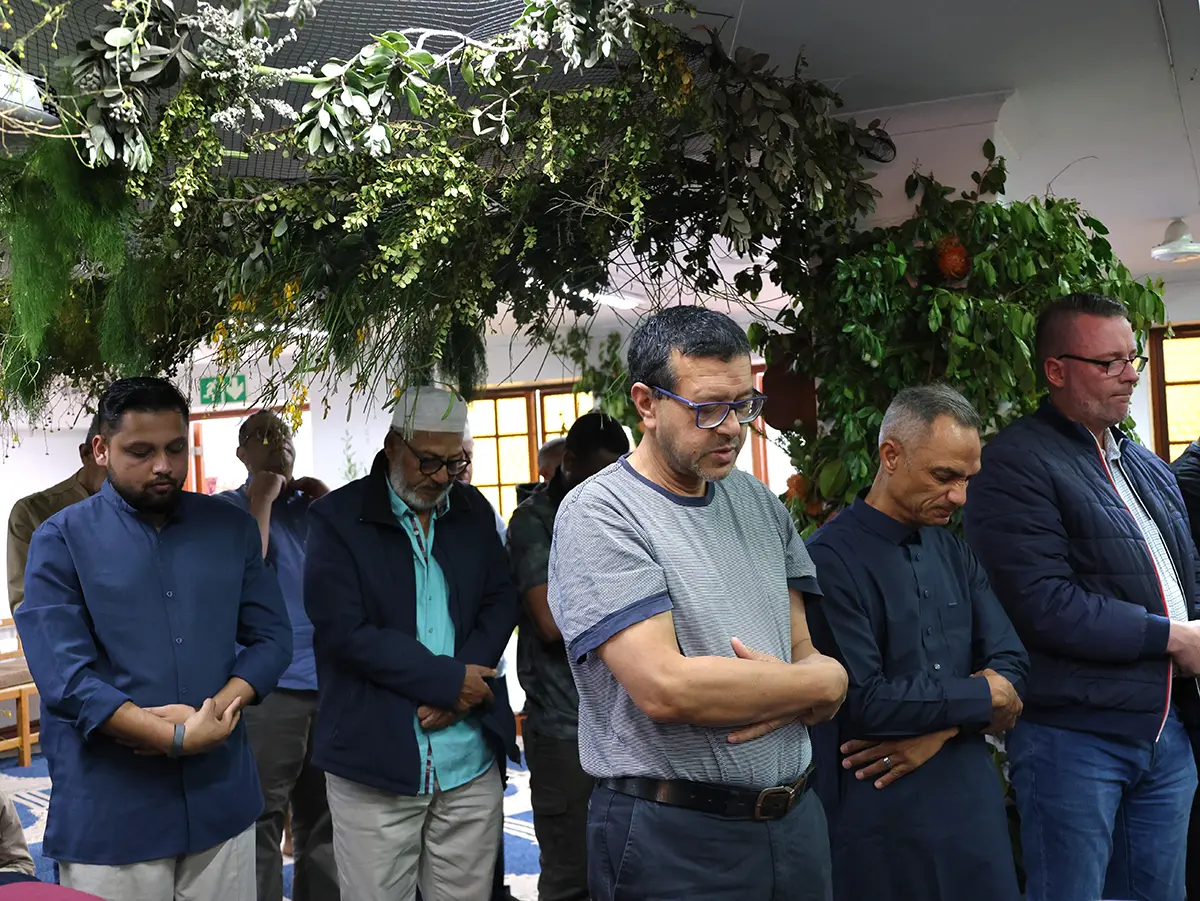
Worshippers entered the masjid, turned into a forest of leafy branches carrying yellow blossoms, hung from the ceiling in a dense canopy and wrapped around the pillars, so the congregation bowed and prostrated beneath the living greenery. The qibla wall was covered in foliage and proteas, the pink and coral flowers of the Cape’s fynbos, framing the mihrab and the wooden minbar. A Palestinian flag hung beside the old grandfather clock.
Along one wall, the shroud ran almost floor to ceiling: long white sheets covered in column after column of handwritten names, washed in soft pink light. At its foot stood a row of young olive trees in hessian sacks. After prayers, congregants lingered to read the names.
Imam Omar asked worshippers to read the names in silence and make a small du’a for each child. These were, he said, only some of the more than 22 000 children killed in Gaza over the past three years.
He reminded the congregation that God has made humankind stewards of the earth. As khalifatullah fil-ard, he said, “we are called to tend the land with humility, to share its bounty with justice, and most of all, to preserve its beauty.” He linked that duty to the hadith, “Allah is beautiful and loves beauty”: on the Day of Judgement, everyone will be asked how they cared for what God entrusted to them.
His second theme focused on hope. “If the Final Hour arrives while you hold a seedling, the Prophet (ﷺ) taught, plant it.”
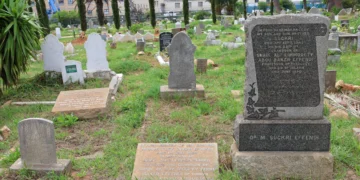
The saplings, he said, had witnessed that day’s Jumu’ah prayer. Six were to be planted at 11am on Tuesday, November 10, along the Palmyra Road boundary wall of the Stegman Road cemetery, one of Cape Town’s oldest Muslim burial grounds. Closed for a century after the Stegman Road Masjid was built in 1911, it reopened five years ago. Imam Omar hopes it becomes a garden of remembrance, its olive trees “a living symbol of Palestinian sumud, Palestinian steadfastness and hope.”

Sabbath inside the masjid
Imam Omar welcomed guests to a mosque built in 1854 and to its fourth annual Shabbat with SAJFP, joined this year by a third partner, Mothers for Gaza.
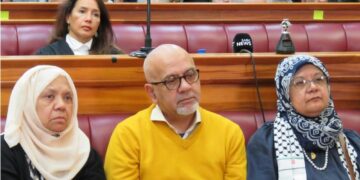
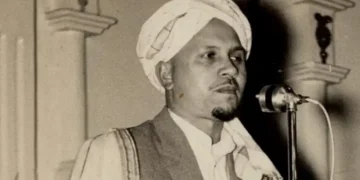
Among the guests were Fatiema Haron, daughter of Imam Abdullah Haron, who died in police detention in 1969, and Michael Weeder, former dean of St George’s Cathedral.
“It’s very rare to find a Jewish Sabbath taking place right inside a mosque, and this didn’t fall from the sky,” the imam said, crediting anti-Apartheid forebears such as Desmond Tutu and Imam Haron.
Mitchell Joffe-Hantam of SAJFP led the service, calling the mosque “a second home”. Ecocide, he said, is the purposeful, systemic destruction of ecology, often a mechanism of genocide. “It’s a technique that oppressors use to remove people from the land.” He traced it to the Nakba, when lakes were drained, water diverted, soil poisoned and forests destroyed, and to settlers’ yearly attacks on the olive harvest.
After the Shabbat candles were lit, the congregation blessed those who “command ourselves to pursue justice”.
Imam Omar read Nasser Rabbah’s “To Whom Should We Recite the Time?”, a poem of poisoned wells and orchards turned to graveyards.
The congregation then turned to olive trees, some 3 000 years old, which settlers bulldoze though they are “older than our faiths are”. Megan Choritz recited Mahmoud Darwish’s “The Second Olive Tree.”
The Nakba prayer was framed around “colonially imposed climate destruction”. It recalled Lubya, a Galilee village buried under the South Africa Forest, planted with money raised from South Africans. Such trees, the congregation heard, block return, hide the ruins and help Israel greenwash its crimes of ethnic cleansing.
The service then named the Jewish value of doikayt, Yiddish for “hereness”: nourishing the land where you live, right here in Claremont.
The shroud
Gonda Perez of Mothers4Gaza told the story of the Gaza Children’s Shroud. Father Peter-John Pearson had sent her a video of a shroud made in Italy by Priests Against Genocide. Mothers4Gaza responded at once. CMRM offered its hall, and within a few weeks volunteers filled long tables, writing the names by hand.
You may also want to read


“Each just wanted to write at least one name,” she said. “They must not be forgotten.”
The shroud, now on its fifth 20-metre length, is unfinished. About 8 000 names remain, and volunteers were invited to write more the next morning.
After a prayer for Gaza’s children, worshippers stood for the Amidah: two minutes of silence on how to cultivate a new way of being and use the earth’s resources sustainably.
The congregation sang the bilingual Ahava/Alhub in Hebrew and Arabic and then rose for the Aleinu: “It is upon us to bring about climate justice. It is upon us to strive for Palestinian liberation.”
Before the Mourner’s Kaddish, Joffe-Hantam explained a Holocaust-era practice: with whole families murdered, entire congregations recited Kaddish for all the dead. They did the same for Gaza’s dead and those lost to ecocide.
The service closed with Od Yavo, “Peace will yet come”, moving between Hebrew shalom and Arabic salaam.
Ecocide in Gaza and Apartheid in Cape Town
Professor Leslie London set out the scale of the damage. The war, he said, “wasn’t just fought as a matter of war, it was a destruction of everything”, including the basis for life.
Gaza’s ecosystem was under strain before October 2023, he argued. Water reached Palestinians as “a drip feed”, and herbicides sprayed from aircraft along the border drifted into the soil and water of a strip only five to 12 kilometres wide. He cited a 2023 B’Tselem report on how Israeli law was used to deny Palestinians water.
London also pointed to Israeli hypocrisy when they advised on desalination during Cape Town’s Day Zero crisis, while its forces were destroying Gaza’s desalination plants. Rooftop solar panels were targeted, leaving families to cook over burning plastic and tyres. In its first two months, he said, the war’s emissions exceeded the annual carbon footprint of more than 20 climate-vulnerable nations. Rebuilding Gaza, he warned, will strain the environment yet again.
Faiza Mayer of the African Water Commons Collective brought the theme home, speaking for working-class women on the Cape Flats.
“The City of Cape Town might not be coming and bombing our water sources, but they might as well,” she said.
She described households on water management devices that release about 200 litres a day, and pensioners scraping ice from freezers to take chronic medication. With x-ray eyes, a professor once told her, “you would see the apartheid in the pipes”. Mothers have become “the water police”, choosing between cooking and bathing a child, while schools ask parents to send water with their children.
A harvest of hope
Imam Omar closed by thanking SAJFP, Mothers4Gaza and the mosque’s board. When an SAJFP member arrived that evening and was shown where to leave her shoes, he recalled, she replied: “I know, I come here often. This is my house.”
Crediting Thania Petersen for the garden, Imam Omar joked that both had been called crazy for attempting it.
“We need crazy people to think out of the box,” he said, “especially when we are pushing for more inclusive, respectful societies.”
Then the call to prayer sounded, guests moved to the back of the hall, and Maghrib was prayed in congregation before everyone shared dinner.