




![Does ta’wīl mean interpretation or fulfilment? A Quranic reassessment [+video]](https://muslimviews.co.za/wp-content/uploads/2026/10/Tawil-Kaskas-360x180.webp)









![Why becoming a wealthy Muslim is commendable in Islam [+videos]](https://muslimviews.co.za/wp-content/uploads/2026/09/Muslim-Trade-Business-1-360x180.webp)




How Islamic art and faith-based design, as espoused by Mahmudah Begum Jaffer, can engage fynbos, biodiversity, and belonging in the Cape Floristic Region beyond science and policy.
By ZAITOON EBRAHIM
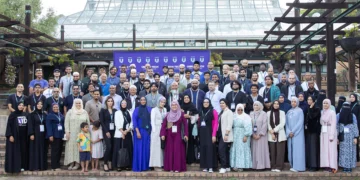
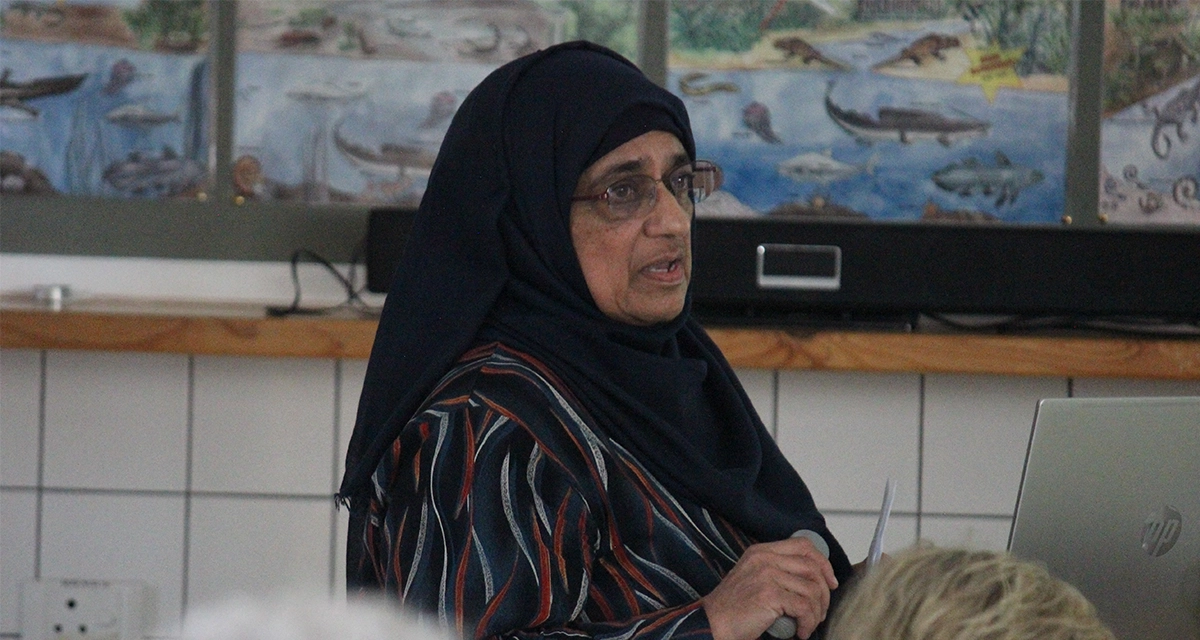
The Cape Floristic Region Partnership (CFRP) Knowledge Exchange, held on Thursday, December 5, 2025, at the West Coast Fossil Park, brought together conservation partners, organisations, and innovators under the theme ‘Innovation, inclusion, and identity’.
Across a rich programme of presentations and discussions, a shared understanding emerged: biodiversity conservation cannot rely on science and policy alone. It must also engage culture, identity, and belonging.
Throughout the day, speakers highlighted how South African flora carries not only ecological value, but also cultural, economic, and symbolic significance. From global horticultural showcases and indigenous heritage initiatives to community storytelling and regenerative tourism, the Cape Floristic Region (CFR) was repeatedly framed as a living narrative that requires new ways of seeing if it is to be protected and sustained.
Within this context the presentation by Mahmudah Begum Jaffer, ‘Fynbos in Janubi Zakhrafa’ offered a faith-based and artistic perspective on how biodiversity might be engaged through sacred visual language, education, and design.
Art as a bridge between knowledge systems
A recurring theme at the Knowledge Exchange was the role of art as a bridge between science and society, heritage and innovation, and data and emotion. Several presenters reflected on how storytelling, visual culture, and creative practice can translate complex ecological knowledge into forms accessible to broader audiences.
You may also want to read


This aligns closely with the Islamic artistic tradition, in which art functions as a contemplative medium that encourages observation, reflection, and ethical awareness rather than passive consumption. In this sense, art is not an ‘add-on’ to conservation, but a means of cultivating relationship with the natural world.
Janubi Zakhrafa: a southern Islamic ornamental language
Janubi Zakhrafa proposes the development of a South African Islamic decorative language rooted in local flora, particularly fynbos. Rather than importing familiar Islamic motifs such as vines, tulips, or lotus forms from other regions, this approach begins with close botanical observation of indigenous plants and translates their structures into geometric and ornamental systems.

In her presentation, Mahmudah Begum Jaffer, founder and author of the Janubi Zakhrafa designs, demonstrated how fynbos species such as proteas naturally lend themselves to symmetry, repetition, and radial balance, qualities foundational to Islamic geometry. Through observation, abstraction, and construction, botanical forms evolve into geometric frameworks, borders, and patterned compositions.
These are not imposed designs, but extracted ones, allowing the plant’s inherent order to guide the artwork. In this way, Islamic geometry becomes a method of seeing rather than a fixed aesthetic vocabulary.
From ownership to stewardship
Discussions at the Knowledge Exchange repeatedly returned to questions of land, responsibility, and belonging. Land tenure, community engagement, and benefit-sharing were recognised as critical to conservation outcomes. Beneath these discussions lies a deeper ethical question: how do people understand their relationship to land?
Islamic art and philosophy approach this question through stewardship rather than ownership. Nature is understood as āyāt, signs that point beyond themselves and invite care, restraint, and responsibility. When local flora forms the basis of sacred design, it reinforces a sense of awe rooted in place rather than abstraction.
This perspective resonates with other contributions at the Knowledge Exchange that emphasised ancestral knowledge systems, cultural memory, and intergenerational responsibility. While emerging from different traditions, these approaches share a common ethic: land is not inert, but relational.
Education, inclusion, and future pathways
A key outcome of ‘Fynbos in Janubi Zakhrafa’ is its educational potential. The presentation outlined how geometry, science, literacy, arts, tourism, and life orientation can intersect through plant-based design practices, fostering eco-responsibility, heritage appreciation, and reflective citizenship.
Such approaches align strongly with the CFRP’s emphasis on youth engagement, inclusive participation, and skills development. By engaging learners through visual and creative processes, biodiversity education becomes experiential rather than abstract, encouraging appreciation before advocacy.
A quiet but necessary contribution
The CFRP Knowledge Exchange demonstrated that building a resilient Cape Floristic Region will require collaboration across disciplines, sectors, and worldviews. Faith-based artistic perspectives such as Janubi Zakhrafa do not replace scientific or indigenous knowledge systems, nor do they seek to dominate conservation narratives. Instead, they offer an additional language that speaks to meaning, identity, and belonging.
In a region where biodiversity is globally celebrated yet locally under-recognised, cultivating new ways of seeing may be as important as developing strategies for protection. When fynbos is encountered not only as data or resource, but as inspiration and sign, conservation becomes not merely an obligation, but a shared act of care.
As an artist and educator, I left the Knowledge Exchange reflecting on how rarely faith-based ways of seeing nature enter conservation conversations. Yet when we pause to observe local flora with care and reverence, something quietly shifts. Art becomes a bridge, not only between science and society, but between knowledge and responsibility.
Zaitoon Ebrahim is a mother of two, an Islamic studies educator, entrepreneur, and artist. She holds a bachelor’s degree in Islamic Theology from the Islamic College of Southern Africa. Her work focuses on Qur’an studies, personal development, and the intersection of art, spirituality, and nature. She started her career as an Islamic studies educator at Madrassatul Quds in Gatesville, Cape Town, in 1999. During this time, she managed youth events with an NGO, facilitating events, camps and leadership training for adults and youth.