





















![The market-builder who restrained the market [Part 2]](https://muslimviews.co.za/wp-content/uploads/2026/08/PHOTO-2026-08-25-17-16-32-360x180.jpg)
![The merchant preceding the Prophetic mission [Part 1]](https://muslimviews.co.za/wp-content/uploads/2026/08/01-360x180.jpg)









Pakistan’s leadership faces mounting pressure as constitutional overreach, geopolitical dependence, and public disillusion expose the limits of authoritarian power. This analysis explores how repression, memory, and emerging resistance are reshaping the country’s political trajectory.
By JUNAID S AHMAD
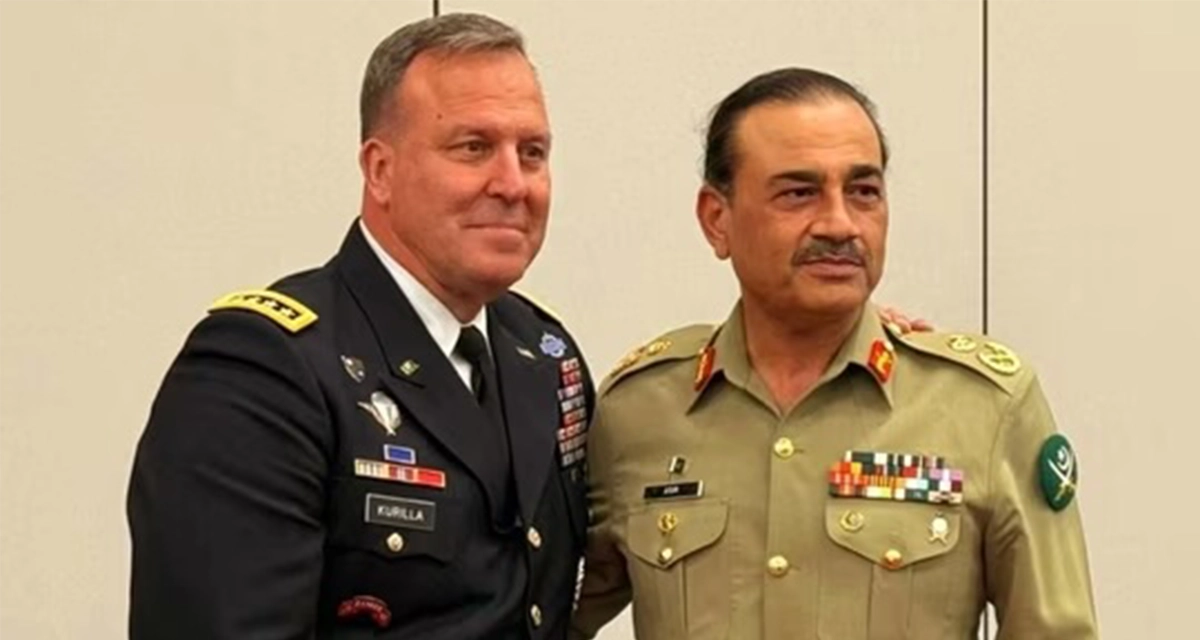
One of the enduring paradoxes of contemporary geopolitics is the peculiar delusion by which authoritarian rulers confuse ceremonial theatrics with structural permanence. The most recent and revealing instance appears in Pakistan, where General Asim Munir — a man who treats the epithet ‘Trump’s favourite Field Marshal’ as a credential rather than a caution — has attempted to transform political exigency into constitutional doctrine.
The regime’s late-2025 push for an omnibus constitutional overhaul, the proposed 27th Amendment, sought to codify what it could never convincingly justify: the elevation of the Army Chief into a supra-constitutional Chief of Defence Forces; lifetime immunities for senior officers; the dilution of judicial independence; and the weaponisation of forced judicial transfers as political leverage. If authoritarianism were to draft a mission statement, this amendment would be its unembarrassed blueprint.
But this hurried attempt at permanence was less an origin story than a confession — an admission that the window of opportunity was closing. The moment radiated impermanence: fatigued institutions, ad hoc governance, and a ruling elite performing the choreography of confidence while betraying an inner tempo of panic. Pakistan’s powerbrokers have stopped pretending that their authority stems from democratic legitimacy; instead, they rely on procedural intimidation staged as patriotic duty. The problem is not merely constitutional — it is existential. It is a political order that fears its own sunrise.
Munir’s central miscalculation is the belief that existential insecurity can be repackaged as geopolitical relevance. Hence the fixation on Washington photo-ops, performative briefings about Afghan ‘terrorist’ threats, and an almost endearing obsession with touting admiration from a former US president who would struggle to distinguish Karachi from Kabul on a map. The spectacle borders on tragicomedy: a general mistaking transient American flattery — the sort routinely dispensed to disposable allies — for strategic partnership. Today’s convenience, tomorrow’s liability.
Yet beneath this theatre lies a geopolitical subtext of far greater magnitude. In the post-2022 political landscape, Pakistan drifted closer than ever to delivering what many external actors — advancing a Zionist architecture of regional disciplining — had long envisioned: a pacified Muslim-majority nuclear state, subdued not by invasion or economic strangulation but by internal capitulation. This transformation was so pervasive and so quiet that even regional observers failed to register it. It was not tanks on boulevards but the stillness of citizens queueing outside courts; journalists muting their instincts; and lawyers whispering arguments to avoid the midnight vibration of an unwelcome phone call. This was pacification by exhaustion, not force — not primarily through foreign command but through domesticated obedience.
The April 2022 ousting of a popular prime minister, Imran Khan, achieved not through brute coercion but through procedural mimicry, inaugurated this new order. Dissenters were arrested in methodical batches, as though processed through a bureaucratic workflow. Civil society was invited to view the so-called hybrid regime as a legitimate evolution of governance rather than a euphemism for institutional capture. Bank accounts were frozen without public outcry. Newspapers reported disappearances as if updating municipal records. No foreign capital needed to dictate this cadence; Pakistan’s elite orchestrated it themselves. The quiet triumph of imperial logic lay in normalisation — the ease with which a state disciplines its citizens once it has disciplined its imagination.
Now the regime confronts a paradox of its own making: it cannot depart without inviting accountability, nor persist without intensifying demands for it. In pursuing permanence, Munir has summoned permanence’s nemesis — inevitability. Borrowed time, by definition, must be returned.
This crisis, however, is not merely authoritarian; it is aspirationally derivative. It reflects a polity that measures its political self-worth through external mirrors. To be ‘Trump’s favourite Field Marshal’ is not a joke — it is a worldview. Domestic legitimacy is displaced by international signalling; foreign applause becomes a constitutional principle. The state no longer governs through consent but performs governance for an imagined global audience.
Yet the deeper tragedy lies not only in military ambition but in the abdication of those positioned to challenge it. Pakistan’s intellectual and professional classes — academics, journalists, and political neutrals at home and abroad — perfected a sophisticated form of strategic timidity. They signed statements against injustices in distant lands while framing injustices at home as complex debates requiring civility. They were not bribed or coerced wholesale; many simply opted for comfort. Enough avoidance becomes sedation; enough sedation becomes complicity.
But no structure of repression is airtight. The fractures emerging today are not primarily street protests — those were predictable — but subtler, more consequential ruptures: an incipient disillusion within the military’s lower and middle ranks; officers unsettled by the moral dissonance of punishing civilians who resemble their own families; a recognition that fear can be compelled but respect cannot. Empires can command obedience, but they cannot manufacture dignity.
The interruptions began as murmurs: a son demanding transparency about his father’s detention; a scion of a long-established dynasty denouncing constitutional opportunism; diaspora journalists shedding euphemism in favour of naming harassment outright; students forming decentralised networks to bypass institutional chokeholds. These gestures, though small, punctured the narrative of pacification. They restored something that Zionist ideology fears most: a society’s memory.
When memory returns, repression loses its camouflage. It becomes audible again, visible again, resistible again.
You may also want to read





This is the threshold at which solidarity becomes not merely useful but necessary. Pakistan is not in the throes of revolution; it is in an interstitial moment — a pre-solidarity phase where international networks, if they choose to act deliberately, possess genuine leverage. Documentation matters. Testimony matters. Exposing judicial distortion matters. Demanding transparency matters — for institutions, amendments, budgets, and the mechanics of state coercion. The task is not glamorous insurgency but disciplined vigilance. The same bureaucratic instruments through which external powers exerted influence can be repurposed to erode it.
Public fatigue is slowly transmuting into lucidity. The population is no longer shocked by authoritarianism; it is increasingly unimpressed by its amateur theatrics. When despair stabilises into reflection, the regime enters its terminal anxiety.
Political theorists often dismiss historical inevitability as myth, but in Pakistan today it feels almost empirical. Governments that obsessively insulate themselves from accountability already intuit its inevitability. Borrowed power decays. Borrowed legitimacy evaporates. Borrowed victories invert into liabilities. The generals understand this. The dynasties understand this. The judiciary, however belatedly, understands this. Even cautious academics, behind closed doors, have begun to say as much.
Munir may continue signing decrees and curating photo-ops. Parliament may continue staging constitutional pageantry. But all borrowed time carries a due date. Whether the reckoning arrives with a bang or through the quiet collapse of elite consensus, it is no longer speculative.
The Vincible Pharaoh of Zionism may imagine himself insulated today. But tomorrow — or the day after the next amendment — he may join the long procession of rulers who mistook temporary impunity for historical exemption. In the end, every ruler of borrowed power is overtaken by what he fears most: being reduced to a footnote in a story he once sought to control.
Prof Junaid S Ahmad teaches law, religion, and global politics and is the Director of the Centre for the Study of Islam and Decolonisation (CSID), Islamabad, Pakistan. He is a member of the International Movement for a Just World (JUST), the Movement for Liberation from Nakba (MLN), and Saving Humanity and Planet Earth (SHAPE).