


![Does ta’wīl mean interpretation or fulfilment? A Quranic reassessment [+video]](https://muslimviews.co.za/wp-content/uploads/2026/10/Tawil-Kaskas-360x180.webp)








![Why becoming a wealthy Muslim is commendable in Islam [+videos]](https://muslimviews.co.za/wp-content/uploads/2026/09/Muslim-Trade-Business-1-360x180.webp)



As South Africa commemorates Freedom Month – and the world marks Palestinian Prisoners’ Day – the imprisonment of Marwan Barghouti draws striking parallels to Robben Island, raising urgent questions about justice and global solidarity.
By SAYED RIDHWAAN MOHAMED
The air in April always carries a specific weight in South Africa. It is the month of our rebirth, the season when we remember the long queues of 1994 and the fragile, beautiful dawn of a democracy won at an Everest-sized cost. But on April 17, Palestinian Prisoners’ Day, that air grows heavy with a different kind of tension. It is the haunting resonance of a cell door slamming shut; not in our past, but in the global present.
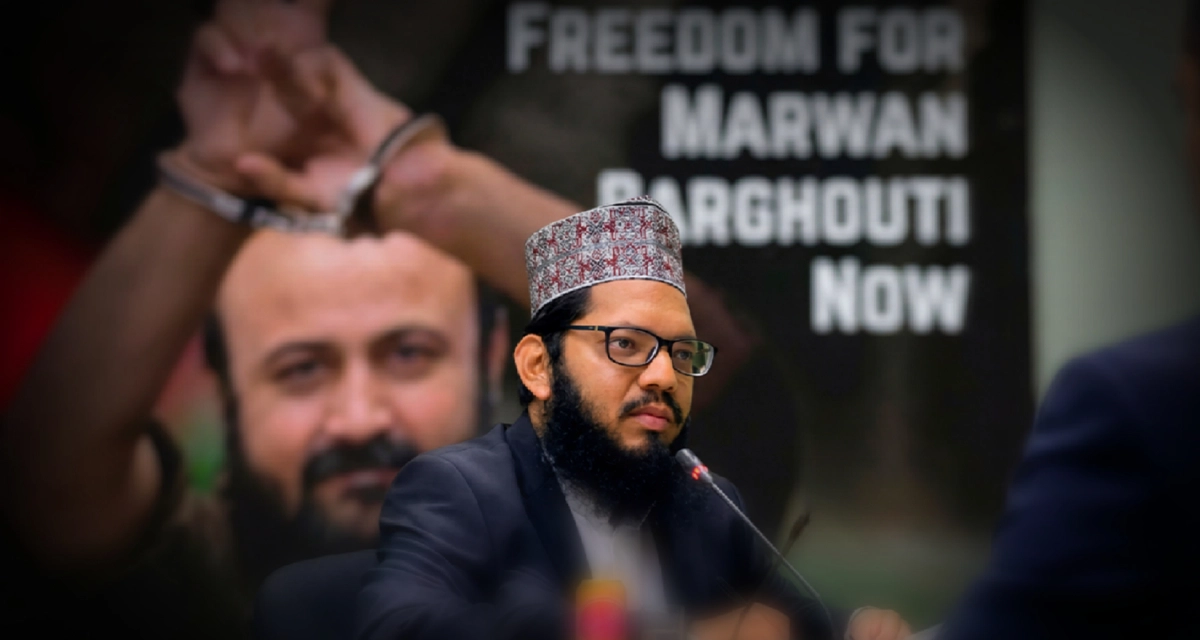
In a cold cell within the Israeli carceral system sits Marwan Barghouti. He has been there for twenty-four years, having been imprisoned on Aril 15, 2002.
To the world, he is a figure of geopolitical debate; to the Palestinian people, he is the ‘Mandela of Palestine’. But for us, as South Africans, Barghouti is more than a symbol. He is a visceral mirror of our own history, and today, that mirror is cracked and bloodied by the latest reports of his treatment.
To walk the corridors of Robben Island is to understand that a prison cell is never just a room; it is a crucible where the spirit of a nation is either forged or broken. When we look at Barghouti, we are forced to confront the ghost of our own history. Like Nelson Mandela, Walter Sisulu, and Robert Sobukwe, Barghouti was not captured for a ‘crime’ in the sense that a civil society understands it. His voice – articulate, unifying, and unyielding – posed a mortal threat to a system built on the premise of one people’s supremacy over another, leading to his unlawful detention.
You may also want to read


However, the ‘Mandela’ comparison is no longer just a poetic metaphor; it has become a desperate plea for survival. As of April 2026, the reports emerging from behind the walls of Megiddo and Ramon prisons are chilling. Barghouti’s legal team recently detailed a systematic pattern of ‘brutal physical assaults’ that occurred as recently as late March and early April. In one horrifying account, guards reportedly entered his cell with a dog and forced him to the ground while the animal repeatedly attacked him. He has been left with fractured ribs and injuries across his body, often denied immediate medical care. This is not ‘security’; this is a calculated attempt to destroy a human being’s dignity.
The mandate of the pulpit
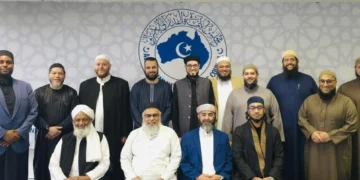
In the face of such degradation, the Cape Town Ulama Board has issued a clarion call that resonates with the very soul of our liberation struggle. They remind us that for religious leaders, standing up for justice is not a political choice, but a theological debt. The pursuit of ‘Adl (Justice) is a divine command that transcends borders.
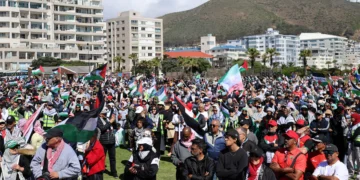
As religious and community leaders, we are indebted to stand up for justice and call others to stand up too. In the South African context, the pulpit has historically been a site of resistance. Whether it was the mosques of District Six or the churches of Soweto, religious leadership provided the moral scaffolding that allowed a tired people to keep standing. Today, that same leadership calls upon the greater South African community to carry on creating awareness and educating the masses on this struggle. We cannot claim to lead a faithful life while remaining blind to the chains of our brothers and sisters.
There is a deep, quiet responsibility that sits on the shoulders of every South African citizen. We are the beneficiaries of a global solidarity movement that once turned the tide of history. If we claim to cherish the legacy of our struggle, how can we remain tepid?
The conditions Barghouti endures – systematic beatings, prolonged solitary confinement, and even threats to his life – are the same tools used by the apartheid regime to try and break the ‘Purple Shall Govern’ generation. To remain silent now is to retroactively betray our own history. We must move beyond passive sympathy and engage in the ‘Deep Solidarity’ that defined our own liberation.
The social justice mandate
Social justice is not a static destination we reached in 1994; it is a continuous, often exhausting practice. Standing up for Palestinian prisoners during this week is about the fundamental principle of self-determination.
When we talk about Marwan Barghouti, we are talking about the right of a people to choose their own leaders. We are talking about the over 9 500 Palestinians, including women and children, languishing in a system of ‘administrative detention’ that mirrors our old 90-day detention laws. This is a system that we, as South Africans, officially declared illegitimate decades ago.
This April 17, let us not simply post a hashtag. Let us sit with the weight of the bars. Let us reflect on the fact that while we celebrate our ‘Freedom Month’, a 66-year-old man who could be the key to peace is being physically broken in the dark.
We must demand that our government uses its significant leverage – from the ICJ to centre the release and safety of political prisoners. We must educate the masses, ensuring that the struggle of the Palestinian prisoner is understood not as a ‘conflict’ between equals, but as the resistance of an occupied people.
Marwan Barghouti is not just a Palestinian prisoner. He is a test of our consistency. If we believe in the ‘Rainbow Nation’, we must believe in the right of every nation to see the light of day. Our freedom is indeed incomplete; it is tethered to that cell. It is time we pulled on the chains until they break.
Sayed Ridhwaan Mohamed is a South African community journalist, researcher and Honours graduate in Islamic Studies. A steadfast advocate for humanitarian rights and global justice, he lends his expertise to numerous committees specialising in interfaith advocacy and the advocacy of human rights in Palestine and beyond. He currently serves on the exco of the Cape Town Ulama Board, an executive member of the Sunni Ulama Council (Cape), and is a co-founder of the Ahlus Sunnah Media Network.