















![The market-builder who restrained the market [Part 2]](https://muslimviews.co.za/wp-content/uploads/2026/08/PHOTO-2026-08-25-17-16-32-360x180.jpg)
![The merchant preceding the Prophetic mission [Part 1]](https://muslimviews.co.za/wp-content/uploads/2026/08/01-360x180.jpg)






OPINION
For South African Muslims to occupy a meaningful space in global Muslim thought, we must first know ourselves, challenge our internal silences and build institutions rooted in integrity.
By ADNAAN ADAMS
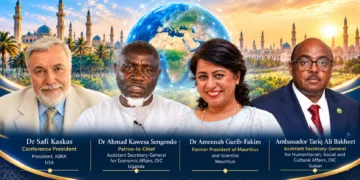
WHEN the Global Imams and Scholars Council (GISC) convened in Cape Town in October 2025 for its international retreat hosted by the United Ulama Council of South Africa (UUCSA), it marked an ambitious effort to articulate a shared moral compass for the global ummah.
While the intention was commendable, the model presented risks reproducing a narrow, centralised and abstract form of authority that does not resonate with the lived complexity, diversity and historical depth of communities such as our own in South Africa.
The Qur’an and Prophetic tradition are already our moral compass – universal, timeless and unconstrained by geography. The real question is not whether we need a global body but whether we can build communities worthy of global respect – communities whose integrity, inclusivity and moral clarity earn them a place in global conversations.
Here at home, we still struggle to honour difference within our own minority community. Sectarian discomfort, inherited biases and a reluctance to embrace dissent undermine our moral confidence. If we cannot acknowledge and include the diversity in our midst, how can we speak meaningfully about global unity? If we selectively champion justice only when it is convenient, how can we claim leadership in confronting global injustice?

A compelling example of authentic, principled leadership comes from beyond our borders: Zohran Mamdani, the newly elected Muslim mayor of New York. A Muslim who happens to be Shia – belonging to a minority sect often marginalised within our own community – his leadership is rooted in clarity, courage and justice for all. During his campaign, Mamdani drew on the ethical legacy of Karbala, Imam Husayn’s (RA) stand for truth, dignity and justice. This moment is not the property of one sect; it is an Islamic inheritance. It is a reminder that prophetic leadership embraces moral clarity even when standing alone.
Mamdani’s victory is not simply political; it is evidence of what becomes possible when a community transcends internal bias and nurtures leaders shaped by prophetic values. Remarkably, his early religious exposure came from both the mainstream Sunni tradition at Claremont Main Road Mosque and formative time at the Ahlul Bait Mosque Complex in Ottery – two spaces that seemingly reflect very different strands within the South African Muslim communal fabric. If such inclusive environments can produce ethical, courageous and principled leadership, imagine what our own community might achieve by cultivating similar openness.
When we raise our youth to think broadly, embrace difference without prejudice and root themselves in justice, we lay the seedbeds for leaders who can stand with dignity anywhere in the world. If South African Muslims wish to be globally relevant, we must adopt this same ethical imagination – honouring diversity from the outset, not half-heartedly, and welcoming dissenting voices rather than policing them.
The GISC’s stated intention to adopt a Code of Conduct grounded in integrity and service to the vulnerable is welcomed. Shaykh Sadullah Khan’s call for Muslim institutions to ‘invest more in people than in buildings’ is equally critical. But investing in people must go deeper. It requires investing in knowledge, research and evidence-based clarity about who we are and what we face. Too often, our khutbahs, institutional decisions and leadership rhetoric rely on assumptions rather than analysis. Without data on youth alienation, inequality, economic exclusion, mental health, religious attitudes or political shifts, our leadership remains reactive, not visionary.
For this reason, The Muslim Thinker is establishing the African Muslim Barometer (AMB) as a core research pillar within its ecosystem. AMB will serve as a critical tool for understanding ourselves – a much-needed mirror reflecting the social, economic, political and ethical realities shaping Muslim life in South Africa and across the continent. By producing rigorous, faith-informed data, it will amplify underrepresented voices, preserve indigenous knowledge systems and provide the empirical foundations for responsible policy, effective organisational strategy and ethical leadership.
You may also want to read


If we wish to be taken seriously on the global stage, initiatives such as AMB must be supported – financially and otherwise – so that our leadership is rooted not only in moral clarity but also in credible, contextually grounded knowledge. No global Islamic initiative can claim legitimacy without understanding local realities, and no community can grow without confronting itself honestly. AMB offers the mirror we have long avoided.
Leadership will not come from forming another council; it will come from cultivating ecosystems of thinkers, scholars, activists, designers, innovators, artists and public servants whose credibility arises from their work.
For South African Muslims, and African Muslims more broadly, to occupy a meaningful space in global Muslim thought, we must first know ourselves, challenge our internal silences and build institutions rooted in integrity. Leadership will not come from forming another council; it will come from cultivating ecosystems of thinkers, scholars, activists, designers, innovators, artists and public servants whose credibility arises from their work.
This is the prophetic path – inclusion over gatekeeping, justice over convenience, truth over comfort. It calls on us to summon the courage to build beyond what is familiar and to imagine a community worthy of the values we claim to uphold. Only when we embody these values will we not merely seek a place in global leadership – we will deserve it.
Adnaan Adams writes for The Muslim Thinker, a digital platform dedicated to critical inquiry, ethical discourse and thought leadership in the contemporary Muslim world. Website: www.themuslimthinker.org and www.africanmuslimbarometer.org