





![Does ta’wīl mean interpretation or fulfilment? A Quranic reassessment [+video]](https://muslimviews.co.za/wp-content/uploads/2026/10/Tawil-Kaskas-360x180.webp)











![Why becoming a wealthy Muslim is commendable in Islam [+videos]](https://muslimviews.co.za/wp-content/uploads/2026/09/Muslim-Trade-Business-1-360x180.webp)



The 50th commemoration of the Soweto Uprising and the sacred month of Muharram offer urgent lessons on justice, leadership, reform and civic responsibility.
By SAYED RIDHWAAN MOHAMED
EVERY nation eventually faces a moment where its foundational ideals are tested against the realities of its decay.
For South Africa, that moment is now. As the 50th commemoration of the June 16, 1976 Soweto Uprising converges with the sacred dawn of Muharram, we are presented with a rare, sobering mirror.
This intersection is not a mere coincidence of dates; it is a universal summons across every layer of society. From the halls of parliament and the pulpits of our places of worship, to the university lecture halls and the kitchen tables of ordinary citizens, a singular question demands an answer: Who will bear the responsibility of reform?
We live in a landscape fractured by systemic crises. Pervasive crime robs our people of their peace, economic stagnation dims the horizon for the next generation, and institutional corruption threatens to hollow out our democracy. For the youth, the temptation to retreat into cynical apathy is immense. Yet cynicism is a luxury a developing nation cannot afford.
When the youth abandon the public square, they leave the geometry of their future to be written by the very forces of stagnation they critique.
To understand our duty today, we must look to the twin legacies of our history and our spiritual heritage.
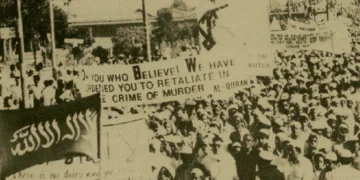
June 16 reminds us that the freedoms enjoyed by our current leaders were purchased by the raw, unvarnished courage of young students who refused to accept an unjust status quo. They did not wait for structural permission to act; they recognised that silence in the face of structural rot is its own form of complicity.
Parallel to this historical fire is the timeless template of the month of Muharram, defined by the stand of Imam Hussain ibn Ali at Karbala. His resistance transcends theological boundaries; it stands as a masterclass in the universal philosophy of human rights and ethical governance.
Confronted with a tyrannical regime that sought to normalise corruption and strip society of its moral compass, Hussain’s refusal to capitulate was not a bid for political power, but a profound moral veto. His declaration, recurrent across centuries – ‘I have not risen to cause mischief or corruption… but to enjoin the good and forbid the evil’ – speaks directly to the crises of modern governance.
To our presidents, ministers, and policymakers, Karbala offers a stark warning: power divorced from justice is inherently illegitimate. True leadership is measured not by the retention of authority, but by the radical protection of the vulnerable. When state resources are squandered or when the rule of law collapses into lawlessness, the social contract is broken. Government must not view youth anger as a threat to stability, but as the raw material required to rebuild the state.
To our religious and moral leaders, this convergence is a call to move beyond ritual. Faith that does not confront structural injustice is stagnant. The pulpits of this country must become incubators for civic duty. Enjoining the good means mobilising congregations to actively combat crime, safeguard their neighbourhoods, and demand absolute accountability from those in power.
You may also want to read





Most critically, to the youth and the general public, this is a call to active agency. We must redefine what it means to participate in daily life. Fighting crime cannot be left entirely to a struggling police force; it requires a unified front where communities refuse to normalise lawlessness or harbour syndicates. Taking part in voting must no longer be viewed as an optional chore, but as the ultimate institutionalised mechanism of our moral veto. To stay away from the ballot box is to willingly outsource your destiny.
True reform requires a disciplined, multi-generational alliance. The university student must lend their intellect to design localised economic solutions; the worker must demand ethics in industry; and the politician must demonstrate the humility to serve.
Let us reject both the paralysis of despair and the naivety of empty optimism. By drawing inspiration from the blood-stained soil of Soweto and the timeless, principled sands of Karbala, we can synthesise a new era of civic consciousness. Let us stand firmly for justice, participate relentlessly in the governance of our daily lives, and prove that the spirit of courage did not die in the past – it is alive within us, ready to rebuild our nation.
Sayed Ridhwaan Mohamed is a South African community journalist, researcher and Honours graduate in Islamic Studies. A steadfast advocate for humanitarian rights and global justice, he lends his expertise to numerous committees specialising in interfaith advocacy and the advocacy of human rights in Palestine and beyond. He currently serves on the executive committee of the Cape Town Ulama Board, is an Executive Member of the Sunni Ulama Council (Cape), and co-founder of the Ahlus Sunnah Media Network.