






























![The market-builder who restrained the market [Part 2]](https://muslimviews.co.za/wp-content/uploads/2026/08/PHOTO-2026-08-25-17-16-32-360x180.jpg)
![The merchant preceding the Prophetic mission [Part 1]](https://muslimviews.co.za/wp-content/uploads/2026/08/01-360x180.jpg)











MAHMOOD SANGLAY
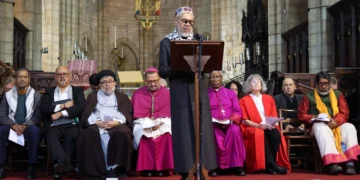
When the Global Imams and Scholars Council (GISC) convened in Cape Town for its third international retreat in October 2025, it signalled a moral alliance of Muslim scholars intent on redefining leadership and justice in a fractured world.
The dinner on October 29, hosted by the United Ulama Council of South Africa (UUCSA) and Awqaf South Africa, followed four days of deliberation on the state of the Ummah. Addressing guests, Maulana Yusuf Patel, newly elected vice-chairperson of the GISC, reminded them that no scholar or nation can exist in isolation in a globalised world where ‘a ripple in one part of the world causes a wave in another.’
Origins and vision
Maulana Patel told Muslim Views that the GISC was formally established in 2023 after years of informal cooperation among national ulama councils that recognised the need for a unified scholarly voice to confront the challenges facing Muslims in non-Muslim societies. The council, he said, is governed by a constitution and charter defining its ethics and decision-making. Its vision is to serve as a unified global body of credible scholarship that fosters cooperation among ulama, engages civil society and governments on justice and peace, and upholds moral integrity in public life.
Founding members include the Australian National Imams Council (ANIC), British Board of Scholars and Imams (BBSI), North American Imams Federation (NAIF), Canadian Council of Imams (CCI), Ulama Council of New Zealand (UCNZ), Council of Imams of Japan (CIJ) and UUCSA. ‘Discussions are under way with bodies in Europe and Southeast Asia,’ Maulana Patel added, ‘to ensure balanced and inclusive representation.’
Membership is institutional and limited to recognised councils that uphold Sunni orthodoxy, integrity and ethical conduct. Although women are not yet formally represented, several member councils include female scholars, and Maulana Patel said broader inclusion ‘must evolve as the structures of national ulama bodies evolve.’
Moral leadership, integrity and independence
Responding to the GISC’s principle that ‘silence in the face of oppression is complicity,’ Maulana Patel said the council challenges injustice through public statements, advocacy and partnerships with civil-society groups. It avoids direct engagement with state-aligned clerics, focusing instead on moral guidance and humanitarian cooperation. While the GISC is composed of Sunni scholars, Maulana Patel said cooperation ‘with entities outside the Sunni tradition will be considered case by case, depending on necessity and benefit to the wider Muslim community.’
You may also want to read


He outlined the council’s practical priorities: upskilling imams for contemporary moral challenges, promoting credible scholarship in minority contexts, developing digital-ethics frameworks for artificial intelligence, and strengthening independence from political capture.
Autonomy is among the GISC’s greatest tests. During the Cape Town dinner, Mickaeel Collier, CEO of Awqaf SA, urged Muslims to move ‘from reaction to vision, from survival to stewardship.’ Maulana Patel affirmed that the council will maintain independence while collaborating with the Organisation of Islamic Cooperation (OIC) and International Union of Muslim Scholars (IUMS) on humanitarian initiatives. It operates without large donors, relying on member contributions, and plans transparent funding and conflict-of-interest safeguards.

Photo Awqaf SA/Nazmeh Schroeder
The council has resolved to adopt a public Code of Conduct as its ethical foundation, emphasising integrity, accountability and service to the vulnerable. This echoes Shaykh Sadullah Khan’s call for Muslim institutions to ‘invest more in people than in buildings.’
While the GISC projects a powerful moral vision, its credibility will depend on whether it can transcend the sectarian and institutional inertia that has paralysed much of traditional scholarship. Many Muslim-majority states remain under authoritarian control, with religious institutions serving as extensions of power rather than its conscience. The council’s independence will be tested by its willingness to challenge governments and clerics complicit in oppression—even when they wield financial or political leverage.
A second test is moral coherence: can the council apply consistent ethical standards to injustices committed by both Muslim and non-Muslim powers? Its authority rests on the integrity of its voice. A third test lies in intellectual renewal—the courage to reinterpret Islamic ethics for contemporary realities such as technology, climate justice and inequality. Finally, credibility will hinge on transparency and inclusivity: without open reporting and the participation of women, youth and scholars beyond the clerical class, the GISC risks reproducing the hierarchies it seeks to reform.
Mamdani’s win: a test and an opportunity
The recent historic election of Zohran Mamdani as New York City’s first millennial and Muslim mayor on November 5 underscores the kind of moral moment the GISC must be prepared to engage.
Born in Kampala and raised partly in South Africa, Mamdani is a Shia Muslim from an interfaith family who speaks publicly about faith as a source of justice, empathy and political renewal. His victory in a city once haunted by extreme post-9/11 Islamophobia marks a turning point for religious visibility in western politics.
For the GISC, this development presents both a test and an opportunity. It can either remain a commentator on global events or demonstrate a proactive initiative for dialogue with the new mayor—whose inclusive moral vocabulary mirrors Islam’s universal ethics.
Engagement with progressive political leaders globally will signal that the GISC is not confined to sectarian boundaries but aspires to embody the Prophetic imperative to build bridges across lines of creed, class and culture.
The GISC occupies a unique position to restore moral authority in the Muslim world. Rooted in minority contexts—from South Africa to Australia, Canada and Japan—it can model a scholarship that is independent, plural and globally relevant. Its greatest opportunity lies in redefining religious credibility through moral courage, speaking truth to both Western power and Muslim autocracy with equal conviction.
The council can also champion intellectual excellence and public reason by fostering fellowships and think tanks that unite jurists, economists and scientists under a maqāṣid-based framework of ethical renewal. Mentoring young scholars would help revive a culture of ijtihād grounded in compassion and justice.
Equally vital is interfaith and intra-faith cooperation. In a polarised world, the GISC can model prophetic engagement—building alliances with faith and civic leaders on poverty, peacebuilding and environmental stewardship while healing internal rifts through dialogue rooted in mercy and shared humanity.
Finally, the GISC can distinguish itself from static institutions by acting as a moral first responder—offering principled guidance during crises of politics, humanity, or ethics. Its authenticity will be proven through sustained ethical action, and its relevance will hinge on the courage, inclusivity, and vision with which it serves humanity.


