






























![The market-builder who restrained the market [Part 2]](https://muslimviews.co.za/wp-content/uploads/2026/08/PHOTO-2026-08-25-17-16-32-360x180.jpg)
![The merchant preceding the Prophetic mission [Part 1]](https://muslimviews.co.za/wp-content/uploads/2026/08/01-360x180.jpg)












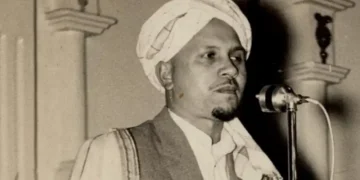
Walter Parry’s life is both a story of exclusion and a call to action. Walter Parry was a brilliant scientist, barred from academia. He became a respected mathematics teacher at Lückhoff High School in Die Vlakte. Coloured families were forcibly removed from this area in central Stellenbosch in the late 1960s.
By ASLAM FATAAR
Denied the opportunity to pursue science under apartheid, his thwarted intellectual journey offers a window into the structural violence that shaped and still echoes through South Africa’s scientific and educational institutions.
Honouring his memory requires commemoration and reckoning with our universities’ historical complicity and the urgent need for a new, ethically grounded vision of science.
Parry’s exclusion was not incidental. It was the logical outcome of a system built on racial separation, legitimised and operationalised through policy, law and, crucially, science itself.
For too long, we have treated science as neutral, objective and value-free. But, in apartheid South Africa, science was not detached from the world. It was mobilised to serve it.
Scientific institutions played a foundational role in giving apartheid its technical language and rational authority. From eugenics-inflected biology to racially coded psychology, from agricultural planning that segregated land to social sciences that underwrote exclusionary policies, science was co-constitutive of the apartheid project. The legacy of this complicity still lingers in curricula, departmental cultures, funding structures and the demographic and epistemic profiles of our disciplines.
You may also want to read



Naming the racial legacy is only the beginning
A true transformation requires that we name this legacy honestly. But naming is only the beginning. We must actively cultivate a socially just ethics of science, a framework that centres historical redress, social accountability, and moral purpose in all aspects of scientific inquiry. This does not imply abandoning science, but rooting it in an understanding of its role in shaping, sustaining and potentially healing, our world.
A philosophy of moral excellence
This ethic must be grounded in what I describe as a philosophy of moral excellence. It is a way of doing science that demands exquisite rigour alongside an unwavering commitment to human dignity.

It recognises that scientific questions do not emerge from nowhere. Context, values and power shape these questions. Excellence is not measured solely by publication metrics or citations, but by science’s capacity to illuminate, connect, and repair. In short, we need science with a soul.
This shift in how we understand science has material and institutional consequences. It should shape what and how we teach, determine how we train researchers, define success, and engage communities, challenge narrow ideas of impact, and reorient our institutions toward meaningful, socially grounded outcomes.
Universities, once key nodes in the apartheid knowledge machine, have a particular responsibility. The path of transformation must be more than symbolic. It must be palpable and concrete. It must be visible in new kinds of curricula, inclusive pedagogical practices, research that is responsive to social need, and structures of genuine community engagement.
This is especially important, given the enduring conceit of modernist objectivist science: it can remain detached, free from social entanglement, untouched by politics or history. This idea has not only proven false; it has been deeply harmful. This posture of neutrality enabled science to operate so comfortably within apartheid, cloaking ideology in the language of ‘neutral’ method.
Rebuild science
The challenge is to replace that pseudo neutrality with conscious responsibility and rebuild science as a profoundly social, ethical and context-aware pursuit.
This does not mean abandoning the rigour or precision of the scientific method. It means applying it more explicitly toward equity, sustainability, and human flourishing.
An ethically conscious science understands its limitations, questions its assumptions, and remains open to different ways of knowing. It is humble, relational, and committed to the broader social fabric within which it operates.
It is also expansive and welcoming, dialogue with disciplines like theology, philosophy, and the arts, not to dilute science but to enrich it. When brought into conversation with science, these disciplines can reawaken the moral imagination and reorient inquiry towards justice.
Together, these disciplines can help shape a world in which scientific excellence and human dignity are not at odds, but aligned.
A seedbed for ethical transformation
This is where the university must step up as a seedbed for ethical transformation. Universities must become places where science is cultivated with conscience, where beauty and excellence walk hand in hand, and where young people are formed, not only as specialists, but as ethical actors in a fragile, unequal world.
This means rethinking the very architecture of higher education, its incentives, hierarchies, and exclusions. It means placing social repair and ethical responsibility at the heart of institutional missions. It also means extending the work of science beyond the lab and the lecture hall into communities, schools, and everyday lives.
Walter Parry’s memory demands this of us, not in abstract terms but in grounded institutional commitments. His memory calls us to build a university that recognises the harms of its past and chooses a different path, not of apology but of repair.
Such a university reimagines science in service of the public good, animated by moral courage and a deep sense of historical accountability. This is not an easy task. It is slow, contested, and often uncomfortable. But it is necessary.
Science must be part of the solution, but only if it learns from its past, recovers its moral centre, and walks toward a more just future. That is how we honour Walter Parry by speaking his name and changing the structures and discourses that once silenced him.
Aslam Fataar is a research professor in higher education transformation in the department of education policy studies at Stellenbosch University (SU), South Africa. This article is based on a panel contribution presented at the Second Annual Walter Parry Honorary Lecture on 22 May hosted by the faculty of theology in collaboration with the Centre for the Advancement of Social Impact and Transformation and the faculty of science, SU.