












![The market-builder who restrained the market [Part 2]](https://muslimviews.co.za/wp-content/uploads/2026/08/PHOTO-2026-08-25-17-16-32-360x180.jpg)
![The merchant preceding the Prophetic mission [Part 1]](https://muslimviews.co.za/wp-content/uploads/2026/08/01-360x180.jpg)








From Olof Palme to Norwegian solidarity campaigns, a travelling exhibition launched at University of the Western Cape earlier this month brings the often overlooked Nordic role in South Africa’s liberation history to the fore.
By SAALIEGAH ZARDAD
On February 28, 1986, a week after standing at a podium in Stockholm alongside ANC President Oliver Tambo and declaring that ‘apartheid cannot be reformed, it has to be abolished’, Swedish Prime Minister Olof Palme walked home from a cinema with his wife, Lisbeth, and was shot dead in the street.
The case was never definitively solved. But it was never without direction, either.
In 1996, Eugene de Kock, the last commander of the apartheid state’s notorious Vlakplaas death squad, gave evidence at the Supreme Court in Pretoria that Palme’s killing formed part of Operation Long Reach, the apartheid regime’s clandestine campaign to eliminate its enemies abroad. The Swedish police closed their 34-year investigation in 2020 without establishing a conclusive South African link.
What is not in question is that the man who bought his wife a rose every Friday had, by the apartheid state’s reckoning, become dangerous through 15 years of political and material support for the ANC.
The bronze figure of Palme, single rose in hand, that stands among the 100 life-size sculptures in the Long March to Freedom Exhibition in Cape Town is, in this light, more than commemorative. It is an acknowledgment that the liberation of SA cost something, in places far from here, that we have not fully embraced.
An exhibition and what it asks
On May 7, 2026, I attended the launch of a travelling exhibition titled: African Independence. Norwegian Solidarity at the University of the Western Cape (UWC). A campus that has long been the intellectual home of the South African left.
The proceedings were opened by Professor Robert Balfour, Vice-Chancellor of UWC, whose introductory address situated the exhibition firmly within the institution’s own history of resistance and anti-apartheid scholarship.
The afternoon brought together scholars, diplomats, students and veterans of the struggle, among them former Ambassador Ruby Marks, who distilled something essential into seven words: ‘Norway acted out of conscience, not charity’.

Norwegian Ambassador Anne Kristiansen posed a question before answering it: ‘Why would Norway, a small country far away from this continent, invest so deeply in Africa’s liberation?’
The Nordic people, she said, know about oppression. The weight of that statement rests on twentieth-century European history and on what it means to have your dignity stripped away by a state that has decided you are less than human.
What Norway’s lived memory produced toward Africa was recognition. And recognition, as Ruby Marks’s formulation implies, is the beginning of conscience.
This is where the Tutu reference, displayed on one of the exhibition’s panels, becomes its most impactful. It reads: ‘Desmond Tutu changed the church of Norway. He changed religious life in Norway from narrow concerns of the morals of the youth to the big issue of apartheid, to the big issues of life. He changed Norway.’ (Tomm Kristiansen, Norwegian journalist)
Tutu did not introduce Norwegians to the concept of injustice. He did not hand them a conscience they lacked. What he did was speak from the authority of a man living inside a theological and human emergency directly to convictions that Norwegian Christians already held.
When South African police massacred 69 unarmed protesters at Sharpeville in March 1960, the images reverberated through Norwegian churches, trade unions, neighbourhoods and newsrooms with force. This was state violence against people demanding basic rights recognisable to a country that had known what the boot of occupation feels like.
When the Nobel Committee awarded its 1960 Peace Prize to Albert Luthuli, he received it at a ceremony in Oslo in December 1961. For Norwegian religious and civic life, Luthuli was a chief, a teacher, a churchman of deep conviction and a conscience.
Oliver Tambo understood this characterisation of solidarity. His first visit to Europe was Denmark, at the invitation of the Prime Minister, in 1960, just weeks after Sharpeville. He addressed meetings in Copenhagen and Aarhus and called on trade unions to back the ANC’s boycott campaigns.
‘The Norwegian Council for Southern Africa played a very important role in opening doors for the representatives of liberation movements…’ O.R. Tambo, OAU/UN World Conference for Support of Victims of Apartheid, Oslo, 1973 (Exhibition Booklet)
This is how Nordic solidarity was built: not as benevolence from a distant north toward a suffering south, but as a meeting between people.
The Nordic countries’ experience of oppression gave them the capacity. SA’s own resistance voices, including Sharpeville’s slain heroes, Luthuli’s Nobel, Tutu’s pulpit and Tambo’s diplomatic mission, gave that capacity its clarity.
However, Nordic solidarity was not cost-free. Conservative critics in Europe and the US accused their governments of legitimising ‘terrorist’ movements during the Cold War. Support for the ANC existed alongside debates of neutrality, Soviet influence and the ethics of assisting liberation movements that had adopted armed struggle.
The fire is not out
Heritage events carry the risk of the past tense, of commemoration becoming closure. What saved the UWC afternoon from that fate was the voice of the SRC President Mcntosh Khasembe.
‘Political freedom was not the end of the struggle; it was the opening of a new chapter. Our generation carries the obligation of deciding what liberation must still mean materially.’ Mcntosh Khasembe – UWC SRC President, May 7, 2026, Norway-Africa Solidarity Exhibition Launch
His remarks reframed the entire evening. The Norwegian solidarity being honoured was not a chapter safely behind us. It was an argument about what conscience looks like.
The unfinished heir of the liberation struggles the Nordic countries supported is the struggle for economic rights, land and material dignity. These are not new questions, but they belong to his generation in a specific and urgent way.
Bronze at ground level
About a year before the UWC launch, I attended the opening of the Long March to Freedom sculpture exhibition at Century City, Cape Town.
Dali Tambo, son of Oliver Tambo and CEO of the National Heritage Project Company, reminded those gathered of Sweden’s role in the liberation struggle.
His project was born from a promise at his father’s grave: there was no statue of Oliver Tambo anywhere in SA. He intended to make one. The voice he heard in reply told him not to do it for one person, but for all.
The result: 100 life-size bronzes placed at ground level so that visitors meet them face to face, spanning 370 years of resistance from Autshumato, the first political prisoner sent to Robben Island, to the democratic breakthrough of 1994.
Among those 100 figures: Olof Palme, carrying his rose.

His inclusion is not incidental. It is a statement about who belongs in this story. Six Norwegians are inscribed in the Wall of Memories at Freedom Park alongside South African freedom fighters and other international allies as testament to their solidarity.
What the dominant narratives leave out
The story of international solidarity with Africa’s liberation struggles has long been shaped by two towering presences: Cuba and the Soviet Union.
Cuba’s contribution was direct and substantial: at its peak up to 55 000 Cuban troops were deployed in Angola alone, fighting alongside the MPLA against both UNITA and South African forces.
The Soviet Union provided the ANC with military training, weapons and logistical support and hosted MK cadres in its military academies. Both relationships have generated enormous commemorative and scholarly attention.
Two solidarities have been sidelined. The first is the Nordic countries. The second is the African Frontline States. Yet even among these under-acknowledged solidarities, the Norwegian role remains unusually absent from South Africa’s heritage landscape.
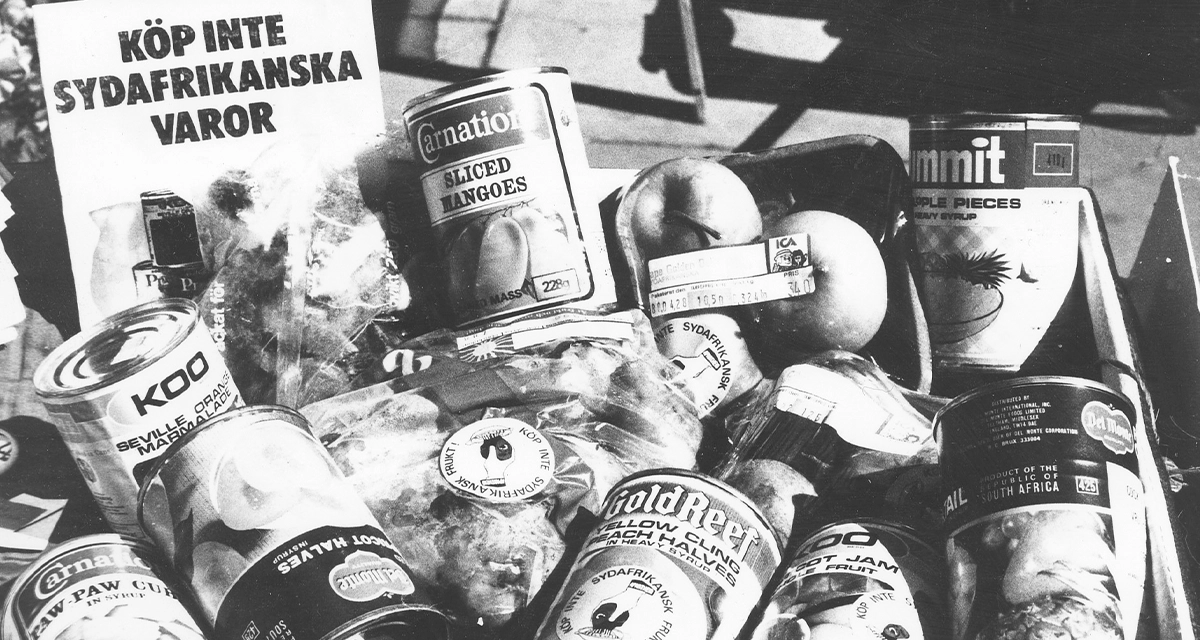

Nordic countries were in the forefront of the boycott apartheid campaign during the seventies and eighties. In Sweden, a supermarket basket with South African goods (top) reaches a till point and a protestor refuses to take the merchandise and walks away. And (below) protestors create awareness in the public space for the boycott of South African fruit. (Photos: Bertil Högberg, via Nordic Africa Institute)
Why the record sits so lightly
Between 1969 and 1994, the Nordic governments collectively provided approximately USD 1.5 billion in humanitarian assistance to Southern Africa, around USD 600 million of it as direct support to liberation movements.
By the Nordic Africa Institute’s assessment, they were almost certainly the single most significant external source of direct support in every sphere except the military.
Sweden provided legal assistance to political prisoners as early as 1965, the first Western country to do so. Norway’s Parliament voted unanimously to endorse official humanitarian support in 1973.
Denmark’s Anti-Apartheid Kommiteen was established in 1962, some of its founding activists veterans of resistance to German occupation during the Second World War. This gives particular texture to Ambassador Kristiansen’s observation.
Finland supported SWAPO from 1974 and the ANC from 1978.
So why does this sit so lightly in public memory?
The literature on Cuban and Soviet involvement is extensive and ideologically animated; Nordic documentation came later and more quietly and has not easily crossed from academic shelves into the space museums, monuments and national consciousness occupy.
Heritage is also always selective. The Nordic countries asked for nothing in return: no ideological debt, no strategic obligation, no commemorative leverage.
Their solidarity was, in Ruby Marks’s formulation, conscience and not charity.
Solidarity as conscience. Not charity
Back at the Long March to Freedom, standing before Palme’s figure with his Friday rose, I find myself thinking about what the curators chose to emphasise.
Not the politics. Not the money. The human gesture.
A man who buys his wife flowers every week is the same man who, a week before his death, declared apartheid unreformable before walking home unguarded through the streets of his own city.
The African Independence. Norwegian Solidarity exhibition and the Long March to Freedom are doing something that the dominant historical narrative has not adequately done.
They are insisting on the fullness of the story that the liberation of SA was not achieved by South Africans alone, that the international dimension was wider and more varied than any single narrative holds and that among those who stood with this continent were people whose own memory of suffering gave them not charity, but conscience.
You may also want to read


The Nordic countries are part of that story. So are the Frontline States. So, in ways this article has only begun to sketch, is a broader international coalition whose solidarities have been quietly eclipsed.
Khasembe’s fire, and the generation he speaks for, is the proof that reclaiming these histories is not an academic exercise. It is the work of understanding what freedom actually cost and what it still requires.
At the Long March to Freedom, Palme stands at ground level holding a single rose. Among South African liberation figures, the sculpture quietly insists that solidarity, too, has a heritage.
Not charity. Conscience.
SAALIEGAH ZARDAD is a researcher and writer whose work focuses on heritage, cultural landscapes and post-apartheid spatial justice.