


![Does ta’wīl mean interpretation or fulfilment? A Quranic reassessment [+video]](https://muslimviews.co.za/wp-content/uploads/2026/10/Tawil-Kaskas-360x180.webp)








![Why becoming a wealthy Muslim is commendable in Islam [+videos]](https://muslimviews.co.za/wp-content/uploads/2026/09/Muslim-Trade-Business-1-360x180.webp)



The march of September 27 will be remembered not just for its sheer numbers, but for the clarity and urgency of its demands.
By SHAKIR ACHMAT
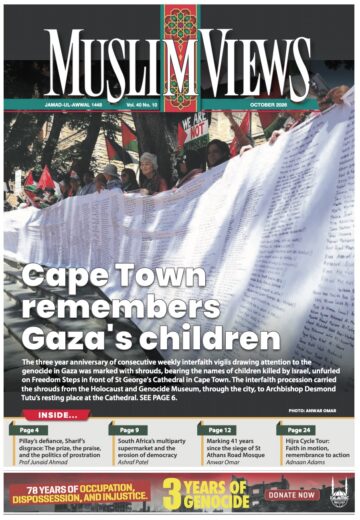
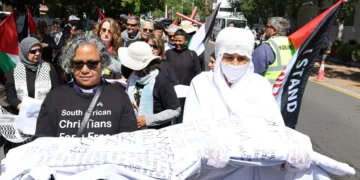
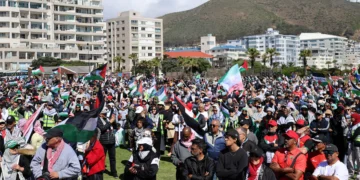
On Saturday, September 27, 2025, Cape Town’s streets became a river of humanity as thousands took part in a march for Palestine. The march to Parliament carried a unified message: South Africa will not stand by in silence while genocide unfolds in Gaza.
According the Al-Quds Foundation, between 200 000 and 250 000 people took part in the march.

The opening remarks were delivered by Shaykh Riad Fataar, President of the Muslim Judicial Council (MJC), who set the tone for the day’s proceedings.
‘We gather here not only as South Africans, not only as Muslims, not only as Christians, or people of faith. We gather here in unity of conscience. We are compelled by justice, and we are driven here today by the cries of the oppressed in Gaza,” he declared.
Shaykh Fataar reminded the crowd that South Africa’s own struggle against apartheid was won through unity, struggle, and sacrifice. Drawing parallels with Palestine, he asserted, ‘We, South Africa, brought apartheid to its knees, and we will bring Zionist Israel to its knees.’
He stressed that the gathering was not one of ‘empty slogans’ but one backed by a detailed memorandum of demands directed at Parliament, calling for urgent and decisive action.

Professor Usuf Chikte, spokesperson for the Palestine Solidarity Campaign (PSC), expanded on the demands of the movement. He praised South Africa for taking Israel to the International Court of Justice (ICJ) but emphasised that words must now be followed by legislation.
He demanded that Parliament should enact the Apartheid Complicity Bill which was drafted by the Al Jama-ah Party. The draft bill declares Israel an Apartheid state and calls for the prosecution of South Africans supporting the Zionist regime.
Chikte further called for comprehensive boycotts across various fronts – academic, cultural, and especially sporting.
‘We want to kick Israel out of FIFA. We want to stop Zionists from travelling there and joining the genocidal war in Israel. The NPA must prosecute them and incarcerate them.’
He further urged action against corporations like Glencore and Amazon, which he accused of complicity in Israel’s crimes. ‘This march should not be the only action,’ he declared. ‘Every day we must ensure that this is the action we are going to take.’
Moulana Khaliq Allie, President of the United Ulama Council of South Africa (UUCSA), echoed calls for global reform and justice, saluting Colombia’s President for his bold stance at the United Nations. He reiterated that resistance against occupation is legitimate and necessary.
‘There can only be a one-state solution where Jews, Christians, and Muslims live together in peace and harmony,’ he said, while denouncing US complicity through its repeated use of veto powers at the UN Security Council.
Sheikh Ebrahim Gabriels, Director of the Al-Quds Foundation South Africa, expressed his gratitude following the march, highlighting its historic significance.
‘To our esteemed stakeholders and partners, it is with immense gratitude to Almighty Allah that we reflect on the protest march in Cape Town on Saturday, September 27, 2025. By every measure it was a resounding success. Calculations estimate that between 200 000 and 250 000 people took to the streets.
‘We stood as one for Gaza. Cape Town stood as one, united by our common humanity across faiths, across race, and across political affiliations. We came together to declare unequivocally “no to genocide”.
‘On behalf of the Al-Quds Foundation South Africa, I extend a heartfelt appreciation to all who made this day possible: our partner organizations, political formations, civil society groups, members of the media, and communities of faith. We are deeply grateful to the masjid and churches, to the madrasas and sport clubs, and above all to the countless ordinary South Africans whose presence and voices gave this march its true strength.”
Religious leaders from other faiths also took to the stage.
Reverend Edwin Arrison, representing Archbishop Thabo Makgoba of the Anglican Church of Southern Africa, read a message linking Palestine’s struggle with South Africa’s local challenges.
Archbishop Makgoba’s letter declared: ‘It seems as if Israel will not stop until there are no more Palestinians in Palestine. Today we declare here from South Africa: this will not happen. Palestine will be free.’
He called this a Kairos moment, a decisive time in history when humanity must act. The letter also urged South Africans to link the Palestinian struggle with the fight against crime, drugs, and despair in local communities.
‘Our young people need hope, and we can provide them with that hope,” it read, underscoring that ‘we will not be free until Palestine is free.’
Renowned cleric and activist Reverend Allan Boesak gave an impassioned speech addressing scepticism about the effectiveness of repeated marches.
‘We march because we cannot look away. We march because where there is pain, we show up. Where there is suffering, we show up,’ he said.
He condemned those who deny or downplay the genocide, declaring, ‘There is something wrong in the spirit of a person that cannot see a genocide.’
Boesak’s challenge was directed both at government and the people: ‘The Israeli embassy is still here. South Africans leave for Israel to join the IDF and return with blood on their hands. Nothing happens to them. So yes, we must ask what is wrong with the government, but we must also ask, what is wrong with us?’
His words ignited chants of ‘Freedom, freedom, freedom!’ across the crowd.
From the Jewish community, Julia Hope of South African Jews for a Free Palestine (SAJFP) reminded the crowd that the struggle is not about religion, but about justice.
‘This is an issue against colonial dispossession, extraction, and oppression,’ she said, noting that she wore a flag from the Democratic Republic of Congo in solidarity with all people facing genocide and exploitation. ‘If we are not yet standing in solidarity and uniting all of these struggles, then our support for Palestine rings hollow,’ she stressed.
Representing the Khoisan people, Member of Parliament Wesley Douglas connected the struggles of Palestinians with South Africa’s own history of dispossession and genocide against its first peoples. He reminded the crowd that indigenous solidarity is not symbolic but rooted in a shared lived experience of displacement and cultural erasure.
The most harrowing testimony came from Palestinian survivor Malak Mohammed, who recounted losing 125 members of her family.
‘I was starving and being bombed, and I asked myself, where is the world? Where is the world?” she said.
She recalled walking for hours with her hands raised to avoid being shot; even her three-year-old child forced to keep her hands up. She described witnessing an elderly man being killed simply because he had a beard and wore traditional clothing.
‘They left him bleeding for two days. He was executed before our eyes.’
Mohammed expressed her gratitude to Gift of the Givers, who facilitated her travel to South Africa, allowing her to share her story firsthand.
Throughout the day, the message was consistent: solidarity with Palestine must be more than symbolic.


The memorandum was handed to the House Chairperson, Cedric Frolick.
The document laid out urgent demands for government action, including the immediate passage of the Apartheid Complicity Bill, termination of diplomatic and economic ties with Israel, prosecution of complicit corporations, and the outlawing of Zionism as a form of racial supremacy equivalent to apartheid.
Upon accepting the memorandum Frolick reminded marchers of the words of Nelson Mandela in 1997: ‘Our freedom will not be complete without the freedom of the Palestinian people.’
You may also want to read


He assured the crowd, ‘I undertake to get this memorandum to the desk of the Speaker to ensure that it is processed and responded to within 14 days. As Parliament we subscribe to international law, and we reject the selective application of international law. We are well aware of the recently tabled report by the United Nations that indeed confirmed that genocide has been committed in Israel.’
His statement was met with loud applause and cheers from the marchers.
The march of September 27, 2025, will be remembered not just for its sheer numbers, but for the clarity and urgency of its demands. South Africans across race, faith, and political lines stood together, affirming that the struggle for Palestine is inseparable from the struggle for global justice.