






![Does ta’wīl mean interpretation or fulfilment? A Quranic reassessment [+video]](https://muslimviews.co.za/wp-content/uploads/2026/10/Tawil-Kaskas-360x180.webp)




















![Why becoming a wealthy Muslim is commendable in Islam [+videos]](https://muslimviews.co.za/wp-content/uploads/2026/09/Muslim-Trade-Business-1-360x180.webp)










MAHMOOD SANGLAY
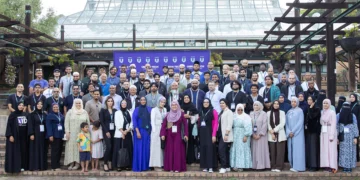
On Saturday, 10 January 2026, scholars, military leaders, educators and invited guests gathered in Islamabad, Pakistan, for the launch of the book The Divine Connection: A Strategic Pathway to Islamic Leadership, published by the Ali Akbar Khan Foundation (AAKF).
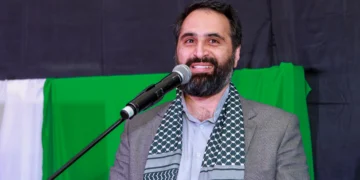
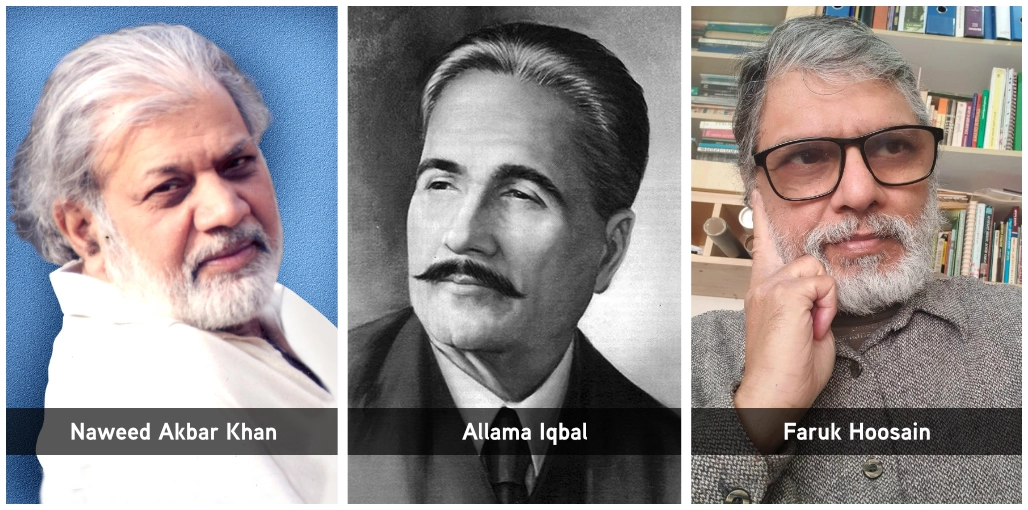
The event marked a significant moment of reflection on Islamic leadership, civilisational renewal and the moral responsibilities of Muslim intellectual life. Among the invited guests was Faruk Hoosain, a South African academic, educationist, researcher and editor. Hoosain was keynote contributor, offering an independent scholarly perspective on the book and situating its ideas within a broader global conversation on the decolonisation of the Muslim mind.
The author, retired Brigadier Naweed Akbar Khan, introduced the motivations behind The Divine Connection, a work that seeks to explore how Islamic leadership must integrate education, spirituality, ethics and responsibility. The programme culminated in Faruk Hoosain’s extended address, followed by a moderated question-and-answer session.
While the launch was formally a literary event, it functioned more broadly as a forum on Muslim leadership in the 21st century, drawing together religious reflection, historical consciousness and contemporary critique. Hoosain’s contribution was framed under the theme ‘The Decoloniality of the Muslim Mind: Reclaiming the Qur’anic Future’. His address did not merely review the book but engaged its core concerns from a wider epistemic and ethical perspective. Drawing on Qur’anic principles and the intellectual legacy of Allama Iqbal, Hoosain argued that many of the crises facing Muslim societies today—political fragmentation, moral confusion and leadership failures—cannot be understood solely in external or material terms.
Instead, he proposed that a deeper problem lies in the coloniality of the mind: a lingering inheritance of colonial power that continues to shape how Muslims think, imagine authority, and relate faith to public life. This coloniality, he argued, is not limited to political domination but manifests in distorted knowledge systems, uncritical imitation, and the separation of religion from ethics and justice.
Decolonisation as a Qur’anic imperative
Central to Hoosain’s analysis was the assertion that decolonising the Muslim mind is not optional, nor merely an academic exercise. It is, he argued, a Tawhidic and civilisational imperative rooted in the Qur’an itself. The Qur’an repeatedly calls believers to think, reflect, reason and act with moral responsibility—qualities that are undermined when faith is reduced to ritual without ethical substance or when knowledge is borrowed uncritically from dominant paradigms.
You may also want to read




Hoosain stressed that Tawhid—the oneness of Allah—must be understood not only as belief, but as a worldview that liberates human beings from all false authorities, whether political, ideological or cultural. When Tawhid is internalised, it restores moral agency and reconnects spirituality with justice, leadership and social responsibility.
Allama Iqbal and moral agency
Drawing on Allama Iqbal, Hoosain described decolonisation as a process of reviving the self—a self grounded in God-consciousness, courage and ethical responsibility. Iqbal, he noted, rejected both passive mysticism detached from social justice and activism divorced from spiritual grounding. Instead, Iqbal called for an integrated Muslim personality: intellectually confident, spiritually anchored and socially engaged.
In this framework, Muslims are not passive subjects of history but khalifahs—stewards entrusted with responsibility towards humanity and creation. Such stewardship demands ethical leadership, critical thought and resistance to oppression (zulm) without reproducing injustice in new forms.
Hoosain’s presentation resonated with the broader aims of The Divine Connection by situating leadership within a moral and civilisational horizon, rather than narrow technocratic or political models. He warned that without reclaiming intellectual sovereignty and ethical clarity, Muslim societies risk continued fragmentation, loss of dignity and the erosion of prophetic values in public life.
Societal transformation, Hoosain argued, cannot occur without inner renewal—of thought, conscience and intention. In this sense, decolonising the Muslim mind is not a rejection of the modern world, but an effort to re-centre Allah, justice and responsibility within it.
The Islamabad book launch was also a moment of collective reflection on leadership, knowledge and faith at a time of profound global uncertainty. Hoosain’s intervention, grounded in Qur’anic ethics and critical thought, underscored the urgency of reconnecting Islamic belief with lived justice and moral courage—an issue that resonates beyond the borders of Pakistan.