




















![The market-builder who restrained the market [Part 2]](https://muslimviews.co.za/wp-content/uploads/2026/08/PHOTO-2026-08-25-17-16-32-360x180.jpg)
![The merchant preceding the Prophetic mission [Part 1]](https://muslimviews.co.za/wp-content/uploads/2026/08/01-360x180.jpg)






This critical reflection on three recent khutbahs explores sectarianism, anti-intellectualism and the moral responsibility of Muslim leadership in shaping ethical public discourse.
By ADNAAN ADAMS
Introduction: The khutbah as a pedagogical site
In reflecting on The Muslim Thinker’s Inaugural Lecture and the responses that followed, particularly the concern that an anti-intellectual condition has quietly taken root in our communities, we were compelled to ask where Muslim public pedagogy most consistently and authoritatively occurs. The answer is both obvious and under-examined: the Friday khutbah remains the most regular, influential and far-reaching educational platform in Muslim communal life. If the intellectual quality of Muslim discourse is to be renewed, then the khutbah cannot remain beyond scrutiny. It must be engaged, analysed and interrogated seriously, week after week.
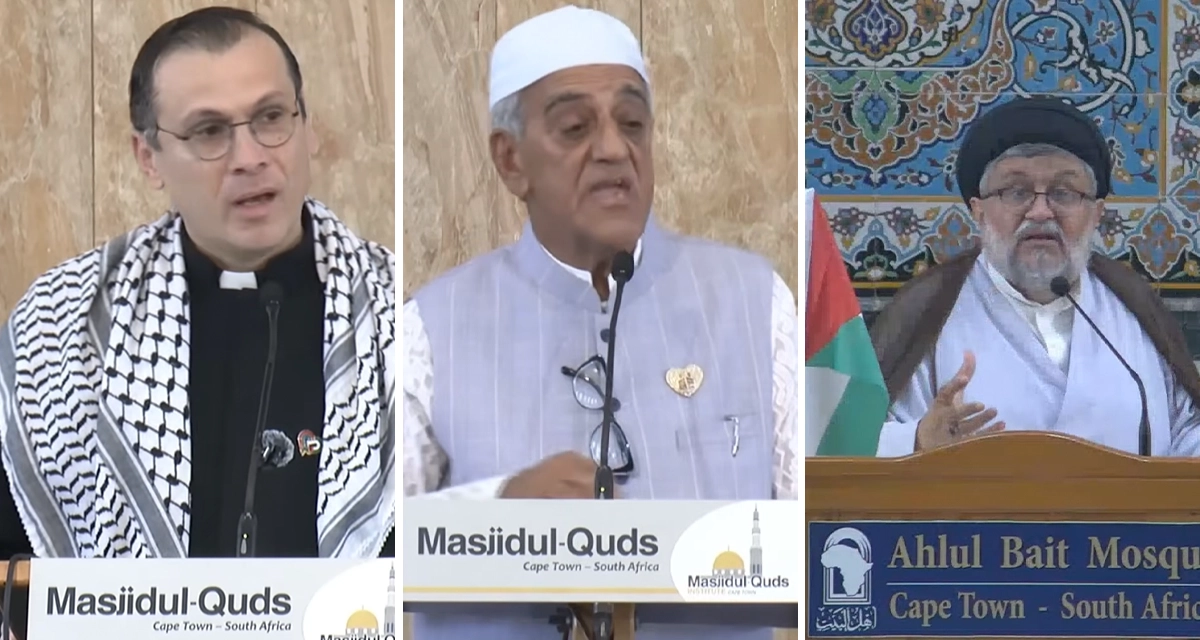
It is for this reason that The Muslim Thinker has begun engaging and examining three selected khutbahs as intellectual entry points into the wider condition of Muslim thought. Among these, the khutbah delivered at the Ahlul Bait Mosque, titled ‘Sectarian Hatred in the Modern Era’, proved especially catalytic. It raised with unusual clarity the tension between belief and reason and exposed how sectarian logic can hollow out moral judgement even when religious language remains intact.
This inquiry is sharpened further when read alongside two additional khutbah moments. The first was the delivery of a Jumuʿah address by Rev Dr Munther Isaac, a Palestinian Christian theologian, whose presence challenged narrow assumptions about moral authority and solidarity. The second was a khutbah entitled ‘When Human Beings Were Bereft of Humanity’, which introduced a striking disclaimer midway through its presentation: the speaker explicitly affirmed his Sunni identity before praising moral courage elsewhere, while noting that Zohran Mamdani is Shia and observing how quickly ethical clarity is eclipsed by sectarian exclusion.
Taken together, these khutbahs form a compelling trio through which to examine a deeper question: what kind of thinking is being cultivated from our mimbar, and what kind is being quietly abandoned?
Anti-intellectualism as a moral failure
The contemporary crisis of Muslim public discourse is not best understood as a crisis of belief, but as a crisis of thinking. This central claim, foregrounded in the inaugural lecture and echoed by scholars and public intellectuals, identifies anti-intellectualism not as a lack of religious knowledge, but as a refusal to engage in ethical reasoning, deliberation and even self-critique. Faith, in such contexts, is protected from questioning rather than deepened by it.
Nowhere is this refusal more visible than in the khutbah. When khutbahs reduce faith to repetition, certainty and inherited positions, the issue is not theological weakness alone but the erosion of reflective thinking. The Qur’an repeatedly calls believers to tafakkur (reflection), taʿaqqul (reason) and tadabbur (deep contemplation). A khutbah culture that discourages complexity or moral questioning therefore stands in systematic tension with the Qur’anic intellectual ethic itself.
Sectarianism as an anti-intellectual condition
The Ahlul Bait khutbah was especially significant because it refused to treat sectarianism as a mere theological disagreement. Instead, it named sectarianism as a disease of thought, one that turns difference into identity, identity into exclusion and exclusion into moral blindness. Sectarianism becomes anti-intellectual when it forecloses questioning, silences alternative voices and reduces faith to inherited positions that must be defended rather than examined.
The problem is not difference. The problem arises when belief becomes immune to interrogation. At that point, faith loses moral depth and becomes ethically fragile.
Condemnation without responsibility
This fragility reveals itself most clearly in what might be called condemnation without responsibility. Acts of violence are publicly denounced, yet the ideas, narratives and everyday practices of ridicule, suspicion and exclusion that make such violence plausible remain untouched. In such contexts, silence is not neutrality. It becomes complicity, allowing the intellectual conditions that sustain sectarian hatred and eventually extremism to persist.
Muslim leadership today requires moral courage in the public sphere, not merely ritual authority or rhetorical unity. To condemn violence while tolerating dehumanising language or casual takfīr is to engage in moral inconsistency. It signals a failure of educative thinking – thinking that does not merely transmit beliefs, but forms ethical judgement.
The sectarian disclaimer and the politics of exclusion
One of the most revealing moments midway through the second khutbah, ‘When Human Beings Were Bereft of Humanity’, was the speaker’s explicit disclaimer: ‘I was born Sunni, I live as a Sunni, and I will die as a Sunni.’ On the surface, this declaration may appear unnecessary. Yet its very necessity is revealing. It signals the extent to which sectarian consciousness has become so pervasive that even those who are not advancing sectarian claims feel compelled to pre-empt suspicion by publicly locating themselves within an accepted identity.
In a healthy intellectual culture, ethical clarity would not require such sectarian certification. Ideas and moral positions would be evaluated on their substance, not filtered through identity labels. The disclaimer therefore exposes how deeply sectarian logic has colonised Muslim public discourse. Before arguments are heard, identities are demanded; before ethical claims are assessed, affiliations are scrutinised. The pressure to declare ‘where one stands’ seemingly becomes a condition for being heard at all.
This dynamic becomes especially clear in an example the speaker himself raised: the political rise of Zohran Mamdani, the first Muslim elected mayor of New York. The speaker’s purpose was not to emphasise Mamdani’s sectarian identity, but to expose how others had done so. Mamdani’s moral courage – his willingness to name war crimes, oppose injustice and challenge powerful interests – was, for some Muslims, reduced to a single and overriding concern: that he is Shia. The khutbah names this reduction as a moral failure on the part of those who make it, not of the speaker who draws attention to it.
The issue at stake is not theological difference, nor an effort to relativise belief, but a breakdown in moral judgement within the community. When sectarian identity is perceived as a greater threat than injustice itself, ethical reasoning gives way to habits of exclusion. Put differently, when identity takes precedence over justice, moral credibility is weakened. The khutbah’s significance lies in its willingness to expose this misalignment and to insist that ethical clarity must not be sacrificed to sectarian responses.
When walls begin to speak
Read alongside the three khutbahs discussed, material expressions of sectarian boundary-making within mosque spaces underscore what is at stake. In some masājid, theological positions are no longer communicated primarily through ethical reasoning or pedagogy, but through fixed notices, categorical prohibitions and exclusionary signage. When belief is translated into unexamined policy, reasoning gives way to regulation and moral deliberation is replaced by enforcement.
Such practices exemplify how sectarianism becomes anti-intellectual in form as well as content. They close down questioning, normalise suspicion and condition communities towards compliance rather than reflection. Where khutbahs resist anti-intellectualism, they reopen space for moral reasoning, ethical courage and human recognition. Where they do not, walls and notices begin to speak in their place. The question, then, is not only what is said from the mimbar, but what kind of thinking it authorises or abandons within the life of the community.
You may also want to read





Crossing boundaries and re-imagining Ummah
The presence of Rev Dr Munther Isaac at a Jumuʿah gathering deepens this dilemma. His address did not weaken Islamic identity; it affirmed a shared moral horizon grounded in justice, human dignity and resistance to oppression, showing that moral clarity can transcend communal boundaries without erasing difference.
This raises an unavoidable question: if a Christian voice can be welcomed to speak to Muslim suffering and ethical responsibility, do we possess the same moral courage to extend similar openness within Islam itself? What would it mean to create space for a Shia cleric, not to debate doctrine, but to reason together about justice, humanity and the condition of the Ummah?
These are not symbolic gestures. They strike at the heart of what Ummah means. In Qur’anic terms, Ummah is not a homogenous collective bound by sameness, but a moral community bound by justice, mutual recognition and responsibility. Sectarian anti-intellectualism reduces Ummah to a rhetorical symbol, invoked selectively and emptied of ethical substance. This is especially damaging for minority Muslim communities, where internal fragmentation erodes both cohesion and public credibility.
Reclaiming the khutbah as an intellectual space
Taken together, the three khutbahs considered here reveal both the depth of the challenge and the possibility of renewal. They show that the crisis confronting Muslim public life is not one of faith, but of thinking – of whether belief is allowed to mature through ethical reasoning or is protected from scrutiny through sectarian closure. The khutbah can either reinforce the boundaries of exclusion or reopen the space for ethical reflection.
Yet the call to stand with the oppressed also invites inward reflection. The Qur’an reminds us that human dignity (karāmah) is not conditional, and that difference exists for taʿāruf, mutual recognition rather than exclusion. Marginalisation and silencing can occur within the Ummah itself when solidarity is extended selectively, welcomed when it is easy and withheld when it is demanding.
This raises a necessary question for our communities: are we prepared to recognise the full humanity and moral agency of those among us who differ from us? Or do we limit inclusion to symbolic gestures, valuing voices for recitation or ritual only, while hesitating to engage their thinking, critique and lived experience?
A pedagogy of risk, as the Qur’an envisions it, calls believers to shahādah, ethical witnessing grounded in ʿadl (justice), even when such witnessing unsettles comfort. It asks us not only to speak differently from the mimbar, but to listen differently as a community – to think across difference, to move beyond inherited suspicions and to allow moral growth to begin where certainty ends. If the khutbah is to remain a living institution rather than a ritual formality, it must be sustained by a thinking community that engages, reflects and responds. The future integrity of the Ummah depends on this shared intellectual and ethical responsibility.
To listen to the khutbahs, find the links below:
Jumuʿah: Sectarian hatred in the modern era | Syed Aftab Haider | February 13, 2026
Rev Dr Munther Isaac – Palestinian Christians in the shadow of Christian Zionism
Hajie A Sataar Parker – When human beings were bereft of humanity
Adnaan Adams is the Founder and Director The Muslim Thinker. He can be reached via email: info@themuslimthinker.org or WhatsApp: 083 687 0559.