





















![The market-builder who restrained the market [Part 2]](https://muslimviews.co.za/wp-content/uploads/2026/08/PHOTO-2026-08-25-17-16-32-360x180.jpg)
![The merchant preceding the Prophetic mission [Part 1]](https://muslimviews.co.za/wp-content/uploads/2026/08/01-360x180.jpg)



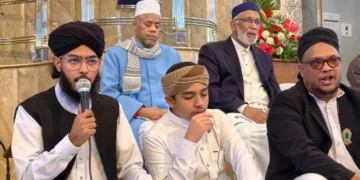





Let us remember that the Prophets of the Quran came to establish a just social order and to guide the inner life of humankind towards justice. Prophets were sent to sanctify our everyday lives.
By REDERWAAN CRAAYENSTEIN
It is fortunate that we are in the time of Milad al-Nabi. The Muslim community in South Africa is among the best places to be a Muslim, almost anywhere in the world. The big days and nights are unlike any other.
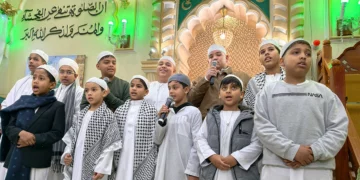
When it comes to Milad-un-Nabi, we have all the usual arguments that are never fully settled. Those of us who celebrate Moulood are perhaps a bit conservative. The Prophet ﷺ does say that his birthday should be remembered every week (https://sunnah.com/abudawud:2426). We just add the rampies, incense, flowers, dressing up, the harmony and melody are beautiful.
As we celebrate Milad-un-Nabi, let us remember that the Prophets of the Quran came to establish a just social order and to guide the inner life of humankind towards justice. Prophets were sent to sanctify our everyday lives.
Man is a being endowed with a covenant and moral responsibility. We live with an accountability to the horizon of al-Akhirah. We are in the world but not for or of the world. This underpins our duty to create a just social order. The core purpose of the Prophets’ mission is to establish social justice and gradually cultivate the souls of human beings as they journey from Him to Him (azza wa jall). Social justice work (al-qist) involves challenging powerful elites — al-mala’, al-mutrafun, al-mustakbirun — and advocating on behalf of those marginalised by society, and those under the influence of power, such as al-mustadafun, al-fuqara, al-masakin, al-ardhalun and ibn asl-sabil. These are Qur’anic terms that should be part of our everyday language.
The other task is soulcraft, the gradual cultivation of the inner self so that we desire differently — striving to be fair and just (al-adl) — and to shift from self-interest to justice for all, regardless of differences. Prophethood is an interaction between al-qist and al-adl.
You may also want to read


Ethical responsibility stems from ‘No power except Allah’ (https://quran.com/28/70) and the belief that Muslims are in a covenant with Allah (https://quran.com/7/172). What does this suggest when Muslims lack political power? I reflect on the participation of Prophet Muhammad ﷺ in Hilf al-Fudul. That responsibility then evolved over the 23 years of Prophethood. What does it signify for Muslims living in countries where they can influence whether the system is just or unjust? Does responsibility arise from ability or simply from being human?
From Surah Al-Hadid (57:5), we have a duty to promote social justice (al-qist). There is a subtle distinction between adl and qist. Adl primarily involves acting fairly and behaving justly, while qist emphasises establishing social justice itself. Whether it is adl or qist, both are regarded as sacred and sanctified acts. We invoke Allah, which indicates that Allah has an interest in our personal attitude towards adl and our social commitment and activism towards qist.
‘Enjoining what is right and forbidding what is wrong‘ function within the same moral conceptual space as adl and qist. Adl for the self and al-qist for the social requires having a well-developed sense of right and wrong. How does one use the dogma that frames right and wrong without becoming dogmatic? To be a Muslim is to stand for something, to interfere on behalf of those who are on the margins of society and on the receiving end of power.
This is an example of a reading strategy rooted in the Quran and the Muslim intellectual tradition, which then extends to our own context, forming a theoretical stance that welcomes correction from others (see: https://quran.com/31/27; https://quran.com/18/109).
When it comes to the words of Allah, we can only hold provisional thoughts. The only Final Word and understanding belong with Allah. Even our most passionately held commitments are but approximations subject to revision. Every word must be read with full consideration of the word itself, where else it has been used in the Quran so that each usage resonates with others.
Surah Al-Hujurat, verse 13, begins with an address to al-Nas, stating that al-Nas is a mixture of clay and Spirit (https://quran.com/15/28; https://quran.com/15/29); Allah has created al-Nas by Himself (https://quran.com/38/75 https://sunnah.com/bukhari:6227 https://sunnah.com/muslim:2841 in His own image. Nothing is like Him https://quran.com/18/109; https://quran.com/112/. In this context, ‘image’ (according to the Muslim Intellectual Tradition) is understood as ‘His names’ (https://quran.com/17/110; https://quran.com/20/8; https://quran.com/59/24). The significant words are ‘We created,’ indicating that al-Nas is created by Him, the Creator. He is Wajib al-Wujud, the Necessary Being. Al-Nas are contingent beings, and for Him non-Existence is impossible. For humans/ al-Nas, both existence and non-existence are possible. We remember that He brings man from non-existence into existence as al-Rahman, as an act of Mercy. Then He guides man with al-Rahim through Prophets and revelation.
As we continue this ayah, we see numerous differences which open windows for the opportunistic whisperings (waswasa) of Iblis and stay aware of how difference can be weaponised https://quran.com/38/76; https://quran.com/7/12. Differences are signs (‘ayat’) of Allah https://quran.com/30/22 . Gender, nationalism, and tribalism are just a few of the causes of injustice in the world. Ta’arafu, as the ayah states, is about knowing the Other. The Self, or oneself, always seeks to understand the Other, but when one tries to see the Other not as an equal despite differences, but instead aims to domesticate or control the Other – for personal gain without the Other’s input – colonialism, imperialism, and subjugation are involved. This ayah can serve as a platform for decolonial, postcolonial, neocolonial, and imperialist discourses. Every ayah can be read this way. Each examination of the Other reveals the assumptions and presuppositions of the Self. This is the necessary hard work.
The most honoured is the most pious (https://quran.com/5/8). Read the ayah closely and slowly. It links Iman, taking a stand not as if, but in the presence of Allah. Something is happening that poses a question to you and me, and Allah is watching how we understand the situation and whether we are actually going to take a stand or shame ourselves in His Presence. We cannot walk to the other side of the road as if nothing happened. We have witnessed what is happening, and our response must be al-qist – social justice. Given its social nature, al-qist is an ongoing witness that we have to carry out within communities and movements. That suggests that we must have structures to defend the good and the right. The ayah continues by presupposing that we are not indifferent. We actually care and are moved by the injustice that requires us to take a stand for justice. Our anger at injustice should not make us hate the unjust so much that we lose track of their humanity. We hate the injustice and leave room for the unjust to make amends. We must embody and instil the justice that we advocate and defend.
As firmly as we stand for justice, we cannot harbour hatred because of al-takhalluq bi akhlaq Allah as espoused by Imam al-Ghazali. Our justice must always be wrapped in mercy and compassion (https://quran.com/7/156). Be just, for it is closest to taqwa. Therefore, the most just among you is also the most pious and the most honoured. We cannot separate our duty to be just from our responsibility to establish a fair social order. This ayah is simple, but it takes a lifetime to truly understand it. We cannot achieve this alone; we need help (https://quran.com/29/69). The starting point and signs along the journey are found here. The pursuit of justice can only be rooted in love, and the reward for love is Love.
Qawlan sadidan (https://quran.com/4/9) is a speech that is plain, on target, with words that are not minced; speaking truth in the face of a tyrant (https://sunnah.com/riyadussalihin:194) suggests that we should be engaged citizens who are critical of power. Where there is injustice, Muslims must break the veil of silence.
Talking about a Prophet of the Quran is to refer to someone involved in society and speaks truth to power. In classical Greek society, Athenian democracy was built on two responsibilities, namely, isegoria and parrhesia. Isegoria is the right and duty to participate in matters affecting the public. Parrhesia is the obligation to speak truth to authority. This indicates that democratic citizenship requires people committed to honesty. They question assumptions and presuppositions. They do not accept things without scrutiny. This echoes the Socratic saying that the unexamined life is not worth living. To be human is to care about oneself and others. For a human, indifference is a tragedy. An examined life, Malcolm X would say, is challenging. However, that is not unfamiliar to a Muslim, for Allah states that man has been created to endure hardship (laqad khalqna al-insana fi kabad).
Muslims, as followers of the Prophets of the Quran, must challenge concentrations of power. Today, it is the state and business that wield power. Our commitment to cover not truth with falsehood indicates that we need to challenge misrepresentation of issues, fake news, and the mis-framing of topics. This means we must oppose those who control the media, whether it’s legacy mainstream mass media or the increasingly concentrated ownership of online digital media platforms.
Prophets of the Quran do not consider odds. They are not prudent weighing the ifs and buts. They speak truth to power even at their own expense.
In classical Greece, the gods cared about major issues and prominent figures. Small matters and ordinary people were irrelevant to the gods. The God of the Quran and Jerusalem cares about widows, orphans, the poor, the needy, and the homeless. Injustice to these is injustice to God. What you do to these, you do to Me (hadith). Prophets were concerned with the lives of real people; not justice and qist in the abstract. The widows, orphans, needy and homeless people are signposts along the path of Allah (https://sunnah.com/bukhari:5353; https://sunnah.com/nasai:2577). Prophets faced trouble because they did not merely tackle the symptoms of the problems. They identified the causes and challenged power.
Muslims, as citizens, have a duty to be critical and speak truth to power. In the neoliberal, global financial capitalist society, our political, economic, and social institutions are shaped to serve elite interests and marginalise the rights of the poor. These institutions must be considered illegitimate unless they prove otherwise.
Much of what I have said so far reflects on Quran 57:25. Al-qist has a dialogical relationship with al-adl. The social and the personal go hand in hand. Prophets came to establish social justice (al-qist), but they also aimed to shape the inner life of individuals. (2:251; 3:164; 62:2) Without this gradual process of transforming people’s internal makeup, social change cannot occur. This is a very challenging process of exemplifying, teaching, and learning. There are no guarantees that people will necessarily desire different things. There is no certainty that even after prolonged periods of slow teaching and learning, people will shift from self-interest to justice for all.