
































![The market-builder who restrained the market [Part 2]](https://muslimviews.co.za/wp-content/uploads/2026/08/PHOTO-2026-08-25-17-16-32-360x180.jpg)
![The merchant preceding the Prophetic mission [Part 1]](https://muslimviews.co.za/wp-content/uploads/2026/08/01-360x180.jpg)









MOGAMAT ALI SALIE
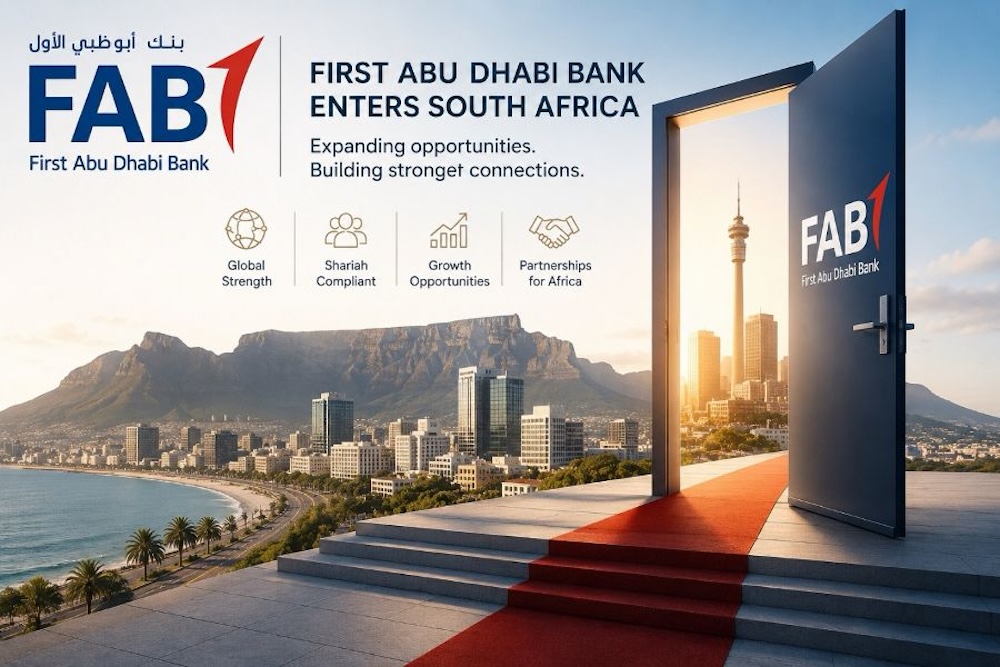
First Abu Dhabi Bank’s legal victory in South Africa is about far more than trademarks. It could pave the way for one of the world’s largest Islamic banking institutions to enter Africa’s most sophisticated financial market, opening new opportunities for ethical finance, investment and regional economic integration.
The recent legal victory of First Abu Dhabi Bank (FAB) in South Africa has attracted considerable attention across the banking and financial services industry. While headlines naturally focused on the court proceedings involving FirstRand, the broader significance extends well beyond a trademark dispute. It represents the potential arrival of one of the world’s largest financial institutions in one of Africa’s most sophisticated banking markets.
For South Africa’s growing Muslim community, as well as the wider African Islamic finance ecosystem, this development could mark the beginning of an important new chapter.
It is important to understand that the case was never about the quality or capability of either banking institution. Rather, it centred on trademark law and whether First Abu Dhabi Bank had demonstrated a genuine intention to use its registered trademarks in South Africa. The Supreme Court of Appeal ultimately found that FAB had established a bona fide intention to enter the South African market and pursue the necessary regulatory approvals, allowing its trademark registrations to proceed.
The judgment also recognised that obtaining trademark protection before applying for a banking licence is a commercially sensible approach for an international financial institution.
With that legal hurdle now behind it, FAB has publicly indicated that it intends applying for a South African banking licence, subject to the country’s regulatory requirements. If approved, this would introduce one of the Middle East’s most significant banking groups into Africa’s largest and most diversified financial market.
A banking giant with global reach
Many South Africans may not yet appreciate the scale of First Abu Dhabi Bank.
Headquartered in Abu Dhabi, the bank manages more than US$400 billion in assets, making it the largest bank in the United Arab Emirates and one of the largest financial institutions in the Middle East. Its international footprint spans five continents, serving governments, multinational corporations, institutional investors, family offices, private banking clients and retail customers.
Its expertise extends across corporate banking, trade finance, treasury, wealth management, capital markets, infrastructure finance and international investment banking. Importantly for Muslim investors, FAB has also invested heavily in developing a comprehensive Islamic banking platform.
A mature Islamic banking platform
Unlike many conventional banks that offer only a limited range of Islamic products, First Abu Dhabi Bank operates a comprehensive Islamic banking framework governed by an Internal Shariah Supervision Committee. This committee comprises recognised Shariah scholars whose appointments are approved by the UAE Central Bank’s Higher Shariah Authority.
You may also want to read


![The merchant preceding the Prophetic mission [Part 1]](https://muslimviews.co.za/wp-content/uploads/2026/08/01-120x86.jpg)



Every Islamic banking product undergoes a structured Shariah review before launch, while dedicated internal Shariah control and audit functions continuously monitor compliance. The governance model follows internationally recognised Accounting and Auditing Organisation for Islamic Financial Institutions (AAOIFI) standards together with the UAE’s robust Shariah Governance Framework.
What could this mean for South Africa?
South Africa already possesses one of Africa’s strongest banking sectors, supported by globally respected institutions including FNB, Standard Bank, Nedbank and Absa. Several local banks have also developed Islamic banking divisions that have served the Muslim community for many years.
The possible entry of FAB should therefore not be viewed as replacing existing players. Rather, increased competition often encourages innovation, improves customer experience and broadens product choice.
For Muslim consumers, several opportunities could emerge.
Firstly, greater access to sophisticated Shariah-compliant banking products could become available, particularly for high-net-worth individuals, entrepreneurs and family businesses requiring specialised Islamic financing structures.
Secondly, South African corporates could benefit from stronger links to Gulf capital markets. The UAE remains one of the world’s most active centres for sukuk issuance, infrastructure investment and cross-border project finance.
Thirdly, trade between Southern Africa and the Gulf region could become more efficient if businesses gain access to banking institutions already deeply integrated into both markets.
Finally, the arrival of another global Islamic finance participant could help raise awareness of ethical and Shariah-compliant financial solutions among younger Muslim professionals and business owners.
Africa’s untapped Islamic finance opportunity
The broader story extends well beyond South Africa.
Africa is home to hundreds of millions of Muslims, yet Islamic banking penetration across much of the continent remains relatively modest compared with the Gulf Cooperation Council countries and Southeast Asia.
Many African economies require substantial investment in infrastructure, renewable energy, agriculture, logistics and affordable housing. Islamic finance offers alternative funding mechanisms through partnership-based structures, sukuk issuances and asset-backed financing that align naturally with many long-term development projects.
South Africa possesses deep capital markets, sophisticated financial regulation and strong legal institutions. Combined with its position as a gateway to sub-Saharan Africa, the country could become an increasingly important hub for Islamic finance serving the broader continent.
Should international institutions such as FAB establish a meaningful local presence, opportunities for collaboration with South African banks, asset managers, family offices and financial advisers could increase significantly.
Collaboration creates stronger markets
Healthy financial markets thrive on competition, innovation and collaboration.
South Africa has consistently demonstrated its ability to welcome global financial institutions while maintaining high regulatory standards and financial stability. International participation has historically contributed to product innovation, increased investment flows and stronger capital markets.
Similarly, local institutions possess decades of experience operating within South Africa’s unique regulatory, economic and cultural environment. International banks entering the market often benefit from partnerships with established local institutions while introducing global capabilities and specialised financial products.
This collaborative approach ultimately benefits consumers, businesses and investors alike.
Looking ahead
The legal judgment does not automatically mean First Abu Dhabi Bank will begin operating in South Africa tomorrow. Any expansion remains subject to obtaining the necessary regulatory approvals and a banking licence from the relevant South African authorities.
Nevertheless, the court’s decision removes a significant obstacle and signals that South Africa continues to be viewed as an attractive destination for global financial institutions.
For the Muslim community, this development deserves careful attention. Greater participation by internationally experienced Islamic financial institutions has the potential to broaden access to sophisticated Shariah-compliant banking, strengthen links with global Islamic capital markets, and support the continued growth of ethical finance across Africa.
Whether through partnerships, investment, innovation or increased competition, the future of Islamic finance on the continent appears increasingly interconnected. If managed thoughtfully, that future could benefit not only Muslim consumers but Africa’s wider financial ecosystem as a whole.
Mogamat Ali Salie is founder and advisory partner at MuslimFin Family Office.