






































![The market-builder who restrained the market [Part 2]](https://muslimviews.co.za/wp-content/uploads/2026/08/PHOTO-2026-08-25-17-16-32-360x180.jpg)
![The merchant preceding the Prophetic mission [Part 1]](https://muslimviews.co.za/wp-content/uploads/2026/08/01-360x180.jpg)











By MAHMOOD SANGLAY
As climate change accelerates and the search for ethical ways to finance the green transition intensifies, Islamic finance is emerging as more than a faith-based financial system. Three recent studies suggest it offers practical tools to mobilise capital, empower entrepreneurs and align economic growth with environmental stewardship and social justice.
For decades, discussions about climate finance have largely revolved around conventional banking, government spending and international development institutions. Yet a growing number of researchers now argue that Islamic finance may possess unique advantages in addressing one of humanity’s greatest challenges: financing a transition to a low-carbon, sustainable global economy.
In three recent publications the authors argue that Islamic finance is particularly well suited to this role because its ethical foundations naturally discourage harmful economic activity while encouraging investment in projects that generate genuine social and environmental benefit.
Rather than treating sustainability as an optional corporate responsibility initiative, they make a case for environmental stewardship as a deeply embedded objective of Islamic finance itself. Unlike conventional financial models that often separate profitability from wider societal outcomes, Islamic finance is founded on principles of justice, risk-sharing, transparency and asset-backed investment.
These principles prohibit speculative transactions, excessive uncertainty and investments in activities considered harmful to society. As climate-related financial risks become increasingly significant, the research suggests these characteristics offer an alternative framework capable of supporting both economic resilience and environmental sustainability.
The urgency of finding new financing models is considerable. According to estimates cited in Policy Hotspots for Islamic Green Finance by Lia Kian et al, achieving the United Nations Sustainable Development Goals (SDGs) requires trillions of dollars in annual investment, a financing gap that conventional mechanisms alone are unlikely to bridge. This has prompted policymakers and financial institutions to explore complementary approaches, including Islamic sustainable finance.
Finance rooted in ethics
The paper Role of Islamic Sustainable Finance in Promoting Green Entrepreneurship, by Lukman Raimi et al, explains that Islamic sustainable finance extends beyond simply avoiding interest-based transactions. It seeks to ensure that financial activity contributes positively to society while protecting future generations.
This approach is closely linked to the Maqasid al-Shari’ah—the higher objectives of Islamic law—which emphasise the preservation of religion, life, intellect, family and wealth. Both Role of Islamic sustainable finance and Policy Hotspots for Islamic Green Finance argue that these objectives naturally complement global sustainability goals because they promote environmental responsibility, social inclusion and long-term economic wellbeing rather than short-term financial gain.
The studies contend that sustainability is therefore not an external concept added to Islamic finance but an intrinsic feature of its ethical architecture. Financial decisions are expected to balance commercial returns with wider responsibilities towards society, communities and the natural environment.
Abdul Wase Samim’s article, Why Islamic Finance Could Provide an Ethical Model for Funding the Green Transition, adds that this ethical foundation also offers protection against practices that have contributed to repeated financial crises. By requiring transactions to be backed by real economic assets and encouraging shared risks between investors and entrepreneurs, Islamic finance seeks to reduce excessive leverage and speculative bubbles that often destabilise conventional markets.
Funding tomorrow’s entrepreneurs
One of the strongest themes emerging from Role of Islamic Sustainable Finance in Promoting Green Entrepreneurship is the potential for Islamic finance to support green entrepreneurship.
Green entrepreneurs develop businesses that address environmental challenges through innovation, renewable energy, sustainable agriculture, circular economy initiatives, waste reduction and environmentally responsible technologies. Such businesses often struggle to obtain financing because they involve long investment horizons or innovative technologies that conventional lenders may regard as risky.
The authors argue that Islamic finance is particularly well suited to supporting these enterprises because its emphasis on partnership and profit-and-loss sharing encourages financiers to become genuine partners in productive investment rather than simply creditors seeking guaranteed returns. This creates opportunities for entrepreneurs whose projects may deliver substantial long-term social and environmental value.
The review highlights Islamic microfinance as an especially important mechanism for supporting small and medium-sized enterprises, particularly within developing Muslim-majority economies. By extending Shari’ah-compliant financing to underserved entrepreneurs, Islamic microfinance can promote financial inclusion while simultaneously encouraging environmentally responsible business practices.
Researchers also point to successful examples emerging from countries including Malaysia, Indonesia, Bangladesh and Pakistan, where Islamic financial institutions have increasingly supported renewable energy projects, sustainable agriculture and environmentally responsible enterprises. These experiences demonstrate that Islamic finance is already moving beyond theory into practical implementation.
Green sukuk gains momentum
Among the most significant innovations discussed across all three publications is the rapid emergence of green sukuk.
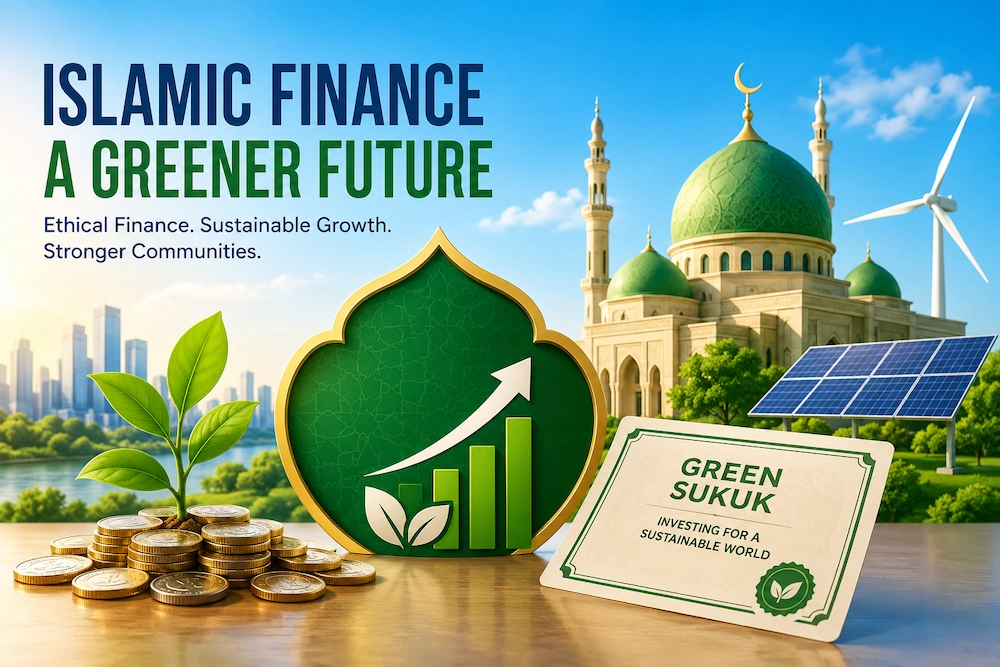
Unlike conventional green bonds, green sukuk combine internationally recognised environmental financing standards with Shari’ah compliance. As explained in Why Islamic Finance Could Provide an Ethical Model, funds raised through these instruments are directed towards projects such as renewable energy generation, climate-resilient infrastructure, clean transport systems, sustainable water management and environmentally responsible urban development.
Meanwhile, Policy Hotspots for Islamic Green Finance identifies Malaysia as a global leader in developing green sukuk markets and highlights Indonesia’s pioneering use of sovereign green sukuk to finance large-scale environmental projects. Saudi Arabia and the United Arab Emirates have also adopted green sukuk as part of broader sustainability strategies. These experiences are increasingly attracting international attention as governments seek new sources of climate finance that appeal to both conventional and Islamic investors.
The policy review concludes that green sukuk represent one of the most promising intersections between Islamic finance and global environmental policy because they satisfy both sustainability objectives and the ethical requirements of Muslim investors.
Policy will determine success
Despite its considerable promise, Policy Hotspots for Islamic Green Finance cautions that Islamic green finance remains underdeveloped in many parts of the world. While demand for sustainable investment is growing rapidly, supportive regulatory frameworks, standardised governance and coordinated public policy have not kept pace.
The paper identifies several priority areas requiring urgent attention. These include harmonising regulatory standards across jurisdictions, strengthening Shari’ah governance, improving environmental reporting and creating internationally recognised frameworks for green Islamic financial products. Without greater consistency, investors may struggle to compare products or assess whether projects genuinely deliver measurable environmental benefits.
The authors argue that governments have a central role to play by developing national green finance strategies that explicitly incorporate Islamic finance. Appropriate tax incentives, regulatory support and public-private partnerships could significantly accelerate investment in renewable energy, sustainable infrastructure and environmentally responsible industries.
The study also highlights the importance of integrating Islamic finance into national climate commitments. As more countries pursue net-zero emissions targets and climate adaptation strategies, Islamic financial institutions could become valuable partners in mobilising private capital for projects that advance both environmental and economic resilience.
Technology is reshaping Islamic finance
Digital innovation is emerging as another powerful driver of Islamic green finance. In Why Islamic Finance Could Provide an Ethical Model, Abdul Wase Samim argues that artificial intelligence (AI), blockchain technology and Islamic financial technology (fintech) can expand access to sustainable finance while improving transparency and accountability.
AI has the potential to assist financial institutions in assessing environmental risks, identifying suitable investment opportunities and monitoring the sustainability performance of financed projects. Automated data analysis can also strengthen environmental, social and governance (ESG) reporting, enabling investors to make more informed decisions.
Blockchain technology offers additional opportunities by providing transparent and tamper-resistant records of financial transactions. The paper suggests this could improve confidence in green sukuk markets by allowing investors to verify that funds are being used for their intended environmental purposes.
Islamic fintech platforms may also broaden financial inclusion by connecting ethical investors with entrepreneurs and small businesses that have traditionally struggled to access finance. Digital platforms can lower transaction costs, expand access to underserved communities and encourage wider participation in sustainable investment.
However, the authors emphasise that technological innovation should complement rather than replace the ethical foundations of Islamic finance. New technologies must themselves operate within Shari’ah principles while maintaining transparency, fairness and accountability.
Challenges remain
Although Islamic finance offers significant opportunities, the three publications acknowledge several important challenges.
One persistent obstacle is the absence of globally harmonised standards governing Islamic green finance. Different jurisdictions often apply varying interpretations of Shari’ah compliance and sustainability criteria, creating uncertainty for investors and limiting the growth of international markets.
You may also want to read





![The market-builder who restrained the market [Part 2]](https://muslimviews.co.za/wp-content/uploads/2026/08/PHOTO-2026-08-25-17-16-32-120x86.jpg)
Limited public awareness also remains a barrier. Many businesses, policymakers and even Muslim investors are unfamiliar with the growing range of Islamic green financial instruments now available. Expanding education and professional training will therefore be essential if the sector is to reach its full potential.
The research further identifies the need for stronger collaboration between regulators, financial institutions, Shari’ah scholars, environmental experts and entrepreneurs. Building an effective ecosystem requires cooperation across disciplines rather than isolated institutional initiatives.
Researchers also caution against treating sustainability merely as a marketing exercise. Genuine Islamic green finance must demonstrate measurable environmental and social impact rather than simply attaching “green” labels to conventional financial products.
A natural fit for the future
The three papers by Kian et al, Raimi et al and Samim present a compelling case that Islamic finance possesses unique characteristics capable of supporting a more ethical and sustainable global economy.
Their emphasis on justice, responsible stewardship, partnership and real economic activity aligns closely with growing international efforts to combat climate change while promoting inclusive development. Rather than viewing financial success solely through the lens of profit maximisation, Islamic finance encourages investment that delivers wider benefits for people, communities and the environment.
For Muslim-majority countries in particular, the researchers argue that Islamic finance represents an opportunity to demonstrate global leadership in ethical climate finance. By strengthening policy frameworks, encouraging innovation and investing in green entrepreneurship, these countries could help close the enormous financing gap that continues to hamper progress towards the Sustainable Development Goals.