














![The market-builder who restrained the market [Part 2]](https://muslimviews.co.za/wp-content/uploads/2026/08/PHOTO-2026-08-25-17-16-32-360x180.jpg)
![The merchant preceding the Prophetic mission [Part 1]](https://muslimviews.co.za/wp-content/uploads/2026/08/01-360x180.jpg)




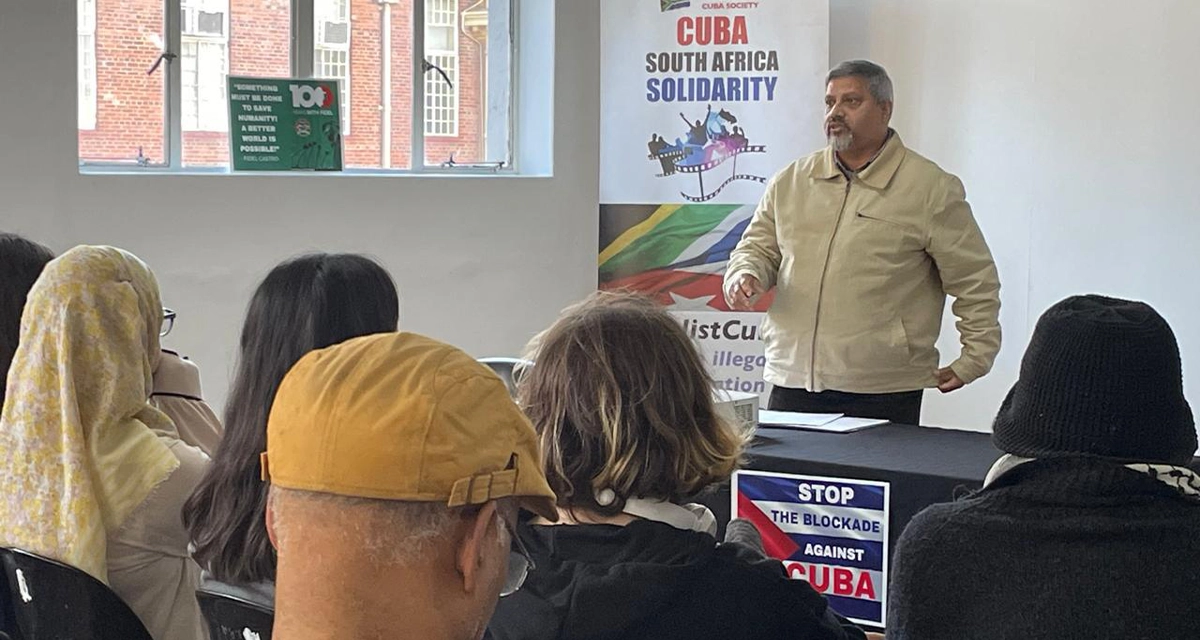

Reflecting on the launch of the School of Solidarity in Cape Town, CASSIEM KHAN examines how imperialism continues to shape Africa through military power, economic extraction and political influence, arguing that naming these systems is the first step towards meaningful resistance.
By CASSIEM KHAN
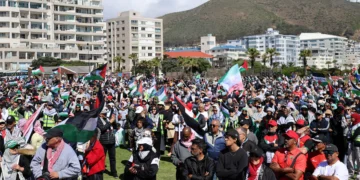
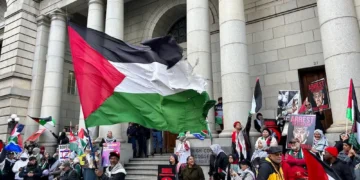
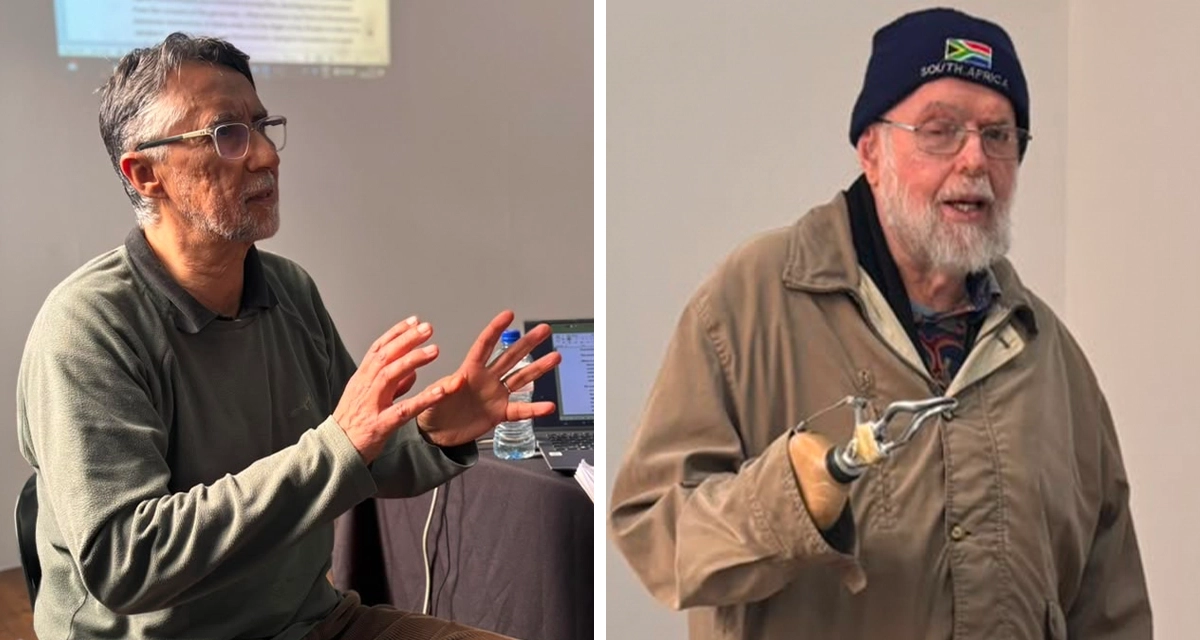
On 4 July, while the United States marked 250 years since its Declaration of Independence, a smaller and quieter gathering took place at the District Six Homecoming Centre in Cape Town. The Friends of Cuba Society (FOCUS) Western Cape and the Palestine Solidarity Campaign (PSC) Cape Town convened a political education event under the title, ‘The Empire Has a Playbook’, bringing together speakers on Cuba, Palestine and Africa to interrogate two and a half centuries of US and Western imperial practice, and to launch a new project: the School of Solidarity.
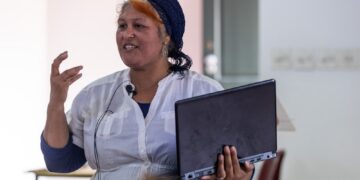
Establishing a school is never a small act. It is the construction of a people’s institution, a space where ordinary people can think together, question fearlessly, and organise consciously and compassionately. I was honoured to speak at the launch on behalf of the Pan Africanist Congress of Azania, addressing what external pressure and imperial interference continue to mean for South Africa and the rest of the continent. What follows are some of the reflections I offered that afternoon, reworked here for a wider readership.
Paulo Freire taught that before the oppressed can liberate themselves, they must first name the world as it actually is – not the world as the powerful describe it, not the world of the boardroom press release, but the world as it is actually lived. That naming is where any serious politics must begin. And the name that belongs on what continues to happen to Africa, and to South Africa, is imperialism: a living, adapting system with a playbook, methods, tools and disguises that runs today in pursuit of the same purpose it has always had – to take what does not belong to it.
Naming matters because an unnamed enemy cannot be organised against. If poverty is simply ‘bad luck’, if unemployment is simply ‘a skills problem’, if a civil war is simply ‘tribal conflict’, then there is nothing left to resist, only something to endure. Naming imperialism turns endurance into strategy, tactics and resistance.
Violence in new uniforms
The playbook begins, as it has always begun, with violence: the taking of what does not belong to you. In the era of conquest, that violence wore a uniform: the colonial soldier, the punitive expedition, the naval blockade. Today it wears many uniforms, and sometimes none at all. Sometimes it is AFRICOM, the United States’ military command for the African continent, whose footprint has steadily expanded in the name of counter-terrorism and stability – a footprint that maps with uncomfortable precision onto the continent’s oil, gas and mineral wealth.
Sometimes the violence carries no state insignia at all. It wears the uniform of armed groups across the Sahel and the Horn, or of Sudan’s Rapid Support Forces in Darfur and Kordofan. They divide a country against itself.
And this is the part the news bulletins tend to leave out: they facilitate extraction. Investigators have traced hundreds of millions of dollars in Sudanese gold moving out through Gulf trading networks, financing the weapons that prolong a war which keeps the mines open to whoever controls the territory that month. A divided, war-torn Sudan cannot regulate its own gold sector. The Democratic Republic of Congo, home to more than 70 per cent of the world’s coltan – the mineral inside every mobile phone – has known almost nothing but war for three decades. Ask who profits from that war continuing, and the playbook names itself.
Land, carbon and the ‘blue economy’
The second chapter of the playbook needs no rifle. It needs a lease, a conservation NGO and a carbon registry.
Gulf states like the UAE and Saudi Arabia import as much as 85 per cent of the food their populations consume. Rather than negotiate fair trade, they have acquired African farmland at scale: tens of thousands of hectares in Sudan, Egypt and Angola, so that food grown on African soil, watered by African rivers and worked by African labour, is exported to guarantee food security in Abu Dhabi and Riyadh while the communities who worked that land go hungry.
You may also want to read


Alongside the food grab sits the carbon grab. Land is enclosed, forests are declared ‘protected’, and carbon credits are sold to polluters in the Global North and the Gulf – credits that let them keep polluting while African communities are removed from the very forests and grazing lands that sustained them for generations. Fortress conservation brands the people who lived sustainably on their land for centuries as ‘encroachers’ and ‘poachers’. Nature and the people who tended it are turned into enemies of one another, on paper, for the benefit of a buyer thousands of kilometres away.
The same enclosure is now moving out to sea under the banner of the ‘Blue Economy’. But whose blue economy? Fishing communities who have depended on healthy oceans for generations are rarely consulted before their waters are opened to industrial fleets, offshore energy projects and the coming rush of deep-sea mining. The wealth flows outward. The risk, and the exclusion, stay local.
The Fisher Peoples Tribunal provides the details, the hardships and the stories of exclusion: https://www.masifundise.org/fisher-people-tribunal/
Hegemony, and the poor turned against the poor
How does a system like this survive, generation after generation, without collapsing under the weight of its own injustice? It survives because it does not rely on force alone. It relies, as Antonio Gramsci taught, on hegemony, on making its worldview appear as simple common sense.
Local politicians are seldom compromised by a suitcase of cash in a dark room, though that still happens. More often they are compromised by language, by learning to speak fluently in the vocabulary of ‘investor confidence’, ‘ease of doing business’, ‘public-private partnership’ and ‘food security partnership’, until they can no longer distinguish the interests of the people who elected them from the interests of the capital they are courting. A finance minister who has learned to think in the creditor’s categories no longer needs to be bribed. He has already been persuaded.
And when the poor begin to notice that something is wrong, when the mine has extracted for 30 years and the town now has only polluted water, the system reaches for one more tool: division.
Xenophobia is not a spontaneous eruption of hatred. It is cultivated, and it is convenient, because it turns the poor against the poor instead of the poor against the system that impoverishes them both. The street trader from elsewhere on the continent and the South African who cannot find work are made to see each other as the threat, so that neither looks up to see who actually owns the mine, the bank or the port.
When division inside a country is not enough, the playbook reaches for the division of countries. A fragmented Africa, cut into smaller and weaker pieces, each negotiating alone with the mining house, the sovereign wealth fund or the multinational, cannot bargain from strength. Every militia armed from outside, every secessionist movement quietly encouraged from outside, every border dispute kept simmering rather than resolved, serves the same final purpose: to keep extraction easy by keeping us small, divided and negotiating alone.
Naming as the first act of resistance
This, then, is the playbook: violence dressed as counter-terrorism; land grabs dressed as food security and a green transition; restitution that returns the topsoil and keeps the minerals; politicians persuaded rather than bribed; the poor turned against the poor; and, when all else fails, a continent broken into pieces too small to say no.
Cuba has lived a version of this playbook — blockade and economic warfare — for more than 60 years. Palestine lives another version of it, sustained by the same power, in the form of occupation, genocide and settler colonialism. These are not separate struggles. They are the same struggle, wearing different names in different geographies.
Naming imperialism is the first act of resisting it. It is why the work of the School of Solidarity matters. Political education has never been a luxury for the oppressed; it is, as Freire understood, the precondition for their own liberation.
If we cannot yet stop every ship that leaves loaded with what belongs to us, we can at least insist on calling it by its name.
Cassiem Khan is the Media Liaison Officer and Spokesperson for the Minister of Land Reform and Rural Development and leader of the Pan Africanist Congress, Mzwanele Nyhontso.