















![The market-builder who restrained the market [Part 2]](https://muslimviews.co.za/wp-content/uploads/2026/08/PHOTO-2026-08-25-17-16-32-360x180.jpg)
![The merchant preceding the Prophetic mission [Part 1]](https://muslimviews.co.za/wp-content/uploads/2026/08/01-360x180.jpg)






The screening of the Gaza ER documentary moved from testimony to action as panellists urged healthcare professionals and the public to support Gaza’s besieged medical workers, challenge indifference and turn solidarity into practical help.
By YASEEN BARDIEN and ANWAR OMAR
Attendees were urged to turn solidarity with Gaza into practical action during a panel discussion following the screening of the documentary Gaza ER at Islamia Academia on Saturday.
Organised by the Moosa Foundation, the event was aimed at healthcare professionals and combined the documentary screening with a panel discussion, fundraising, a campaign update and what organisers described as a “call to action and solidarity”.
The evening was held in partnership with the Islamic Medical Association of South Africa, Kromboom Medical Centre and Healthcare Workers 4 Palestine South Africa.
A foundation rooted in South Africa’s anti-apartheid struggle
The Moosa Foundation carries the legacy of the late Judge Essa Moosa, one of South Africa’s most prominent anti-apartheid human rights lawyers. Born in District Six, he spent decades defending political detainees under apartheid, co-founded the National Association of Democratic Lawyers, and later served as a judge of the Western Cape High Court.
His son, Faizel Moosa, now chairs the foundation. Ambassador Moosa took part earlier this year in the Global Sumud Flotilla, an aid mission to Gaza, and was detained after the flotilla was intercepted before being released by the IDF.
In his welcome address, Moosa said, “those who knew Essa Moosa would know that in times like this, he would not be sitting back at home doing nothing. He would be encouraging all of us to be part of something to ensure that the people of Gaza are never neglected or think that they are not being supported by us.”
You may also want to read


The documentary: setting the scene
Gaza ER, produced by SeenPalestine, follows healthcare workers inside Gaza’s besieged medical system, depicting several hospitals operating with limited supplies, overcrowded wards, and staff treating traumatic injuries without anaesthesia, alongside worker testimonies and footage of destruction.
The event also highlighted the campaign calling for the release of Dr Hussam Abu Safiya, director of northern Gaza’s Kamal Adwan Hospital, who has been held by Israeli authorities since a raid on the hospital in December 2024. UN bodies, including the Working Group on Arbitrary Detention, have called his detention arbitrary and urged his release. His family has also raised concerns about his deteriorating health. Israeli authorities allege he is linked to Hamas, a claim rejected by supporters, including the medical charity MedGlobal.
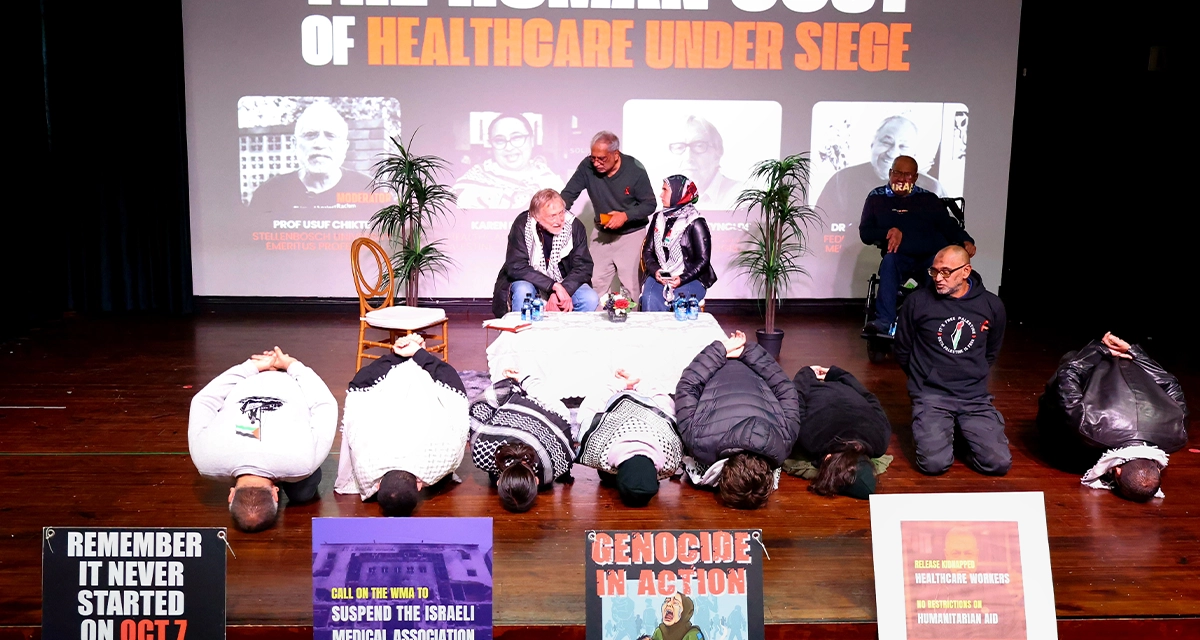
After the screening, the event moved from a documentary to a demonstration. Ambassador Moosa, joined by fellow Sumud Flotilla participants and a group of youth, staged a physical re-enactment of the stress positions that were imposed on them during their detention by the Israeli military.
During the re-enactment, participants knelt in a line at the front of the stage with their heads lowered and their hands behind their backs. One participant wore a dark hood. Behind them, the panel sat beneath a screen reading, “The Human Cost of Healthcare Under Siege”.
The panel discussion
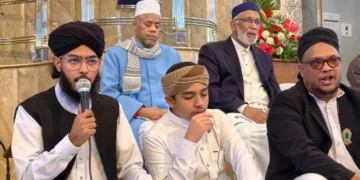
During a panel discussion moderated by Palestine Solidarity Campaign coordinator Professor Usuf Chikte, panellists Nazreena Hassim, Dr Ashraf Jedaar and Dr Louis Reynolds addressed the challenges facing healthcare workers in Gaza.
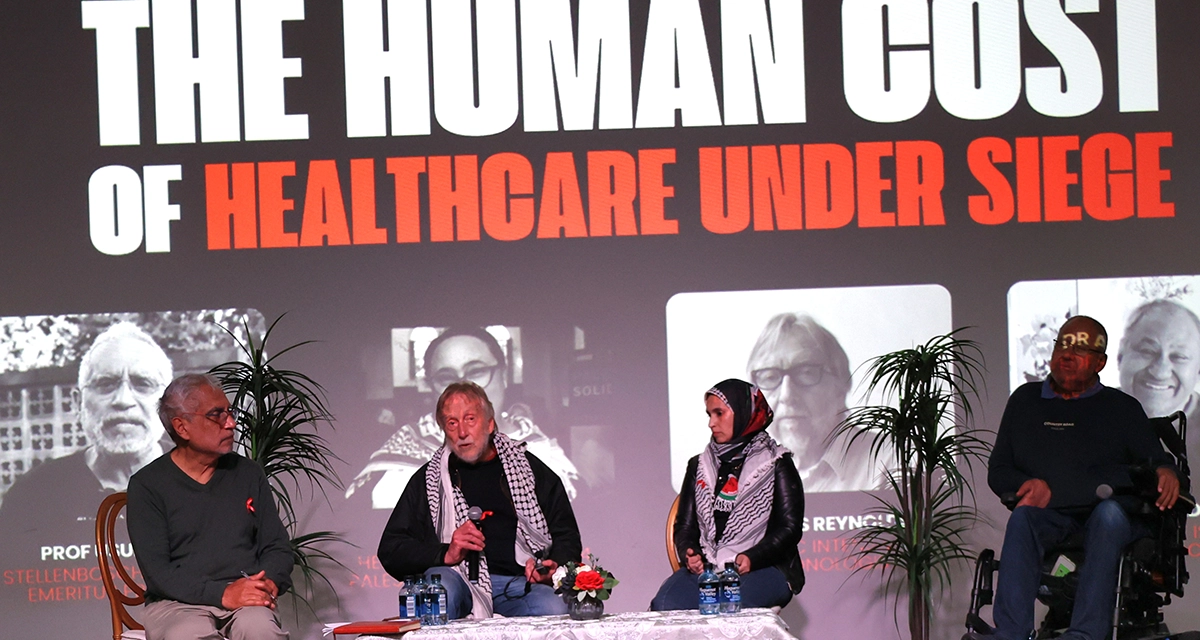
Introducing the panel, Professor Chikte opened the discussion by asking what practical action people could take after having seen the documentary.
The panellists spoke about working in damaged hospitals with limited resources, the psychological toll of the conflict and the need for greater international solidarity and action.
Nazreena Hassim from the Healthcare Workers for Palestine said the destruction of hospitals had wide-ranging consequences affecting healthcare.
“When you destroy a healthcare facility, you are destroying access to any form of healthcare, whether that’s acute or chronic,” she said.
She said the collapse of healthcare facilities affected emergency treatment, chronic disease management, maternity care and rehabilitation, leaving many without essential medical support.
“There is no way to function in a system like that,” she said. “The first thing that I can say is that the Palestinians have so much Sumud and resilience, and that is why the doctors in the documentary say they are heroes, because they literally experience it day in and day out.”
Dr Ashraf Jedaar from the Islamic Medical Association of South Africa said repeated exposure to online images from Gaza risks numbing people emotionally.
“For me, tonight was a reawakening of those same passions that we had at the beginning,” he said. Jedaar encouraged healthcare professionals, including psychologists, psychiatrists and counsellors, to volunteer their expertise to support colleagues affected by trauma.
Dr Louis Reynolds from the People’s Health Movement recalled witnessing the impact of the attacks on healthcare workers while working in Gaza in 2014.
“I saw ambulances that had been bombed. There’s no doubt about it,” he said.
Reynolds said medical organisations should do more to support Palestinian healthcare workers.
Anthony Svelto, who attended the screening, described the documentary as “quite powerful”, saying he was struck by the bravery of doctors working with limited resources.
Another attendee, Abraham Ross, said the documentary should be shown to medical students to help prepare them to work under difficult conditions.
Speaking to Muslim Views, Ambassador Moosa said he hoped the documentary had given attendees a clearer understanding of conditions facing healthcare workers in Gaza.
“What you read on the news is watered down so I think the audience now really have an insight into what’s really happening in Gaza and in hospitals in particular,” he said.
Moosa said he hoped the event would encourage people “to take a step out of their comfort zone and become part of a solution”.
Videos by Anwar Omar