












![The market-builder who restrained the market [Part 2]](https://muslimviews.co.za/wp-content/uploads/2026/08/PHOTO-2026-08-25-17-16-32-360x180.jpg)
![The merchant preceding the Prophetic mission [Part 1]](https://muslimviews.co.za/wp-content/uploads/2026/08/01-360x180.jpg)






COMMEMORATING NATIONAL WOMEN’S DAY
‘From Palestine – where a woman is born already knowing what resilience means – to South Africa – where women stood bravely against an unjust apartheid system – our struggles intersect.’ – Mai Shaer
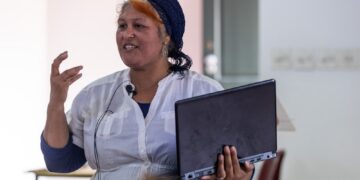
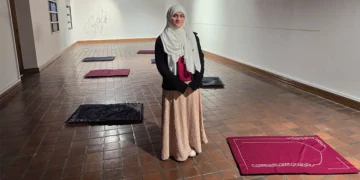
The Robert Waterwitch Thornhill branch of the African National Congress (ANC) commemorated National Women’s Day on Saturday, August 9, at the Samaj Centre in Gatesville, Cape Town with Palestinian visual artist, graphic designer and business graduate, Mai Shaer, as the keynote speaker.
In his welcome address, Abdul Majid Mowzer, the branch secretary, linked the commemoration of the 1956 march, led by Lillian Ngoyi, Helen Joseph, Rahima Moosa, and Sophia Williams-De Bruyn, to the current struggle against the occupation of Palestine.
The commemoration of the march by ’20 000 courageous women to defy apartheid oppression’ was not only ‘a celebration of South African women’s strength but also as a call for justice, unity, and shared resistance with our Palestinian sisters.’
Mowzer added that this year’s commemoration of Women’s Day to honour the legacy of the women who marched on the Union Buildings in Pretoria was to express solidarity with the women of Palestine, ‘who endure displacement and loss, but remain resilient under the ongoing genocide in Gaza.
‘Let us honour the countless women and men of South Africa and Palestine who have sacrificed their lives in the pursuit of justice. We also hold space in our hearts for the thousands of innocent Palestinian children lost to violence, their stolen futures a call to our collective conscience. In solidarity, we commit to continuing their struggle.’


Mai Shaer’s address
This is a slightly abridged version of Mai Shaer’s keynote address:
My name is Mai Shaer. I’m a Palestinian visual artist, a graphic designer, and a business graduate.
I was born in Khan Younis and raised in Rafah, and today I live here in South Africa.
I carry with me everything that the word ‘homeland’ means. I believe that art and words are among the strongest tools for change.
I stand before you today not just to celebrate Women’s Day, but to say: We, as women, are not just participants in history – we are the ones writing it.
From Palestine – where a woman is born already knowing what resilience means – to South Africa – where women stood bravely against an unjust apartheid system – our struggles intersect. Our stories may be told in different languages, but they echo the same spirit.
In 1956 is a day engraved in the memory of this country, when over 20 000 women of all backgrounds marched silently to the Union Buildings in Pretoria to protest the pass laws that restricted their freedom of movement.
They stood there – not with weapons, but with silence, strength, and faith.
And how similar that history is to our present…
In Palestine, women are not just part of daily life – they are present at every stage of the struggle. Mothers, sisters, grandmothers, students, farmers, prisoners, refugees… All resisting in countless ways.
Today, the Palestinian woman is not only a mother, sister, or wife – she is a lawyer, teacher, journalist, artist, doctor, and activist. She works across every field. And in every place she stands, she carries a single message: Palestine.
Her role has grown far beyond preserving history – she now defends it.
She writes, documents, and speaks about her country – with a voice that is loud, clear, and brave. She is not only a witness to injustice – she now tells the world our story, demands our rights, and plays a powerful role in shaping the future of Palestine.
From past to present, she teaches her children the meaning of freedom. She may be working in a school, a hospital, or an office but her heart is always focused on how to protect dignity in a brutal reality.
She carries within her the strength of generations of women who never surrendered.
And in Gaza today, amidst relentless bombing, siege, displacement, and hunger, the woman has not broken. She is the one searching for bread for her children under fire, the one who turns rubble into life. She nurses the wounded, comforts the orphaned, and stands tall – no matter what.
You may also want to read




We see her in schools turned into shelters, organising, cooking, healing, mourning.
In the recent assaults, we saw her holding her children tightly, screaming the name of her homeland – without fear.
Throughout our history, Palestinian women have stood firm in the face of occupation. From mothers of martyrs and prisoners, to women who have led movements, documented truths, spoken out, resisted in silence and in voice.
Women like Leila Khaled, who challenged the world’s perception of Palestinian resistance, and Dalal Mughrabi, who symbolised the deep connection between land and sacrifice. These names are written in the memory of our people. But beyond them are thousands of women whose stories the world may not know, yet they’ve all carried the same mission: freedom.
I am not here today just to speak about suffering – I’m here to share resilience. To speak of hope. Of how a simple woman can build a home in the middle of destruction, create life from nothing, and smile through her pain.
But I believe in something even deeper: this resilience cannot survive alone. It needs the solidarity of women. To learn from one another. To listen to one another.
South Africa taught us that freedom is taken, not given.
And Palestine shows the world every day that the woman does not stand behind the man in the struggle – she stands beside him
In my homeland, girls grow up loving the land. They are raised knowing that a homeland is not just a place – it is a voice, a colour, a story, and a seed of hope.
And when that woman is forced to leave her country – like I was – and live in a new culture, she finds herself redefining who she is, carrying the love for her land, with the hope of returning someday.
Identity is not just geography – it is a feeling. And as a Palestinian woman, wherever I go, I carry my identity in my voice, in my art, in my words, and in my solidarity with every free woman in the world.
My sisters, we women know how to turn pain into light. How to rise from beneath the rubble. How to plant roses in stone. How to sing in the face of oppression. And how to dream – even behind walls.
Let us celebrate Women’s Day, not just as a memory, but as a call to action. A call for change, for solidarity, and for continuation. Hand in hand, from Palestine to South Africa, and across every land where women refuse to be silenced.
To every woman – may we grow stronger, truer, and closer to freedom.
Thank you.