








































![The market-builder who restrained the market [Part 2]](https://muslimviews.co.za/wp-content/uploads/2026/08/PHOTO-2026-08-25-17-16-32-360x180.jpg)
![The merchant preceding the Prophetic mission [Part 1]](https://muslimviews.co.za/wp-content/uploads/2026/08/01-360x180.jpg)










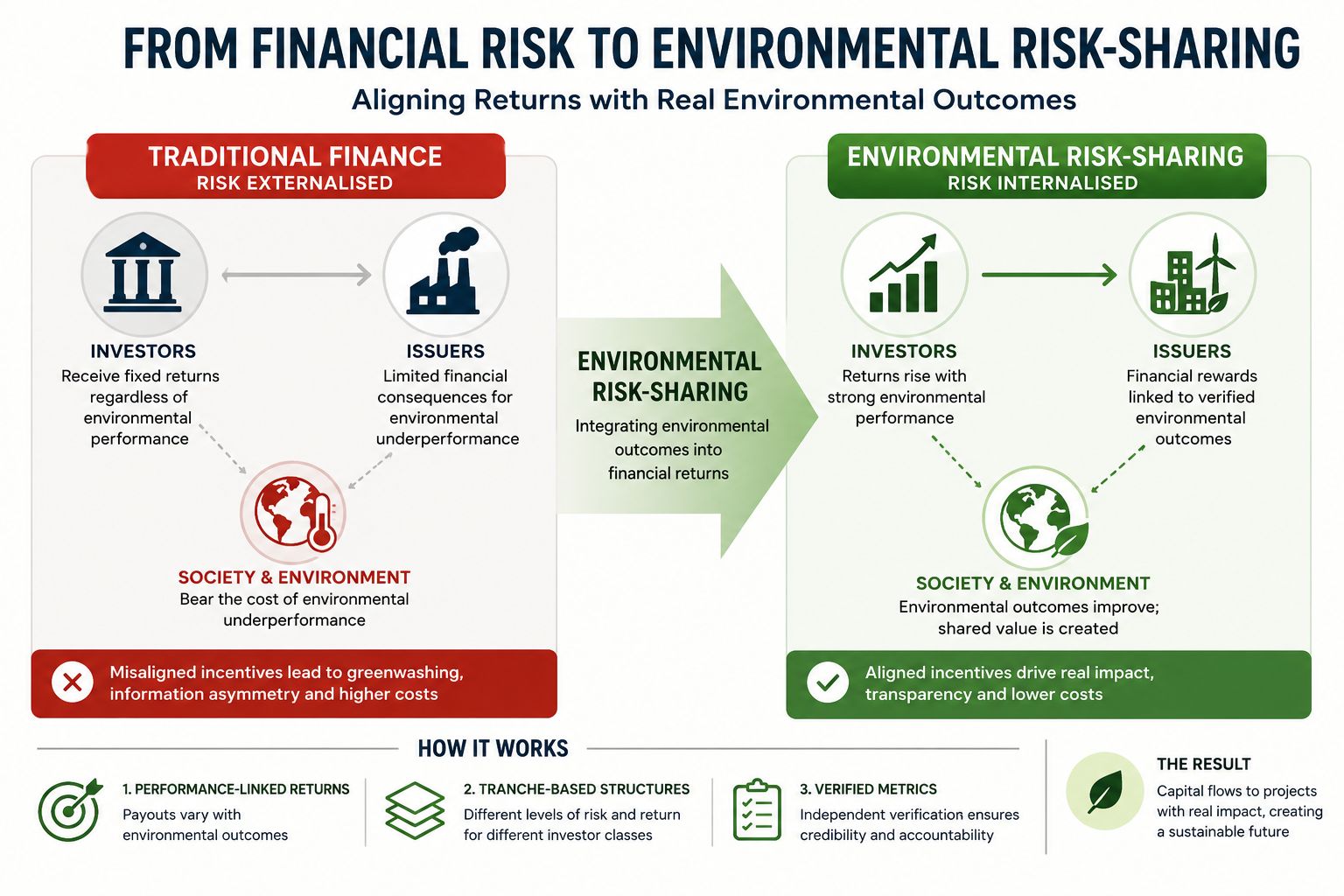

Sustainable finance has mobilised trillions, but often fails to link capital to measurable outcomes. DR HAZIK MOHAMED argues that environmental risk-sharing can align returns, accountability and climate impact.
The rapid growth of sustainable finance — spanning green bonds, environmental, social and governance (ESG) funds, and sustainability-linked instruments — has mobilised trillions in capital. Yet a fundamental weakness persists: financial markets struggle to translate capital flows into measurable environmental outcomes.
The problem is not scale, but design. Most instruments mobilise funding without fundamentally linking risk, return and environmental performance, leaving a persistent misalignment between public climate goals and private incentives.
A new class of financial innovation — environmental risk-sharing — offers a solution. By embedding environmental outcomes directly into financial structures, these instruments reshape how risk is priced, capital is allocated and accountability is enforced.
From financial risk to environmental risk-sharing
Traditional financial instruments expose investors to credit, market and liquidity risks, while environmental risks — such as emissions or climate impact — remain externalised. Society bears the cost of environmental underperformance, not investors or issuers. This disconnect lies at the heart of the climate finance challenge.
Environmental risk-sharing addresses this gap by integrating sustainability outcomes into financial returns. Rather than treating environmental performance as a disclosure or reputational signal, it becomes economically consequential. Investors no longer remain insulated from environmental outcomes; they participate in them.
This approach operates through three mechanisms:
- performance-linked returns, where payouts vary with environmental outcomes;
- tranche-based structures, allowing differentiated exposure across investor classes; and
- verified metrics, ensuring outcomes are measurable and credible.
Together, these features internalise environmental externalities within financial contracts. Capital markets evolve from systems that distribute financial risk into mechanisms that also distribute environmental responsibility.
Incentive alignment and market behaviour
At its core, environmental risk-sharing is about incentives. Conventional sustainable finance often lacks enforcement: investors receive fixed returns regardless of environmental performance, while issuers face limited financial consequences for underperformance.
Performance-linked structures fundamentally alter this dynamic. Returns adjust continuously with environmental outcomes:
- strong performance enhances investor returns; and
- weak performance reduces financial rewards.
This creates a gradient of incentives, encouraging optimisation rather than mere compliance. Issuers are incentivised to invest in cleaner technologies, stronger governance and operational efficiency. Investors, in turn, allocate capital towards projects with verifiable impact.
The result is a shift in market behaviour — from rewarding sustainability claims to rewarding sustainability outcomes.
Enhancing price discovery
Price discovery — the process by which markets incorporate information into prices — is central to efficient capital allocation. Traditionally, prices reflect financial variables, while environmental performance is only weakly embedded.
Environmental risk-sharing introduces a new dimension: prices begin to encode expectations of environmental outcomes. This has three important implications.
First, markets can differentiate projects based on actual impact rather than broad ‘green’ labels. Second, superior environmental performers benefit from lower capital costs, reinforcing efficient allocation. Third, investors receive a more nuanced signal that integrates financial and environmental risks.
In this framework, price becomes multidimensional, reflecting profitability, sustainability and credibility simultaneously.
You may also want to read


Reducing information asymmetry
Information asymmetry remains a major obstacle in sustainable finance. Investors often rely on issuer-reported data, which may be inconsistent, incomplete or strategically framed. This undermines trust and weakens capital allocation.
Environmental risk-sharing mitigates this problem through embedded verification mechanisms. Independent audits, standardised reporting and continuous monitoring improve data quality and comparability.
Crucially, financial outcomes are tied to verified metrics. Misreporting carries direct financial consequences, aligning incentives for accuracy. This dual effect — better information and stronger accountability — enhances market transparency and efficiency.
Greenwashing and the Greenwashing Risk Premium
As ESG investing expands, greenwashing has become a systemic concern. Firms may exaggerate sustainability credentials or rely on vague commitments, distorting market signals and eroding investor confidence.
Environmental risk-sharing provides a structural response. By linking returns to verified outcomes, it reduces reliance on narrative disclosures. Issuers must deliver measurable performance rather than promises.
This shift introduces the concept of a Greenwashing Risk Premium (GRP) — the additional return investors demand to compensate for uncertainty around sustainability claims. In traditional instruments, especially where verification is weak, this premium can be substantial. However, as verification improves and incentives align, the GRP declines.
Lower uncertainty reduces required returns and the cost of capital, improving market efficiency while discouraging deceptive practices.
Implications for Islamic finance
Environmental risk-sharing aligns closely with the principles of Islamic finance, which emphasise asset-backing, risk-sharing and ethical investment. However, many contemporary instruments — such as green sukuk — have replicated conventional structures, limiting their transformative potential.
Integrating environmental performance into financial contracts revitalises these principles. Risk-sharing expands beyond financial uncertainty to include environmental outcomes, aligning with broader objectives of social welfare and environmental stewardship.
This convergence positions Islamic finance as a natural bridge to global ESG markets. Instruments that combine ethical foundations with measurable impact can attract a wider investor base, offering both financial returns and verifiable sustainability outcomes.
Towards an impact-oriented financial system
Environmental risk-sharing has broader systemic implications. It transforms markets from passive channels of capital into active mechanisms of accountability and performance.
Three key effects emerge:
- improved capital allocation, directing funds to projects with real environmental impact;
- stronger issuer discipline, incentivising sustained performance improvements; and
- reduced greenwashing, enhancing trust and credibility.
Most importantly, it aligns financial incentives with long-term climate objectives. This addresses a central challenge in climate finance: ensuring that capital not only flows but flows effectively.
A shift in financial logic
The transition to environmental risk-sharing represents a fundamental shift in financial logic. Markets are no longer evaluated solely on financial performance, but on their ability to integrate environmental outcomes into core operations.
By improving price discovery, reducing information asymmetry, aligning incentives and curbing greenwashing, environmental risk-sharing offers a credible pathway towards a more efficient and impactful financial system.
In the context of the global energy transition, such innovation is not optional — it is essential.
Dr Hazik Mohamed is the managing director of Stellar Consulting Group. He can be contacted at hazik@stellarcg.com