



![Does ta’wīl mean interpretation or fulfilment? A Quranic reassessment [+video]](https://muslimviews.co.za/wp-content/uploads/2026/10/Tawil-Kaskas-360x180.webp)







![Why becoming a wealthy Muslim is commendable in Islam [+videos]](https://muslimviews.co.za/wp-content/uploads/2026/09/Muslim-Trade-Business-1-360x180.webp)




‘The sea carries everything — our fear, our prayer, and our faith in the mercy of Allah. We were never alone.’— Dr Fatima Hendricks at Masjid al-Quds, Cape Town
By ADLI YACUBI
When the Global Sumud Flotilla set sail for Gaza in September 2024, few imagined that a South African woman from Cape Town would become one of its enduring symbols of conscience. Dr Fatima Hendricks boarded the ship Amsterdam, one of the vessels in the Global Sumud Flotilla, with a single purpose — to break the siege and deliver humanitarian aid to a people cut off from the world.
She was one of six South Africans — Zukiswa Wanner, Nkosi Zwelivelile Mandla Mandela, Dr Fatima Hendricks, Dr Zaheera Soomar, Carolyn Shelver, and Reaaz Moola — who joined the voyage of conscience to Gaza. Their detention and release reverberated across South Africa, reminding the nation that solidarity is not performed from a distance but carried in the body, across the sea.

The Israeli navy intercepted the ship in international waters. The crew was detained, interrogated, and expelled. Yet even in captivity, the journey refused to end. The sea itself seemed to carry her story back to shore.
The sea will testify
‘They took her at sea, but they could not take her voice.’
Those words echoed through Masjid al-Quds on the Tuesday morning of her return, when the Housewives Forum gathered — a circle of women bound by remembrance and prayer. In that moment, the sea seemed to speak through every breath she drew.

Shaykh Abduragmaan Alexander addressed the gathering before calling her to the microphone:
‘She went to Gaza to break the Israeli siege … They faced brutality and were even arrested. Before she left, she took off her wedding ring and gave it to her husband, Dr Suleyman Teo, saying, ‘Keep this ring. If I return by the will of Allah, you may place it back on my finger.’’

The hall fell silent. The gesture became a covenant — a circle of witness, a symbol of faith that travels and returns. It spoke not only of parting and reunion, but of trust placed entirely in Allah — sacrifice made visible, yet offered without spectacle. When Dr Fatima finally spoke, her voice was steady as surf:
‘The sea carries everything — our fear, our prayer, and our faith in the mercy of Allah. We were never alone.’
Her words turned the mosque into a sanctuary of shared gratitude.
The sea and the sanctuary
Days later, the witness travelled across the mountain to St George’s Cathedral. Former Dean Michael Weeder led an inter-faith vigil that brought together clergy, students, and citizens who have stood for Palestine week after week on the Cathedral steps.

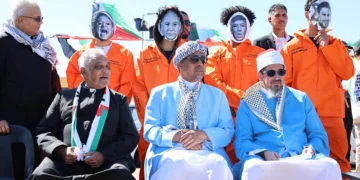
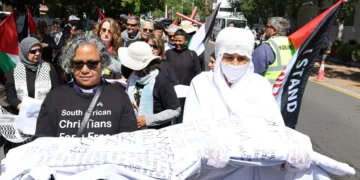
Dr Fatima — still in the white robe and Palestinian shawl she had worn on the flotilla — sat between Jimi Matthews, the veteran journalist whose lens has long searched South Africa’s moral horizon, and Imam Rashied Omar, the scholar-activist who has spent decades linking faith to freedom, beneath the stained-glass windows.
She spoke softly about endurance, about faith that refuses spectacle:
‘Sumud is not only to stand firm in Gaza; it is to hold firm wherever conscience is tested.’
Dean Weeder listened in silence. Beside him, activist-priest Michael Lapsley bowed his head in affirmation. Outside, volunteers from the Palestine Solidarity Campaign raised flags and banners. When Dr Fatima stepped out to join them, the flags caught the Cape wind, echoing the sails of the Global Sumud Flotilla.
The sea had entered the sanctuary.
Witness as collective memory
To bear witness in this context is not simply to narrate. It is to remember ethically — to connect past to present, South Africa to Gaza, faith to freedom. Dr Fatima’s journey has revived a moral language that many feared was fading; one rooted in Ubuntu, Qur’anic conscience, and South Africa’s own struggle tradition.
You may also want to read



Across the country, small circles have formed in mosques, school halls, and community civics — some for prayer, some for study, others to hold silence together. What binds them is not a single liturgy but a shared remembrance: that freedom is indivisible, and that the word witness obliges the one who speaks it.
The return to community
This revival has unfolded into the Journey of Witness — National Tour 2025, a collaboration among civic and faith networks in KwaZulu-Natal. Beginning at Radio Al Ansaar and moving through schools and campuses, each stop became a small act of resistance against forgetting.

In a message to the KZN Sumud group, Dr Fatima wrote:
‘The light of your resistance in the everyday acts of collective care pierces the darkness of hate. I sincerely appreciated the late-night coffee chats, the stories of organising and struggle. Your acts of care have been inspiring.’
At every venue — from the University of KwaZulu Natal‘s Westville Campus to Port Shepstone — she encountered new generations linking faith to liberation, memory to action.
‘Sumud is steadfastness woven with love.’
The two women of power
Before she sailed toward Gaza, Dr Fatima had chosen her companions: Sayyida Zaynab bint ʿAlī (ر.ض) and Sayyida Nusaybah bint Kaʿb (ر.ض) — inheritors of sacred defiance.
‘One spoke truth to power in the court of Yazīd,’ she reminded the gathering, ‘dragged across deserts in resistance to tyranny. The other stood on the battlefield of Uḥud, defending our Prophet ﷺ when others fled. When I went to sea, I took them with me.’
Between Zaynab’s voice and Nusaybah’s shield, she found her purpose. The sea became her ʿArafah, her battlefield, her pulpit.
‘We put our hands in front of us,’ she said, ‘to show that we carried no weapons. But we will never, ever surrender.’
In that single gesture, the ocean recognised its own believer — one who bows only to Allah.
By time, we stand witness
Every poster, every voice, every salaam exchanged across these halls carries the same light: truth and endurance; time and patience.
Dr Fatima reminded us that this story is not about her.
‘I am bearing witness,’ she said. ‘The story is about the Palestinians. There is no need for thanks for that which is obligatory — la shukran ʿala wājib.’
Her words return us to the essence of Sūrah al-ʿAṣr: to act, to endure, and to believe that Allah sees, hears, and is with us.
In an age of spectacle and despair, the Journey of Witness restores proportion. It reminds us that faith without justice is empty ritual, and that solidarity without sacrifice is sentiment. Dr Fatima Hendricks’s voyage is no longer about one person but about what she represents — a nation still learning to see, feel, and act with moral clarity.
The sea will testify, and so will the land that welcomed her home.