![Ebrahim Moosa’s political theology of Gaza [+ videos]](https://muslimviews.co.za/wp-content/uploads/2026/09/moosa-360x180.jpg)


























![The market-builder who restrained the market [Part 2]](https://muslimviews.co.za/wp-content/uploads/2026/08/PHOTO-2026-08-25-17-16-32-360x180.jpg)
![The merchant preceding the Prophetic mission [Part 1]](https://muslimviews.co.za/wp-content/uploads/2026/08/01-360x180.jpg)










‘This book restores a sense of intellectual dignity to a conversation that is often hijacked by slogans. It shows us that the Islamic tradition, when approached with sincerity and expertise, contains the tools to address modern challenges without abandoning its core.’
Review by DR MOHAMMED AMEEN ALLY
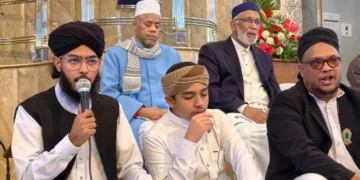
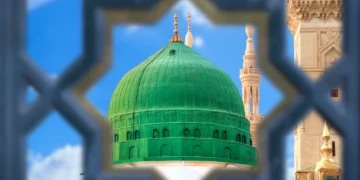
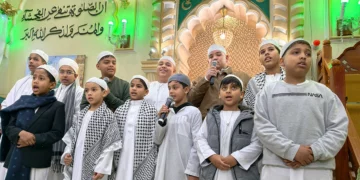
IN Iẓhār al-Surūr li Mawlid al-Nūr (Expressing Delight for the Birth of the Light), Shaykh Dr Muhammad bin Yahya al-Ninowy offers more than a legal or theological defence of the Mawlid – he offers a heartfelt, scholarly, and deeply principled framework for understanding joy, tradition, and what it means to love the Prophet Muhammad ﷺ in our time.
At first glance, the book appears to be about the permissibility of commemorating the Prophet’s birth. But beneath that surface lies something far more meaningful: a meticulous and compassionate deconstruction of how we approach bid‘ah (innovation), tark (Prophetic omission), and inherited religious authority in a world increasingly marked by oversimplification and sectarian polemic.
The work is divided into two parts. It opens with Ḥusn al-Maqṣid fī ‘Amal al-Mawlid by the 9th-century scholar al-Imām al-Ḥāfiẓ al-Suyūṭī, a concise yet powerful endorsement of Mawlid gatherings when grounded in love and reverence. This classical gem is followed by Shaykh Ninowy’s far more extensive contribution, Iẓhār al-Surūr, a scholarly monograph written in clear and reasoned prose, infused throughout with devotion and warmth.
What distinguishes the book is its method. Shaykh Ninowy does not offer a modern reinterpretation or rely on emotional appeals alone. Instead, he returns us to the heart of the tradition: the Quran and the Authentic Sunnah. He invites readers to contemplate not only the meaning of the Prophet’s birth ﷺ, but also the larger question of how Muslims engage with inherited practices.
His central proof-text is simple and profound: The Prophet ﷺ, when asked why he fasted on Mondays, replied, ‘It is the day I was born.’ From this statement springs a rich theological and legal inquiry into how joy for the Prophet ﷺ has been—and can be—expressed by his ummah.
A large portion of the book addresses common objections to the Mawlid, including those based on the claim that it constitutes a forbidden innovation. Drawing on classical authorities like Imām al-Shāfiʿī, Ibn Ḥajar al-ʿAsqalānī, and ʿIzz al-Dīn ibn ʿAbd al-Salām, Shaykh Ninowy explains that not every innovation is blameworthy, and not everything the Prophet ﷺ omitted is necessarily prohibited. With care and precision, he categorises types of innovation based on their relationship to Shariah principles and the actions of the Companions, showing how some practices – in the Prophetic era and afterwards – were praised, others discouraged, and all evaluated according to sound methodology.
What is particularly timely about this work is its relevance beyond the Mawlid debate. Concepts like bid‘ah and tark are too often weaponised today – used by extremist and sectarian groups to label, divide, and condemn. This book offers a different way: one that is principled but not rigid, traditional but not exclusionary. It reminds scholars and laypeople alike that Islamic scholarship is a living, interpretive tradition – not a list of prohibitions frozen in time.
And yet, for all its academic rigour, Iẓhār al-Surūr is not dry or impersonal. The Shaykh’s love for the Prophet ﷺ permeates every page. His writing, while methodical and sourced, carries an emotional charge that makes the book more than just an intellectual exercise. It is a spiritual offering. In a rare combination of qualities, Shaykh Ninowy brings together the lens of a hadith master, the analytical training of a legal theorist, and the clarity of a medical scientist, creating a work that is at once rigorous and deeply moving.
He does not shy away from critique, either. The book acknowledges and firmly censures misguided practices that may occur under the banner of Mawlid in some cultural contexts. This balanced tone – affirming the essence while correcting the excess – is a hallmark of serious scholarship.
Ultimately, Iẓhār al-Surūr is not a polemic. It is not written to score points in theological debates or provide talking points for online arguments. Rather, it is a guide – for the student navigating confusing claims about innovation, for the scholar seeking a structured response to inherited objections, and for the ordinary Muslim who may have been shamed or unsettled by accusations of deviance for expressing love for the Prophet ﷺ.
You may also want to read


More than anything, this book restores a sense of intellectual dignity to a conversation that is often hijacked by slogans. It shows us that the Islamic tradition, when approached with sincerity and expertise, contains the tools to address modern challenges without abandoning its core. And it leaves the reader not just better informed, but spiritually uplifted.
In short, Iẓhār al-Surūr li Mawlid al-Nūr is a reminder that our love for the Prophet ﷺ can – and should – be both reasoned and radiant.
Dr Mohammed Ameen Ally is a Durban-based anaesthesiologist and a student of Islamic knowledge. He completed a diploma in foundational Islamic sciences (Usul Al Din) at the Madina Institute and has been involved in local community education under traditional teachers.
- Iẓhār al-Surūr li Mawlid al-Nūr is available at Daral Latif Networks, Baitul Hikmah and Chapter 96 Bookz.