













![The market-builder who restrained the market [Part 2]](https://muslimviews.co.za/wp-content/uploads/2026/08/PHOTO-2026-08-25-17-16-32-360x180.jpg)
![The merchant preceding the Prophetic mission [Part 1]](https://muslimviews.co.za/wp-content/uploads/2026/08/01-360x180.jpg)






By ANWAR OMAR
In a high-stakes debate on politics, identity and Cape independence four speakers engaging the issue of who “owns” the Western Cape, politically, culturally, and historically.
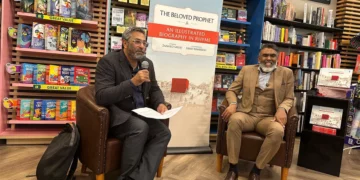
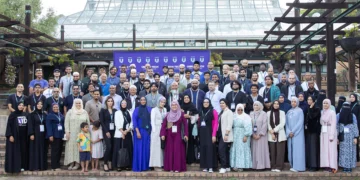
Academia Library hosted the event on June 24 at Islamia College, Cape Town, with over 100 guests in attendance, along with an audience of countless more on livestream.
The debate around who “owns” the Western Cape, is not new, but currently it carries a particular nuance: Land expropriation legislation has been enacted in January 2025, but that no land has been formally expropriated; The Western Cape remains the only province not governed by the ANC. The DA is in power in Cape Town with a commanding majority; and finally, a small but vocal movement is actively campaigning for the independence of the Western Cape from South Africa altogether.
The panel consisted of veteran anti-apartheid activist Dr Allan Boesak, Ambassador Ebrahim Rasool, Minister of Land Reform, Mzwanele Nyhontso (whose address was read by his spokesperson Cassiem Khan, the Minister being detained in Cabinet), and Cape Independence Party leader Jack Miller.
Veteran Cape Town anti-apartheid clergyman and former chairman of the Western Province Council of Churches Rev Lionel Louw chaired the event and opened the discussion by reminding the attendees that:
You may also want to read


“This is an election year and particularly significant because it’s the local government elections and so there will be many discussions and debates and activities during the year leading up to 4 November, and this is just one of such events to open up the discussion and debate.”
Notable absentees
The DA, which governs the province at the centre of this debate, chose not to be present, with the Mayor of Cape Town Mayor Geordin Hill-Lewis having formally declined. President Cyril Ramaphosa and Julius Malema from the EEF also did not respond to their invitations.
The Participants: Four Visions, One Cape
The four panellists, each represented radically different answers to the night’s central question: Who Owns the Cape?
Minister Mzwanele Nyhontso – Land First, Everything Follows
Nyhontso’s written address, delivered by Cassiem Khan, the Minister’s Spokesperson set the tone by invoking the PAC’s founding president Robert Sobukwe, view that Azania is “an indivisible whole” won by an entire people not relinquishable province by province. He reminded the attendees how from the time since 1652 when the land was invaded, heroic battles ensued in defence of the land, spanning a continuous period of more than two centuries.
“A highly offensive and repulsive part of this history took the form of the brutality of dispossession through the forced removal of communities, which itself was implemented over an extended period.”
He highlighted:
“The pain of dispossession from communities such as District Six and the ongoing gentrification of Bo-Kaap has emptied this area of families who had lived here for many generations, remains as a vivid reminder of many of you as if it only happened yesterday. The heroic manner in which you or your parents waged the struggle against this terrible act continues to occupy an iconic position in the minds of the oppressed and their descendants all over our country, and it has left an indelible mark on the sands of our country’s history.”
He backed up his argument with data. Between 2023 and 2024 every South African suburb with the highest concentration of foreign buyers was situated in the Western Cape. Over 40% of all property transactions above R10 million went to international buyers, overwhelmingly from Germany, the Netherlands, Britian and Switzerland. In early 2025 alone, overseas capital poured more than R1 billion into Cape Town properties. According to him, this is a province that is being bought suburb by suburb by foreign capital.
He quoted Robert Sobukwe, the founder of the PAC who famously said:
“We guarantee no minority rights, but we think in terms of individuals not groups and that there is only one race to which all belong and that is the human race. These formulations constitute the bedrock upon which the PAC’s soul rests, and it is the basis upon which we reject Herenvolkism or white supremacy in whatever guise in which it may present itself. To us therefore the notion of secession that is propounded by CapeXit’s represents Herenvolkism in its most dangerous form, that is precisely why this new brand of Herenvolkism stands to be defeated.”
The DA’s deliberate marketing of Cape Town as an emigration destination was, in his framing, “demographic engineering with better marketing than the architects of the Bantustan policy ever had.”
Jack Miller – The Separatist in the Room
Miller immediately pushed back on the concept of an “African” and the charge of racism by the PAC. According to him, the Cape was “the only true rainbow nation,” a melting pot of Dutch, Khoi, San, Indonesian and Malay intermingling for centuries, defined by the Afrikaans as a melting pot language.
He argued that South Africa was a British imperial imposition of 1910, after they committed genocide of the Afrikaner community and that communities which are a majority within a territory have the right to self-determination, citing the constitution.
According to him, Singapore under Lee Kuan Yew was his economic model, disciplined, post-colonial governance producing high incomes and low unemployment regardless of racial composition. He closed his presentation by declaring that:
“I don’t think people really care about the race of their neighbour if they’ve got a roof over their head, their children are going to a good school, and there’s a bright future in front of them. That is what we would like to bring to the people of the Cape.”
Ebrahim Rasool – The Cape Is Our Common Property
Rasool opened with three premises: belief in one undivided South Africa; love of the Western Cape and Cape Town; and a record of engaging Jews as Jews rather than as Zionists.
Having established these, he distinguished between “honest secession”, Miller’s own pitch and what he called “secession by stealth.” He noted the Cape Town Mayor had been quoted enticing Jewish students to the city, and the Jewish Board of Deputies providing an infrastructure of schools and business listings to facilitate it and according to him, this is not accidental, but rather by stealth.
He cited a January 2026 article in the Times of Israel arguing South Africa was “unsustainable in its current form” and recommending fragmentation, with the Western Cape among the named territories.
His policy prescriptions were specific. The antidote according to him is to return to the rule of law. In some cases, the law must be consistently and vigorously applied and in other cases the law must be managed and changed, revise the rule.
He argued that provincialism need to be tighten; property laws needs to be amended to match global practice. Almost uniquely, South Africa gives foreign buyers identical rights to citizens; and test CapeXit’s advocacy against the constitutional hierarchy of rights through the Human Rights Commission. The Western Cape government’s consistent return of billions in infrastructure grants earmarked for low-cost housing was, he argued, not capacity failure, “it can’t be accidental” but deliberate demographic shaping.
Dr Allan Boesak – Politically Scandalous, Morally Despicable
Boesak, delivered the evening’s most unsparing verdict. According to him, the struggle he and others had fought was for “one united, undivided South Africa with a non-racist, anti-racist life in our societies”
. It has not yet been achieved, “not by a long shot,” but should not be abandoned. He totally rejected the idea of a CapeXit.
CapeXit was, in four words: “politically scandalous”, a denial of everything the liberation struggle stood for; “economically disastrous”, built on capitalism; “sociologically unsustainable”, and “morally despicable”, ignoring continental realities and “twisting the history of our people”; feeding the most base human instincts and using real need to advance a false solution.
He challenged Miller directly: “who built the Cape, and on whose backs?”
He raised Phil Craig, a British citizen permitted to register a political party and referred in CapeXit literature to the Western Cape as “a little Israel,” with reported letters to Donald Trump asking for intervention. The two most evil individuals on the Planet
“CapeXit pretends to speak of independence while in reality binding us hand and foot to a new imperialism, a new colonialist strategy not just for South Africa but for the continent.”
Post-1994 Disillusionment.
All four speakers from entirely different positions registered disappointment with the post-apartheid dispensation. The unexpected common ground: Boesak and Rasool both acknowledged ANC failures as enabling CapeXit’s argument. Rasool said: “My generation of ANC leaders must take responsibility for creating the impression of the unsustainability of our country, we lost the ball.”
Closing Reflections
In closing, Ebrahim Rasool remarked that “The Cape is our common property. It belongs to South Africa. It belongs to the people of South Africa, it belongs to our nation, but our ownership is being eroded by stealth, and therefore we don’t want to wake up one date and find that the prime land is all gone.” [Link to Videoclip 16]
Moderator Rev Lionel Louw brought the evening to a close noting that the debate had been “a celebration of our constitution and our democracy, open, frank, and illustrative of the audience sentiment.”
The evening ended with a commitment to have a follow-up session to focus on strategies and solutions.
Video content recorded by Anwar Omar.