












































A pocket-sized Gamildien family book holds a rare daily record of 595 Muslim deaths in Cape Town during the 1918 Spanish flu. The account explores what the register reveals about Black October and the community’s struggle to bury its dead.
By ANWAR OMAR
While researching possible mass burials at the Mowbray Muslim Cemetery during the Spanish flu of 1918, I was led to a small gilt-edged family book. Among its births, marriages and deaths are two pages that count, day by day, the Muslims who died in Cape Town that October.
For some time I have been researching the Spanish flu of 1918 and one question in particular: whether the epidemic led to mass burials at the Mowbray Muslim Cemetery. To answer this question requires data on both the magnitude and the pace of mortality over that period, but written evidence from within the Muslim community has been few and far between and hard to find.
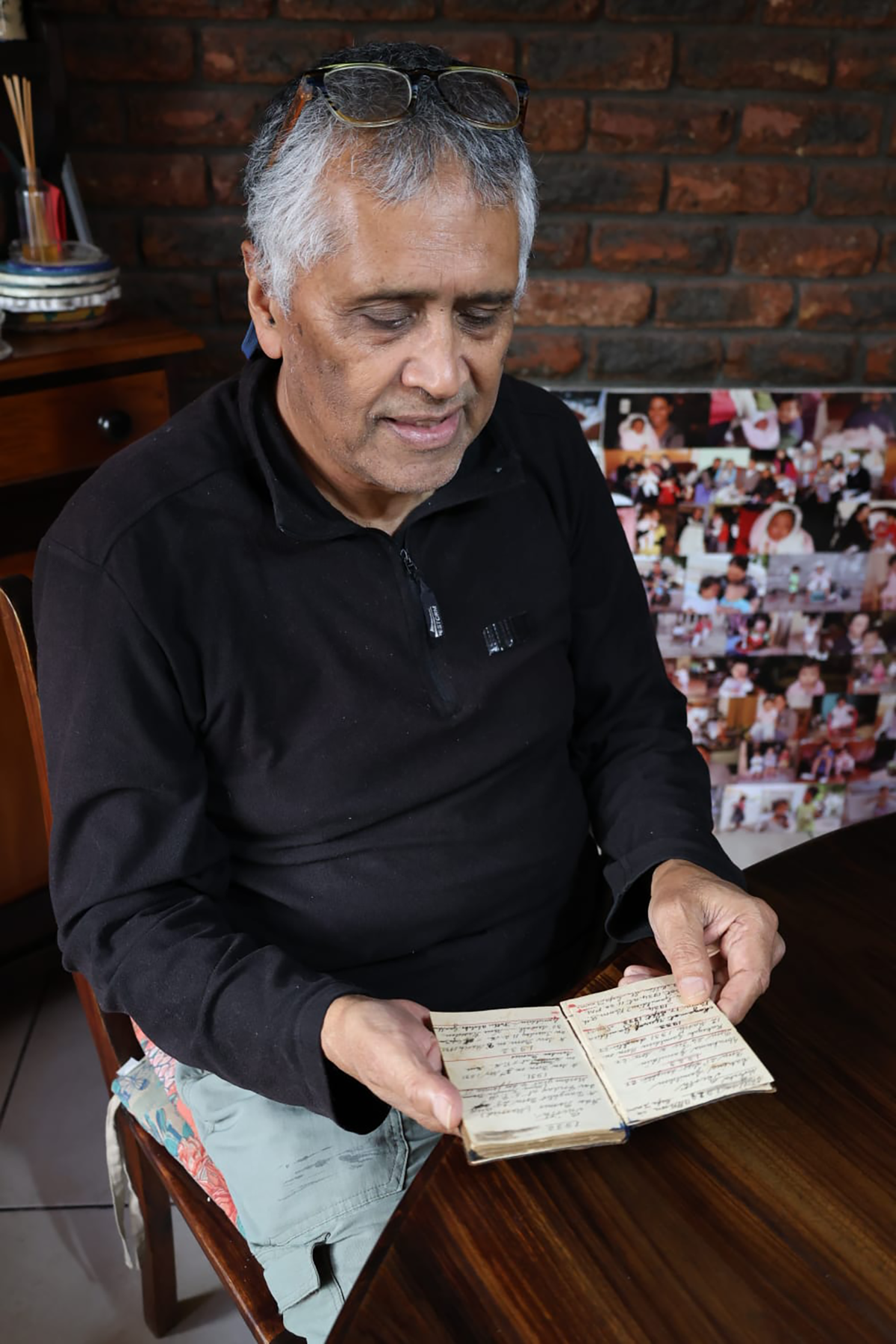
It was Moegamat Kammie Kamedien who pointed me in the right direction. He introduced me to Shamiel Gamildien, trustee of the Cape Family Research Forum, on which both of them have served for decades. Shamiel had in his possession exactly the kind of source I had been looking for.
It fits in the palm of his hand: a pocketbook 130 mm by 85 mm, bound in a navy-blue grained cover with a thin gilt border, its page edges still bright with gold leaf. The paper, once white, has turned a soft brownish yellow. A tiny label inside the back attributes its production to Marcus Ward of London, the well-known Victorian stationer.
Mounted on its first page is a small sepia photograph of a young girl, a patterned headscarf drawn across her lower face, posed against a painted backdrop. She is not named. Shamiel believes that she is most probably Haji Samdon’s wife, Kaamila Samodien.

The book was begun by his great-grandfather, Haji Samdon Gamildien, who wrote on its first page: “This Book is made over from an old date Book in 1903. By H. S. Gamildien, Cape Town. 11-1-03.” In other words, it continued an older family record, one whose whereabouts are no longer known.
A family register
Like many such books of its time, it was kept as the family’s register. In a careful, looping hand, Haji Samdon recorded the births of his children, often to the hour: Rorada, Ebrahiem and Mustapha in Johannesburg in the 1890s, a daughter in Aden in 1899, and then Kassiem, Abdullah, Abobaker, Maymoena and others in Cape Town from 1901.
He recorded deaths as well, with the precision of someone who knew their weight: his father, who died in Mecca in 1898; his mother in 1902; his infant son Abdullah in 1903; his youngest daughter Fatiema, who lived only four weeks in 1910. Burials are noted, usually the same or the next day, and Islamic dates appear alongside the English ones: “17th of Ramadan”, “10th of Muharram”.
Haji Samdon’s own death is recorded too, in another handwriting: he died at 9.30pm on March 23, 1934 at 125 Constitution Street and was buried the following Saturday.
The Spanish flu
Then, in the middle of the book, standing on their own after a run of several blank pages, are two pages unlike anything else in it. The first is headed:
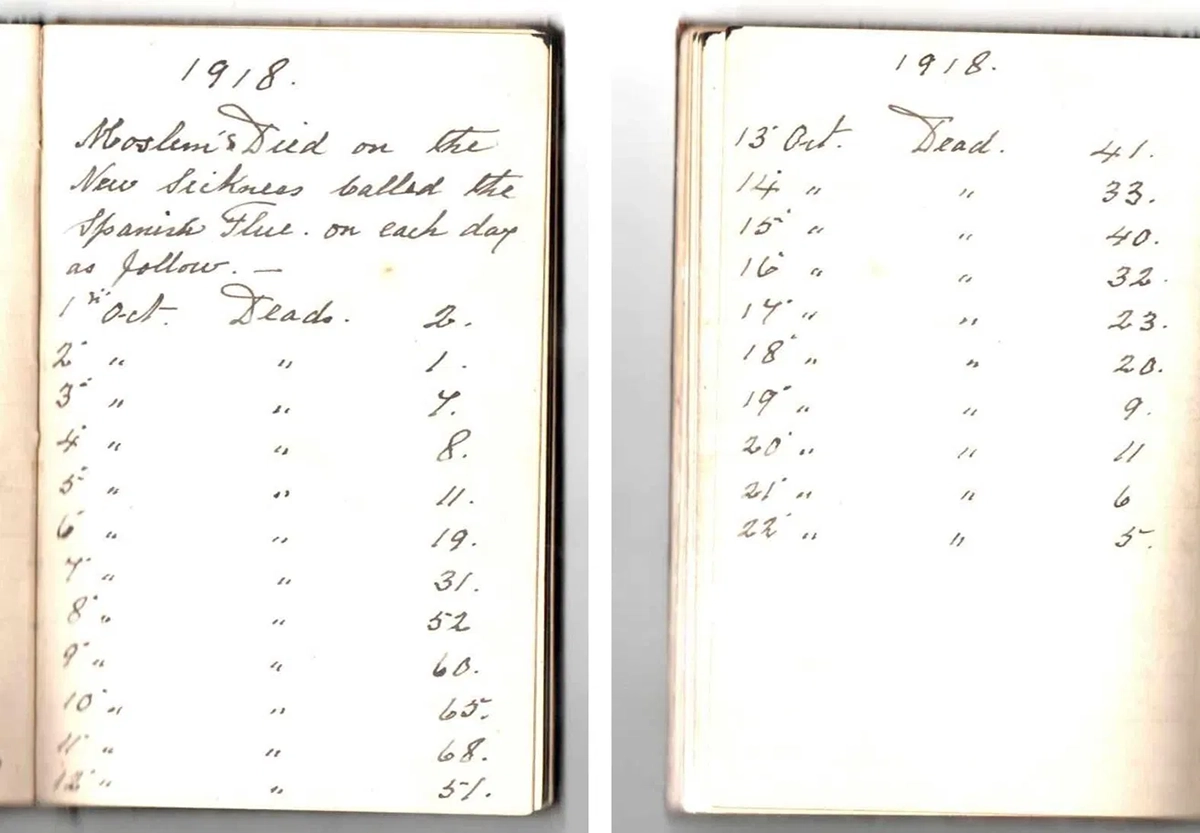
“1918. Moslems Died on the New Sickness called the Spanish Flue on each day as follows.”
Below it, in two neat columns, is a daily count of deaths from October 1 to 22, 1918. It begins with two deaths on the first day and one on the second. Within a week the figure is 31. On October 11 it reaches 68. For six days, from October 8 to 13, between 51 and 68 Muslims died every day. Then the numbers fall away almost as fast as they rose, to five on October 22, where the record stops. In all, the pages record 595 deaths in 22 days.
Those three weeks are what South Africans came to call “Black October”.
The historian Howard Phillips estimates that some 300 000 to 350 000 people, about 6% of the population, died in South Africa’s epidemic, one of the worst death tolls in the world. As one contemporary account quoted by Phillips put it, “Cape Town is like a city of mourning”.
What makes the Gamildien pages remarkable is their focus. Official statistics of the time seldom counted deaths by community. Here, written by a member of the community itself, is a day-by-day tally of the Cape’s Muslim dead. It is a record, in effect, of the janazahs that followed one after another across the city that month.
For my own research, the figures are sobering. At the height of the epidemic, 60 or more Muslims were dying every day, and each had to be washed, shrouded and buried according to Islamic practice, ordinarily within a day. Burying the dead at that rate would have stretched any community’s gravediggers, imams and burial societies to the limit. The book does not say where these 595 people were buried, and it cannot by itself prove that mass burials took place at Mowbray. But it shows the scale of what the community faced, and it gives a precise daily count against which cemetery and burial records can now be checked.
The epidemic reached into the family too. Two entries on the family deaths page fall in those weeks. Haji Samdon’s niece Fatiema, the daughter of his brother Omar, died in Cape Town on Friday, October 18 at 1.05pm. His sister Ada, recorded simply as “Sister Ada”, died in Bulawayo on October 31, as the flu swept through Southern Rhodesia. The book gives no cause of death for either.
Muslim deaths per day, Cape Town, October 1–22, 1918, as recorded in the Gamildien book
You may also want to read


Total, October 1–22: 595. The peak, 68 deaths, came on October 11.
Where did the numbers come from?
Why would a family register contain a count of the whole community’s dead? Shamiel Gamildien offers a possible answer. “He had a part-time job at Somerset Hospital,” he says of his great-grandfather. “I just am not sure, but he could have had access to who died then. And he thought maybe he should write it in some way.” He is careful to present this as a possibility, not a certainty.
Recorded in the moment, or in hindsight?
It is not certain that he wrote the tally as the deaths happened. The heading introduces a finished list (“on each day as follows”); the pages stand apart in the middle of the book; and the columns are so even, with uniform ink and ditto marks, that they may have been written out in one sitting after the epidemic, from figures gathered elsewhere. If so, the family’s own losses in those weeks may have been part of what moved him to set the record down, though the count itself began on October 1, before either family death.
The hand behind the count?
The flu pages are unsigned. But comparing them with Haji Samdon’s signed and dated entries elsewhere in the book gives strong grounds for attributing them to him. The same looped capital “D” appears in “Moslems Died” and in “Sister Ada Died at Bulawayo”, written the same month. The numerals are formed identically. And the flu pages share his most distinctive habit, a full stop between words and after every number (“Flue. on each day”), which runs through all his entries from 1894 onwards.
This is the author’s visual comparison, not a forensic one, but nothing in the handwriting itself points to anyone else at all.
Four generations of keepers: from Samdon to Shamiel
The book’s later history is written into it as well. “This Book was hand over to me – Abobakar Gamildien – by Mother on 30 March 1934,” reads an entry made a week after Haji Samdon’s death.
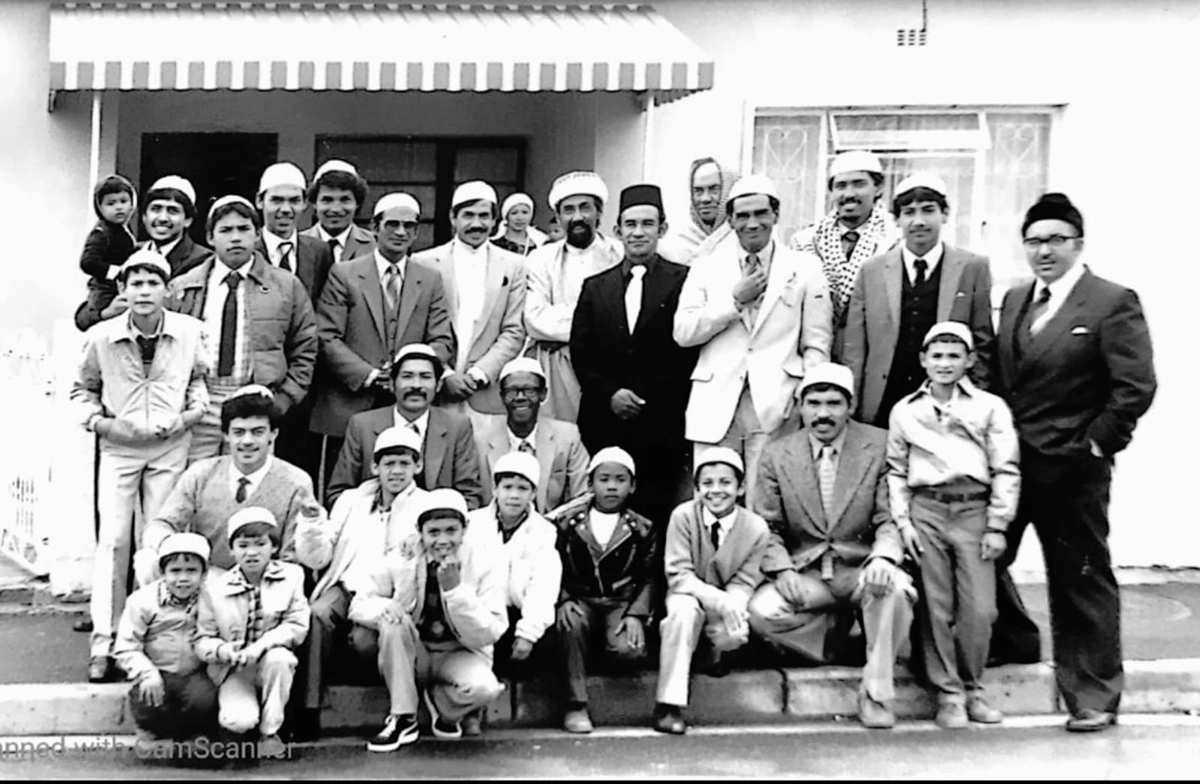
In October 1969, just before he left for Hajj from DF Malan Airport, Abobaker gave it to his eldest daughter, Sakena. She noted: “Daddy have passed this book over to me Sakena on the 5th Oct 1969.”
Sakena was married but had no children, so she passed the book to her brother Kassiem, Shamiel’s father, who kept it safely until he handed it to his son Shamiel. A faint pencilled line records the moment: “Shamiel Gamildien received this book on the 26th August 1986.”
Along the way the book gathered other traces of family life: a long du’a written out in blue capitals in a mix of Afrikaans and Arabic, opening with the Bismillah; a household account from 1953, in which Kassiem handed over his wages of £5 17s; and the births of the generations that followed.
A treasured family record
My thanks to Shamiel Gamildien for allowing me to examine and photograph the book, and to Moegamat Kammie Kamedien for the introduction. Family records like this one were once common in Cape Muslim homes. Many have been lost; others lie forgotten in drawers. The Gamildien book is a reminder of what information they can hold: not only a family’s story, but, often, a window onto the life of the whole community.
Readers who have such manuscripts or other artefacts with information about the history of the Cape Muslim community are invited to contact the writer through Muslim Views. Also note that Awqaf SA has offered to provide assistance to preserve such manuscripts that form part of the Cape Muslim history and heritage.


