













![Does ta’wīl mean interpretation or fulfilment? A Quranic reassessment [+video]](https://muslimviews.co.za/wp-content/uploads/2026/10/Tawil-Kaskas-360x180.webp)





















![Why becoming a wealthy Muslim is commendable in Islam [+videos]](https://muslimviews.co.za/wp-content/uploads/2026/09/Muslim-Trade-Business-1-360x180.webp)











South Africans could face historic fuel price hikes as global oil prices surge following the war on Iran, exposing the country’s dependence on the petrodollar system.
By YUSUF ISMAIL
We are in for a rough ride in South Africa. South African motorists are set for financial depression and real concern at the petrol stations in April, as the ongoing war against Iran and a weaker rand will push up the price of fuel significantly.
A viral video circulated last Saturday, March 21, showing an Engen petrol station in Umhlatuzana in KwaZulu-Natal selling diesel for approximately R29.00. Shocking and unheard of.
According to BusinessTech, the latest data from the Central Energy Fund (CEF) shows that petrol prices are now building for the single biggest jump in South Africa’s history, more than doubling the previous record.
The biggest driver of the coming price hikes is oil, which has surged following the criminal bombardment of Iran by the United States and Israel.
Amy Goodman of Democracy Now last week reported that global oil and natural gas prices are soaring after Israel bombed a massive natural gas reserve in Iran, the largest in the world. At one point earlier this week, the price of oil reached $118 a barrel, a 60 per cent jump since the US and Israel launched their war on Iran.
In an online post, a now deeply deranged Donald Trump threatened to blow up the entire South Pars gas field if Iran continued to target UAE and Qatari oil facilities. Trump also claimed the US ‘knew nothing’ about the Israeli attack on the South Pars gas field, but he was lying as The Wall Street Journal reported that Trump approved the strike to pressure Iran to open up the critical Strait of Hormuz.
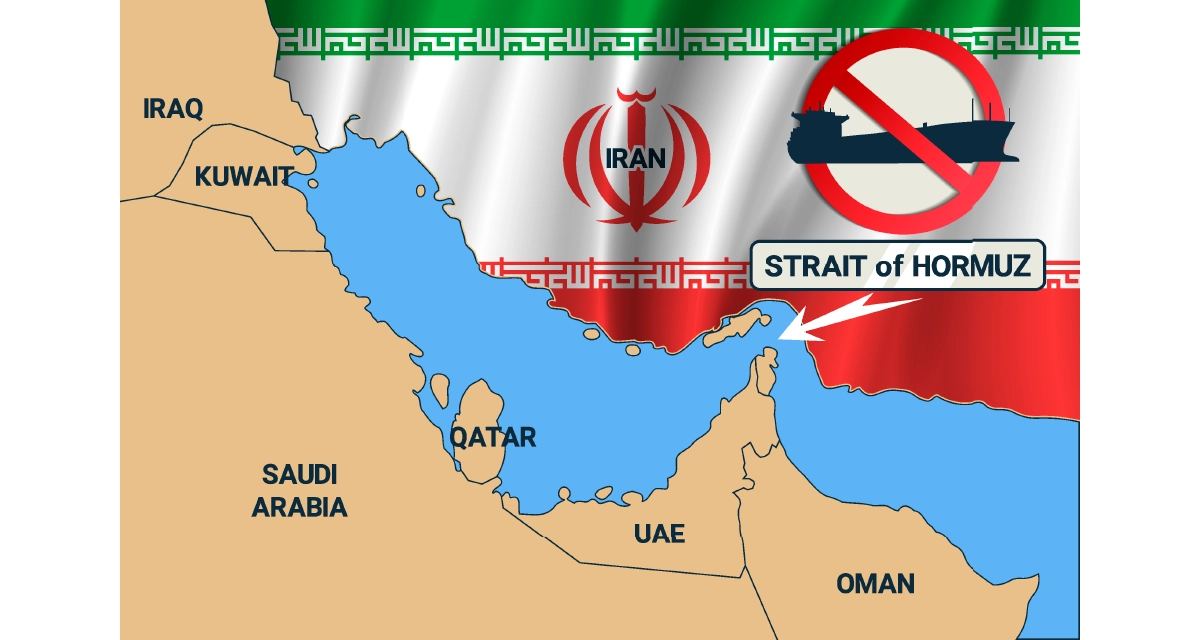
The Strait of Hormuz is key. It is one of the world’s most crucial energy chokepoints, where an average of about 20 million barrels per day is shipped. A chokepoint is an area which, if shut, results in a shock stop of the flow of global trade. Thirty per cent of global oil flows through it. Part of the reason for this is that many of the world’s biggest oil producers are located around the Persian/Arabian Gulf. [See featured image]
The petrodollar system is a global arrangement where oil-exporting countries price and sell their crude oil in United States dollars. All the Gulf states have to sell their oil in dollars to the US and globally. The dollars they receive are then invested back into the US economy by these states. This is nothing more than a mafia enterprise.
This system, established in the 1970s, has been a cornerstone of global finance, ensuring a constant worldwide demand for the dollar. The fundamental basis of the US imperial order since the end of the Second World War has been, on the one hand, petroleum and, on the other hand, the US dollar. The globe’s production and financial systems are dependent on the petroleum that the US has controlled and which, until the nationalisation of oil in the 1970s and 1980s, accounted for something like 60 per cent of the world’s oil reserves.
Petrodollar impact on South Africa
The sale of oil in US dollars forces South Africa to bear higher fuel and logistics costs when oil prices rise and the rand weakens. As a heavy importer of dollar-denominated oil, this system drives up local inflation, raises interest rates, and stifles economic growth. Because oil is priced in US dollars, a weakening rand against the dollar makes imports more expensive, directly increasing petrol and diesel prices.
South Africa relies heavily on the petrodollar system, primarily because it is a net importer of petroleum products, which are priced and traded globally in US dollars. This reliance makes the South African economy vulnerable to the strength of the dollar and fluctuations in oil prices. High oil prices drive up transportation, logistics and food costs.
In 1970, the exchange rate for the British pound to the South African rand was approximately £1 = R1.71. This is hard to believe for those of us born in the 1980s or the Gen Z generation. During that time, the rand was stronger than it is today, often trading at a value even higher than the US dollar.
When the rand was first introduced in 1961 to replace the South African pound, it was set at a rate of £1 = R2.00. By the late 1960s and early 1970s, the rand had gained significant value against the pound, reaching levels around R1.61 in 1968 and roughly R1.71 by 1970. For shocking comparison, as of March 2026, the rate is approximately £1 = R22.65.
The South African rand was stronger than the US dollar from its introduction in 1961 until early 1982. During this period, the rand was often worth over US$1.40. The rand reached its strongest level of approximately US$1.35 in 1980. Today, we have been reduced to beggary.
Iran’s challenge to the petrodollar system
You may also want to read


The fact that Iran is looking for alternatives to the dollar in order to challenge the petrodollar regime, one of the foundations of the US empire, is something we should support. This could lead to a potentially new world order post this illegal war, where there is a multipolar financial system and the dollar is no longer the single dominant global currency.
South Africa needs to hit back now. South Africa buys oil and refined petroleum products in US dollars, even though it pays using the South African rand. It pays dollars to a country whose currency is not dollars. The insanity of it all. Because South Africa is a net importer of fuel, this dependence means that when the rand weakens against the dollar, fuel prices rise, increasing inflation across the economy. South Africa can settle oil and gas imports in non-dollar currencies, specifically Chinese yuan or directly in local currencies like the Nigerian naira.
It is time to end the petrodollar reliance once and for all. We could start regulating fuel prices and use the obscure Petroleum Products Act of 1977 to increase control. Nationalisation could be achieved by amending the Mineral & Petroleum Act of 2002 to force state participation in all new exploration and production projects for possible oil. However, South Africa currently imports nearly 80 per cent of its fuel, making complete nationalisation a logistical nightmare. Hence, the Iranian erosion of the petrodollar system is something we need to support. If Iran can challenge the petrodollar system by demanding alternative currencies, specifically the Chinese yuan, for oil sales — particularly for exports passing through the Strait of Hormuz — and shutting down Israeli/American access, we may one day see petrol being sold at R5 a litre.
Yusuf Ismail is a criminal defence lawyer and founder of the South African Debate Initiative.