











![Does ta’wīl mean interpretation or fulfilment? A Quranic reassessment [+video]](https://muslimviews.co.za/wp-content/uploads/2026/10/Tawil-Kaskas-360x180.webp)














![Why becoming a wealthy Muslim is commendable in Islam [+videos]](https://muslimviews.co.za/wp-content/uploads/2026/09/Muslim-Trade-Business-1-360x180.webp)






Mahmudah Begum Jaffer’s Janubi Zakhrafa breaks new ground in Islamic manuscript illumination, blending sacred geometry with South African flora and identity.
By SHAFIQ MORTON
One of humankind’s most basic impulses has always been the urge to visually communicate meaning.
From the 73 000-year-old San cross-hatches in the Blombos Cave, to the 27 000-year-old zigzags, handprints and shamanistic shapes in the Richtersveld, to the patterned friezes and enigmatic figures of America’s first peoples, humanity has consistently left behind cryptic suggestions of its past.
This expression speaks to the seen and unseen worlds intuitively observed by the first peoples of fitrah, spread across the great fluvial cradles of the Nile, the Tigris, the Zambesi, the Euphrates, the Amazon and the Indus.
As the only species on earth with a consciousness beyond itself, humans learned to communicate through pictographs. These evolved into Sumerian wedges etched on clay, writings on parchment and papyrus rolls, and eventually paper. Writing – perhaps humanity’s greatest symbol – would ultimately become the medium of divine messaging.
The illumination of texts, I believe, originates in primeval geometric shapes expressed on rock faces: circles, dots and waves – hauntingly beautiful forms that enhance or inform the environmental context of millennia-old messages.
The art of illumination – adding adornment to manuscripts – dates back to the first century CE, when the Chinese invented paper. By the fourth century, Christian scribes were using richly coloured pigments, as well as gold and silver leaf, to decorate Biblical manuscripts.
Islamic illumination, which emerged after the seventh century, is the art of applying ‘light’ to mushaf, or sacred texts. Primarily, it utilises biomorphic patterns structured on geometric grids. Careful to avoid depicting human forms, these patterns are emblematic of tawhid, or divine unity.
For centuries, illumination has been inspired by the environments from which it has emerged. Floral illuminations, for example, reflect the indigenous flora of Persia or Central Asia. While often perceived as a subtle detail, illumination is deeply rooted in identity and symbolism.
Arabic script, the textual focus of the illuminated page, also developed strong regional styles. More recently, there have been efforts to indigenise Arabic calligraphy at the Cape. Its chief protagonist has been calligrapher Faheem Jackson, who, drawing on aspects of Tuan Guru’s Jawi-Maluku style, has been developing the Janubi (South African) script.
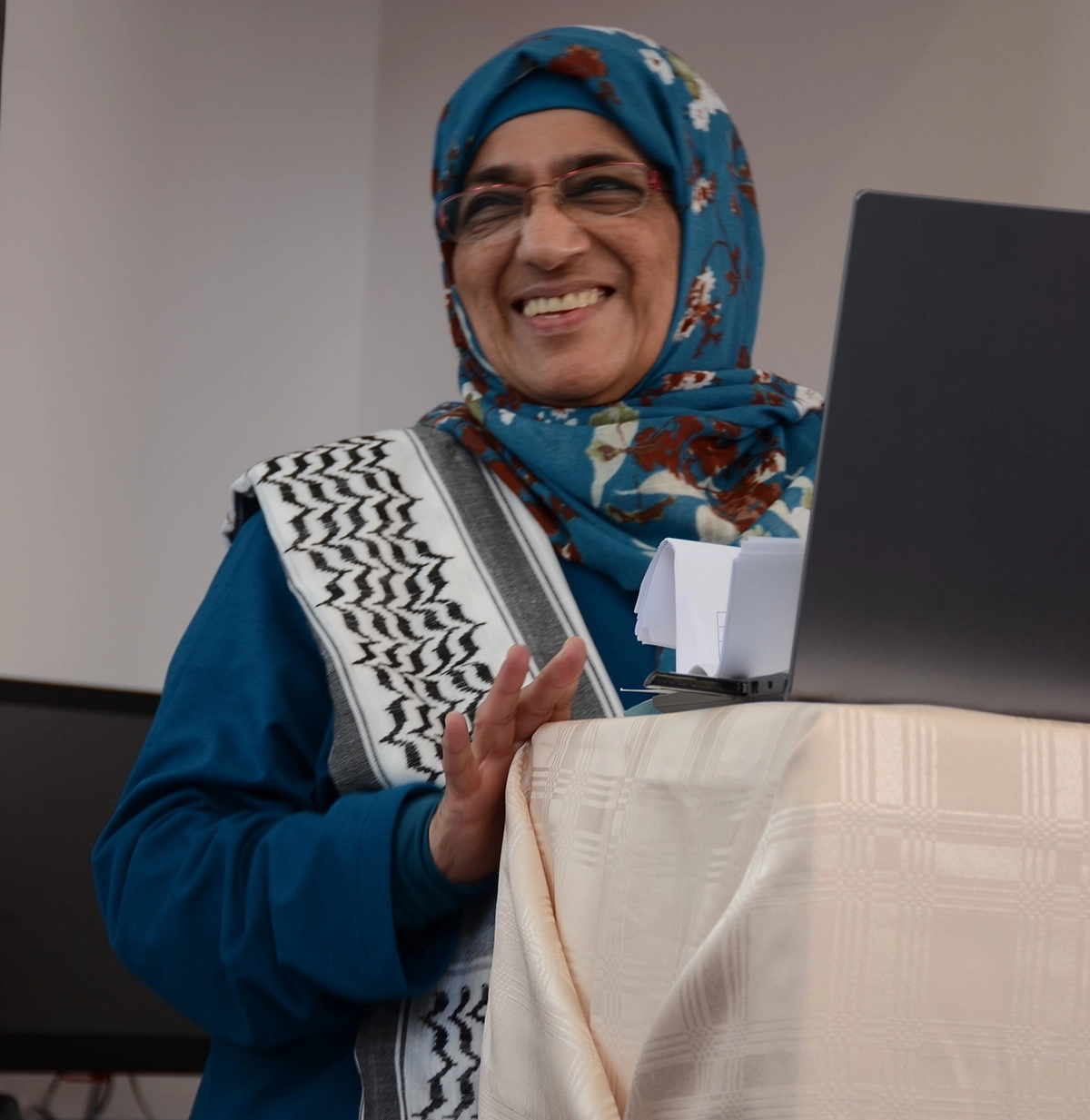
At the same time, local artist Mahmudah Begum Jaffer has been breaking exciting new ground in illumination. She labels her work Janubi Zakhrafa, signalling a distinctly South African expression.
She has recently published Janubi Zakhrafa: Patterns in Islamic Line Design (South African Expression in Islamic Manuscript Illumination).
Within its pages, readers are introduced to the concept of Islamic line design through hadith, using line drawings as teaching tools. For example, the Prophet (SAW) once drew lines in the sand, placing his hand on the central line while reciting: ‘This is my straight path.’ (Sura Al-An‘am, 6:153)
Among Jaffer’s most painstaking and exquisitely detailed works is her adoption of the strelitzia, symbolising the pioneers of Islam. The ten outer petals of the protea represent the ten days of Muharram, Hajj and the last third of Ramadan.
You may also want to read


![A mother’s taweez and the Cape’s interfaith traditions [+ video]](https://muslimviews.co.za/wp-content/uploads/2026/05/Michael-Weeder-Book-Launch-9May26-120x86.webp)
Her use of local flora is both ingenious and layered with meaning. A baobab is stylised into forty leaves, while a begonia leaf shaped into a heart sprouts a protea, four strelitzia heads and the five-petalled shepherd’s delight – a reminder of the five pillars of Islam.

What strikes the reader most profoundly, as one surrenders to the book’s richly illustrated pages, is the level of detail. It is not merely a celebration of indigenous flora, but a powerful statement of South Africa’s artistic contribution to the Muslim world.
This book comes highly recommended. Jaffer demonstrates the importance of developing our own illumination traditions, and even envisages the Quran penned in a uniquely Janubi script, accompanied by Janubi Zakhrafa illumination.
Such a manuscript would stand proudly alongside the finest illuminated works in the Muslim world. It would indeed be a pity if local talent of this calibre were overlooked.