












![The market-builder who restrained the market [Part 2]](https://muslimviews.co.za/wp-content/uploads/2026/08/PHOTO-2026-08-25-17-16-32-360x180.jpg)
![The merchant preceding the Prophetic mission [Part 1]](https://muslimviews.co.za/wp-content/uploads/2026/08/01-360x180.jpg)





MAHMOOD SANGLAY
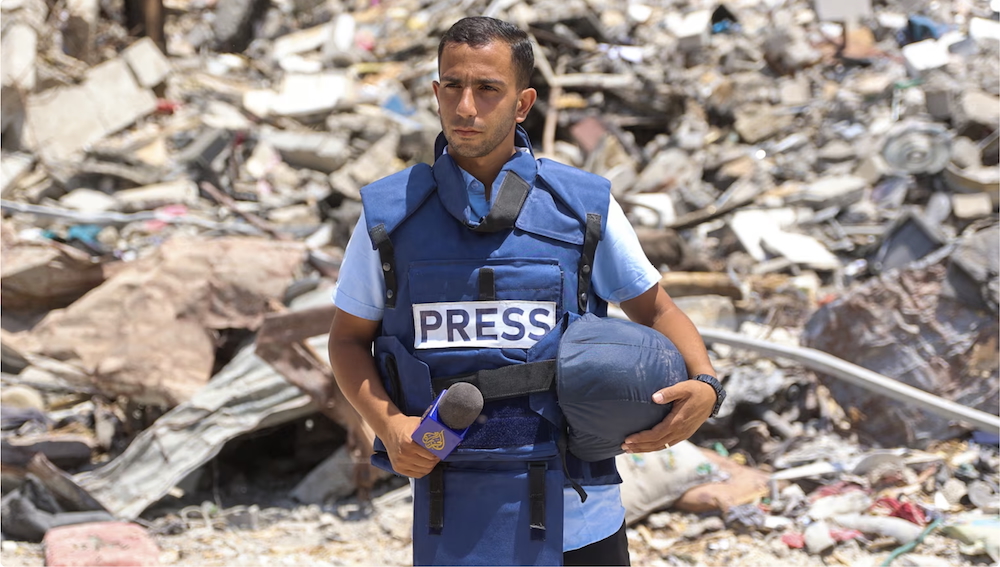
On August 10, 2025, Israel murdered journalist Anas al-Sharif in a planned execution. The Al Jazeera correspondent had warned that Israeli officials were threatening him.
Al-Sharif asked the UN Special Rapporteur on freedom of expression, Irene Khan, to go public precisely so that the threats would not end in a missile strike. He went back to work anyway. Days later, an Israeli strike hit a clearly marked media tent outside Al-Shifa Hospital, killing al-Sharif and five Al Jazeera colleagues – Mohammed Qureiqa, Ibrahim Zaher, Moamen Aliwa and Mohammed Noufal – along with freelance journalist Mohammed al-Khalidi.
Israel then did what it increasingly does in Gaza: it justified the killing by smearing the dead as ‘terrorists in press vests.’ This was not ‘collateral damage.’ It was the application of a policy.
Smear, isolate, kill
The Hind Rajab Foundation (HRF) and the Palestinian Center for Human Rights (PCHR) have filed an Article 15 Communication to the International Criminal Court, mapping the chain of command from the drone operators to Israel’s highest political leaders. Named in the filing are senior military commanders, intelligence chiefs, and government spokespersons—among them Colonel Avichay Adraee, who led a sustained social media smear campaign against al-Sharif, mocking his emotional reporting and branding him a Hamas operative.
The pattern is consistent: Label journalists as ‘terrorists’ without proof, then smear them publicly to dehumanise and pre-justify their killing. And finally eliminate them in targeted strikes, often while they are clearly marked as press.
As Irene Khan put it, these are not deaths in the context of war but a ‘deliberate strategy to stop independent voices reporting’.
Deadliest conflict for journalists in modern history
The Gaza Government Media Office lists 238 killed journalists and media workers—names preserved for the record . Each is a human being with a family, silenced for the act of bearing witness.

Research published in Shattered Lives, Unbroken Stories (De Gruyter, 2024) documents how Gaza has become the deadliest place for journalists since records began in 1992 . At the time the study was published Israel had already killed 102 Palestinian journalists. Shahira Fahmy et al describe conditions unique in modern conflict: the complete ban on foreign reporters, forcing local journalists to be the world’s only independent eyes; repeated targeting of homes, families, and clearly marked press vehicles; and a collapse of safety gear into a target identifier rather than a shield.
This is not accidental attrition. It is the systematic destruction of the witness corps.
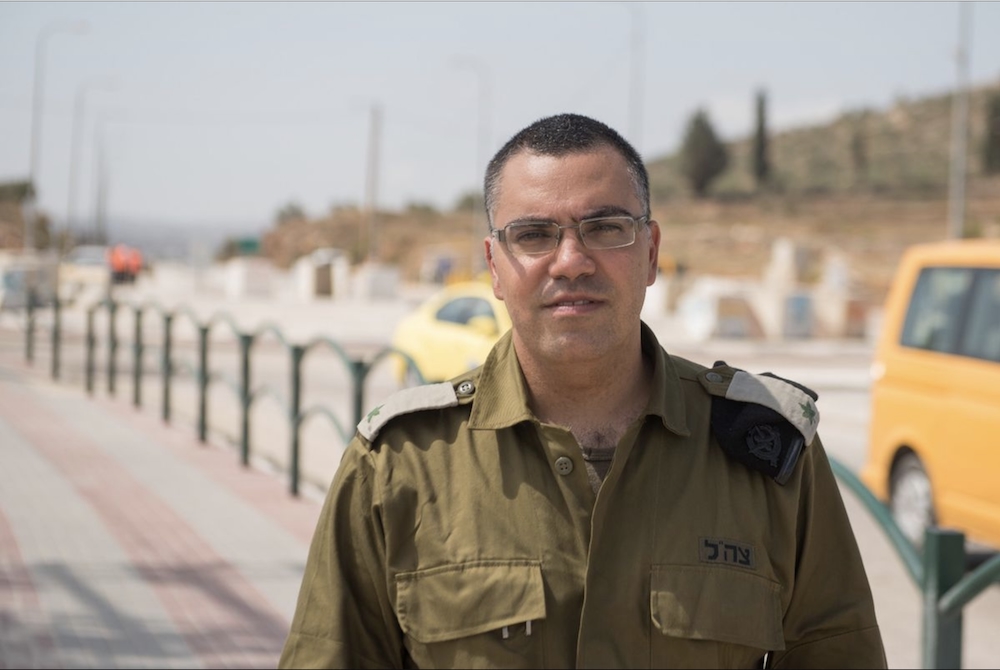
Photo X
South Africa and Africa Respond
In South Africa, the South African National Editors’ Forum (SANEF) condemned the killings with ‘deepest repugnance,’ noting that Israel has publicly admitted targeting journalists while producing no evidence to support its allegations. SANEF reaffirmed that journalists are civilians under the Geneva Conventions and called for accountability through the UN, the Committee to Protect Journalists, and Reporters Without Borders.
Across the continent, the Network of Independent Media Councils in Africa (NIMCA) and the World Association of Press Councils (WAPC) issued statements demanding an independent international investigation, the lifting of Israel’s media blockade, and recognition of journalists as protected persons in conflict .
You may also want to read


Their message is simple: if the killing of journalists in Gaza goes unpunished, no newsroom anywhere is safe.
But solidarity statements alone are not enough. We must also confront the complicity that creeps in through more insidious channels: compromised journalism at home. Writing for Muslim Views, Hassen Lorgat revealed that three prominent South African media outlets—The Sunday Times, The Citizen, and BizNews—accepted SA Jewish Board of Deputies (SAJBD)-funded trips to Israel and then published stories without disclosing the sponsorship. The goal was to produce supposedly ‘balanced’ coverage of Israel-Palestine while erasing the context of occupation, siege, and war crimes.
These publications breached clauses in section 1 of the of the Press Code, dealing with the gathering and reporting of news, as well as section 2, dealing with independence of conflicts of interest in reporting. These are not a minor lapses.It is a breach of the code which explicitly requires transparency when an outside entity pays for or facilitates newsgathering. By failing to disclose, these outlets misled readers, compromised their independence, and allowed themselves to be conduits for state-aligned propaganda.
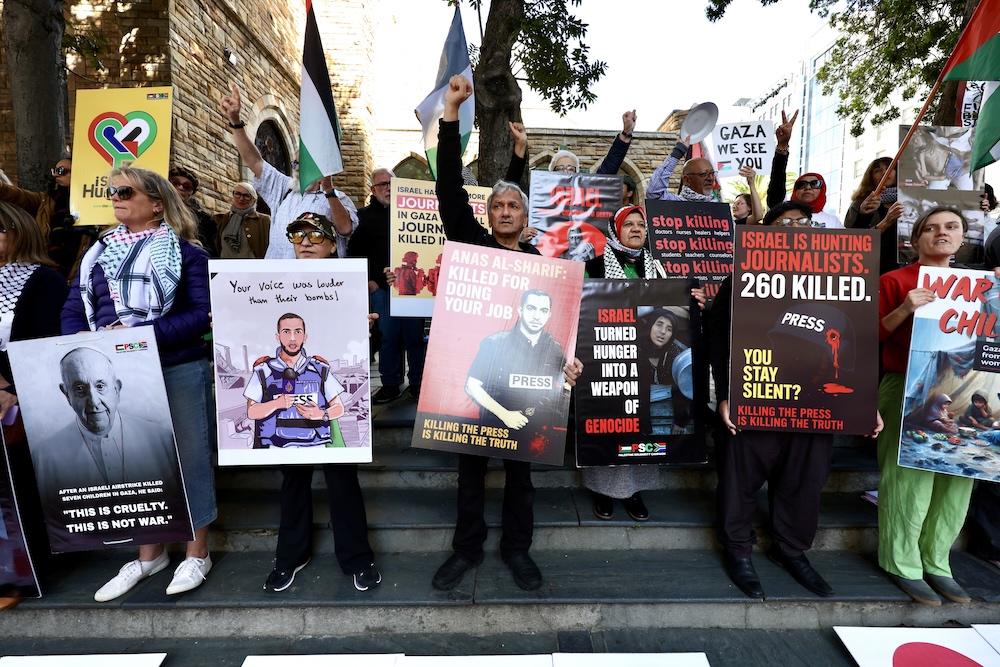
Photo Supplied
In addition, ‘balanced’ reporting on a plausible genocide cannot ignore vital context of the narrative. This includes the Israeli occupation preceding October 7, 2023, decades of massacres of Palestinians and the relentless expansion of Israeli settlements, in violation of international law.
The journalistic ethical rot here is directly connected to the murder of journalists in Gaza: a press that hides its sponsors at home is less likely to hold foreign power to account abroad. And it is less likely to offer an honest narrative of the conflict. It is the domestic counterpart to the ‘smear before the strike’ doctrine—softening audiences with compromised narratives so that when the missile falls, outrage is muted.
Israel’s ability to kill journalists with impunity depends on more than drones and missiles. It depends on narrative control—on the indulgence of international actors willing to excuse violations as ‘complex’ or ‘tragic mistakes,’ and on media ecosystems willing to launder propaganda.
The atrocity on August 10 is a powerful case study in Israel’s calculated war on journalists. Just hours before the attack, Netanyahu publicly claimed that Israel would allow journalists into Gaza to ‘protect their safety.’ Yet, soon thereafter, the IDF deliberately targeted and destroyed the last independent media presence in northern Gaza. The sequence could not have been more brazen: Israel can murder journalists in plain sight and complicit media houses will still offer ‘balance’ on a genocide.
What must be done
To confront Israel’s systematic targeting of journalists, the full record of 238 (and counting) murdered media workers must be preserved as evidence and presented in every legal forum, from the ICC to national courts, while building cases—like the HRF–PCHR submission—that name commanders, trace orders, and seek arrest warrants for both political and military leaders. International media must have unescorted access to Gaza, with journalists afforded protections equal to those of humanitarian workers, and newsrooms must uphold ethical integrity by rejecting undisclosed sponsored trips, correcting errors transparently, and enforcing the Press Code.
Press bodies such as SANEF, NIMCA, and WAPC should unite to demand an independent investigation into these killings and defend global press freedom, while governments must cease arming a state that kills protected civilians, impose sanctions on those responsible, and support prosecutions for crimes against journalists.
Al-Sharif’s prepared message, released after his death, reads:
‘If these words reach you, know that Israel has succeeded in killing me and silencing my voice… Do not forget and do not forget me in your sincere prayers for forgiveness and acceptance’.
We owe him more than remembrance. We owe him a profession that refuses to collaborate in its own destruction, a public that demands truth over spin, and a legal order that treats the murder of journalists not as an occupational hazard, but as the crime it is.
Mahmood Sanglay is CEO of Muslim Views and the Association of Independent Publishers (AIP) representative on the Adjudication Panel of the Press Council of South Africa.