













![The market-builder who restrained the market [Part 2]](https://muslimviews.co.za/wp-content/uploads/2026/08/PHOTO-2026-08-25-17-16-32-360x180.jpg)
![The merchant preceding the Prophetic mission [Part 1]](https://muslimviews.co.za/wp-content/uploads/2026/08/01-360x180.jpg)






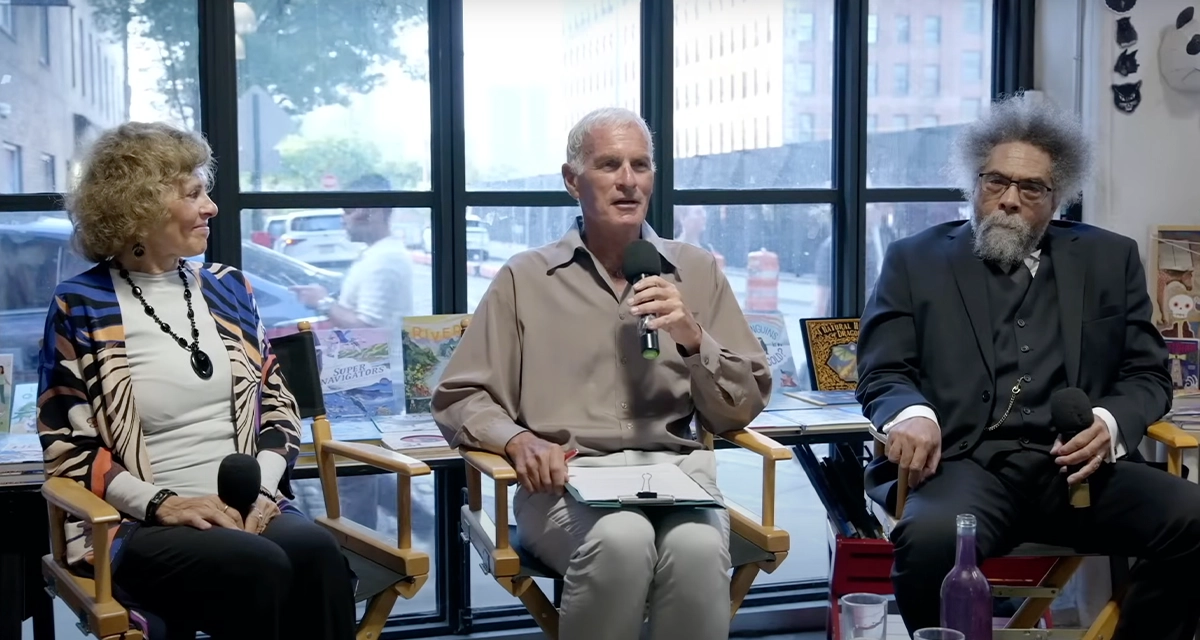

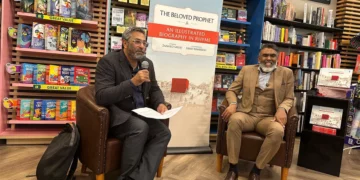
On July 17, 2025, an engaging panel discussion was hosted by OR Books at the Powerhouse Arena in Brooklyn, New York, featuring three eminent scholars, Prof Norman Finkelstein, Dr Cornel West, and Dr Nadine Strossen. MAHMOOD SANGLAY offers a critical analysis of the discussion.
The panel discussion is a timely engagement with the dilemmas of free speech amidst Israel’s ongoing genocide in Gaza, and the panellists engaged in this high-stakes moral contest with admirable clarity. Yet, to better appreciate its implications, we must locate this dialogue within a broader legal, media, and ethical ecosystem – one shaped by the genocidal violence in Gaza and the eroding space for critical discourse in Western democracies.
Free speech and legal failures
Both Finkelstein and Strossen correctly highlight that US constitutional law provides expansive protection for speech, even that which is hateful or offensive. Yet, legal protection is not synonymous with moral legitimacy. A reliance on ‘viewpoint neutrality’ in Western democracies structurally disadvantages Palestinian voices. In contexts of asymmetrical power, formal legal equality functions as a screen for material inequality.
Finkelstein’s call to draw a ‘moral ceiling’ above the constitutional ‘floor’ is quite relevant in this light. His position is an ethical demand for accountability, particularly when it comes to those complicit in war crimes. His analogy – inviting war criminals to speak at universities as akin to inviting lynchers to Emmett Till memorials – is more than rhetorical. As the UN has reported, Israel’s campaign has involved systematic attacks on civilians, hospitals, and schools, with potential violations of international law amounting to genocide. In this context, platforming perpetrators is not just tasteless – it is politically consequential.
Gaza is a real catastrophe
One of the strongest aspects of the discussion is its framing of Gaza as the moral centre of the discussion. Unlike many academic and journalistic treatments that abstract Gaza into a rhetorical device, the panel – particularly Finkelstein and West – repeatedly insist on its material and human reality. The international media’s ‘selective blindness’ and failure to name the violence as genocide must be denounced.
Strossen’s caution against censorship is fair, but her framing risks conflating critique of speech with suppression of it. The real threat to free speech is not public scrutiny of offensive speakers, but institutional gatekeeping that systematically excludes Palestinian perspectives. In the name of neutrality, universities silence voices calling for decolonisation while hosting generals who direct airstrikes.
The panel should be commended for foregrounding this contradiction, yet it stops short of confronting the complicity of liberal institutions in normalising genocidal speech under the guise of balance.
Cancel culture, power and selective speech policing
There is a convergence among all three speakers on the dangers of selective censorship on campuses. The discussion exposes how speech about Gaza – especially from students and scholars critical of Israel – is disproportionately targeted for repression. ‘Cancel culture,’ often caricatured as a leftist tool, is revealed here as a mechanism of state and institutional power, deployed to silence Palestinian solidarity while preserving elite consensus.
Finkelstein condemns the ‘pseudo-left’ that sacrifices principle for popularity. Meanwhile, West’s warning about trauma being wielded as power invites a deeper reflection: how does suffering become commodified to suppress the suffering of others?
You may also want to read


Yet, while the report celebrates this alignment, it could probe more deeply the political economy behind such cancel culture. Why do universities – supposed bastions of free inquiry – act as enforcers of geopolitical orthodoxy? Who funds them? Who sits on their boards? These silences point to a broader systemic complicity that remains unaddressed.
One of the most compelling sections of the report centres on Finkelstein’s argument that certain voices – particularly those responsible for atrocities – should not be given the dignity of a platform. He does not call for their silencing through state force, but through collective moral judgment.
The media’s responsibility is not merely to host all views, but to critically curate public discourse in ways that honour the humanity of victims. Allowing those responsible for mass death to speak without meaningful confrontation desecrates not only memory, but truth itself.
Strossen’s counterpoint – ‘Let them speak but interrogate them’ – is theoretically sound but practically weak. In today’s heavily moderated and PR-managed academic landscape, ‘interrogation’ often means moderated questions and polite applause. Finkelstein’s emphasis on moral line-drawing thus becomes not illiberal, but a demand for integrity.
Speech is crucial in a time of genocide
The international community has failed in its responsibility to prevent or even name the Gaza genocide. In this climate, free speech is not a neutral virtue, but a tool of either complicity or resistance. The speakers recognise this – but perhaps they understates it.
West’s declaration that Gaza is ‘not a metaphor but a moral test’ captures the moment’s urgency. Yet the report could benefit from deeper engagement with how speech acts as a form of political mobilisation. Speech in this context is not only expressive – it is strategic. When students chant ‘From the river to the sea,’ they are not merely asserting identity but challenging the architecture of occupation.
Strossen’s model of classical liberalism, while admirable in theory, is poorly equipped to navigate this terrain. Media systems in the West are not neutral platforms – they are ideological ecosystems designed to protect state-corporate alliances. To pretend otherwise is to mistake the map for the territory.
This discussion presents a vital conversation at a time of unprecedented ethical crisis. Yet it also reveals the limits of free speech discourse when detached from the structural conditions of violence and domination.
Finkelstein’s moral absolutism, West’s prophetic libertarianism, and Strossen’s legal liberalism each offer valuable insights. But speech alone is not enough. In an age of genocide, the real question is not simply ‘who can speak?’ but ‘whose speech interrupts power – and at what cost?’
This is the moral terrain that lies beneath the constitutional floor. And it is there, amid the rubble of Gaza and the silencing of truth-tellers, that the future of free speech will be decided.