














![Does ta’wīl mean interpretation or fulfilment? A Quranic reassessment [+video]](https://muslimviews.co.za/wp-content/uploads/2026/10/Tawil-Kaskas-360x180.webp)





















![Why becoming a wealthy Muslim is commendable in Islam [+videos]](https://muslimviews.co.za/wp-content/uploads/2026/09/Muslim-Trade-Business-1-360x180.webp)








The Sunnah is more than a collection of outward practices.
SHAYKH NISHAAT AHMED SIDDIQI explores how the Prophetic example shapes character, cultivates mercy and guides believers towards inner transformation and complete humanity.
When many people hear the word Sunnah, they immediately think of certain outward practices of Prophet Muhammad ﷺ: how he ate, how he dressed, how he prayed, or how he greeted others.
These actions are indeed part of the Sunnah. They are precious and worthy of love and preservation. Yet, from a deeper perspective, the Sunnah is far greater than a collection of practices. It is not merely a list of things that the Prophet (pbuh) did. It is the way he lived, the way he saw, the way he loved, and the way he stood before Allah. In its broadest sense, the Sunnah is the path of complete humanity.
The word sunnah means a path, a way, or a well-trodden road. The Prophet ﷺ did not simply teach this path; he embodied it. His life became the living expression of Divine manifestation and guidance.
After his passing, his wife, Aisha (RA), was asked about his character. She replied: ‘His character was the Qur’an.’
The Qur’an was not merely something he recited. It had become his nature and essence. Mercy, patience, justice, humility, forgiveness, generosity, compassion and wisdom were all visible in his conduct and interactions.
In him, revelation became visible. It is perhaps for this reason that Allah says:
‘Indeed, in the Messenger of Allah you have an excellent example for whoever hopes for Allah and the Last Day and remembers Allah much.’ (Sura Al Ahzab, 33:21)
Prophet Muhammad (pbuh) is not merely a teacher of Islam. He is the model of what it means to be truly human.
There is great blessing in following the outward practices of the Prophet (pbuh). Yet many of the early Sufis have always reminded us that the outer form is meant to lead us to an inner reality. Two people may perform the same action, yet they are not necessarily experiencing the same reality.
Two people may bow in prayer. One simply bends his body. The other bows with his heart. The outward action may be the same, but the inward reality is entirely different. The Sunnah is therefore not simply about copying movements. It is about allowing the qualities of the Prophet ﷺ to transform our own hearts.
The Sunnah is all about adab. ‘Tasawwuf is adab,’ is a well-known description of Sufism. Adab is usually translated and understood as good manners or etiquette, but its meaning is much deeper. Adab is the appropriate behaviour in any given situation, putting everything in its proper place.
It means recognising what is due to Allah, what is due to people, and what is due to ourselves. The Prophet ﷺ embodied perfect adab. He showed adab with Allah through complete servanthood. He showed adab with his family through kindness and tenderness. He showed adab with children by entering their world and understanding their hearts.
He showed adab with the poor by honouring their dignity. He showed adab with his enemies through forgiveness. He showed adab with nature and animals through mercy and compassion. Nothing was beneath his concern. The Sunnah, therefore, is not merely about external behaviour. It is about learning how to relate correctly to all of existence.
The Sunnah, when incorporated into our daily lives, brings balance. One of the remarkable features of the Prophet ﷺ was his perfect balance. He worshipped deeply, yet remained fully engaged in the world. He loved solitude, yet lived among people. He led armies, yet wept in prayer. He possessed authority, yet he served his family and mended his own clothes.
Perhaps one of the deepest dimensions of the Sunnah is that it reconciles apparent opposites. Human beings have a tendency to fall into extremes. We become overly rigid or excessively permissive, withdrawn from the world or consumed by it, harsh in the name of truth or so accommodating that truth itself is lost.
The Sunnah brings harmony where there is division and balance where there is excess. In the person of the Prophet ﷺ, qualities that appear opposite to one another were brought together in perfect proportion. In him, strength was never separated from mercy, justice was never separated from compassion, and wisdom was never separated from love.
He possessed majesty, yet he was gentle. He had authority, yet he remained a servant. This is why the closer one comes to the Prophetic way, the more integrated one becomes. The fragmented self begins to heal. Contradictions begin to dissolve. The struggle between the various dimensions of our being slowly gives way to wholeness. For the Sunnah is not merely a path of actions. It is the art of becoming inwardly balanced. And perhaps balance itself is one of the signs of the Insan-i Kamil.
The ego tends towards extremes, while the Sunnah restores balance.
The Sunnah is also an expression of Divine mercy. Allah describes the Prophet ﷺ as:
‘We have not sent you except as a mercy to all the worlds.’ (Sura Al Anbiya, 21:107)
Notice that Allah does not say that he was sent as a mercy to Muslims alone. His mercy embraced humanity, animals and all creation. His life demonstrated that strength and mercy are not opposites. The Sunnah teaches us that to become more human is to become more merciful.
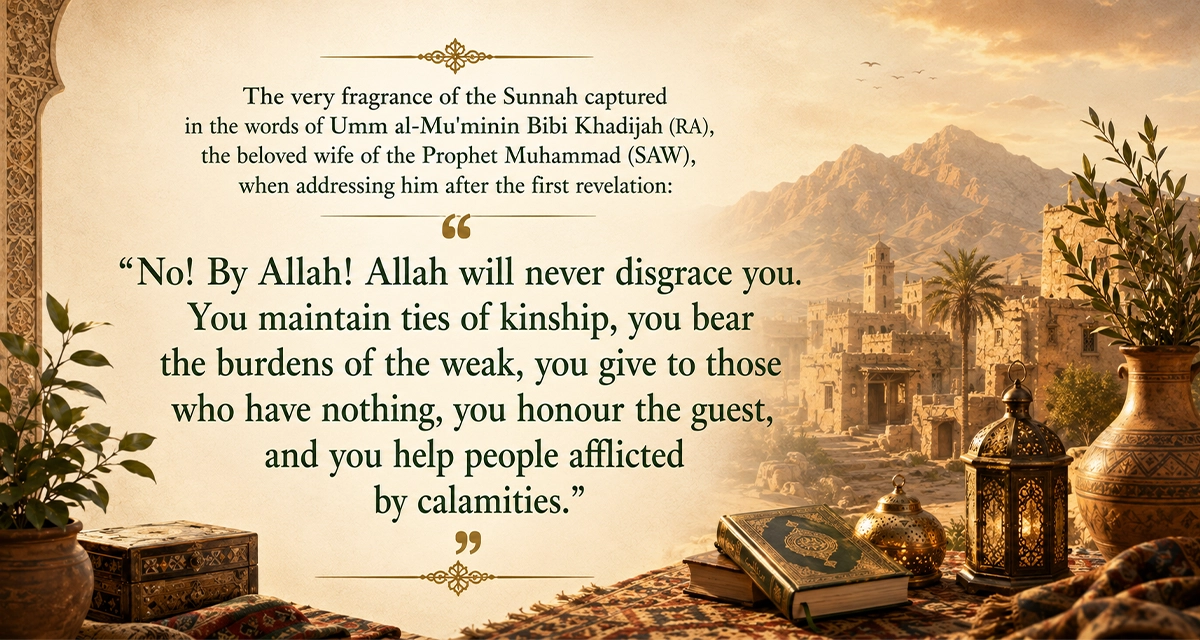
When the first revelation came and he returned home shaken and overwhelmed, Khadijah (ra) reassured him with words of remarkable insight and tenderness:
‘No! By Allah! Allah will never disgrace you. You maintain ties of kinship, you bear the burdens of the weak, you give to those who have nothing, you honour the guest, and you help people afflicted by calamities.’
Reflect carefully on her words. She did not speak about extraordinary spiritual states. She spoke about character. She spoke about mercy, and about the goodness that flowed naturally from him.
One could say that she was describing the very fragrance of the Sunnah. In many ways, Khadijah’s testimony may be one of the earliest and most intimate descriptions of the Sunnah itself. Long before scholars would compile books on the Sunnah, she had already recognised it. It is the Sunnah seen through the eyes of love. And perhaps there is no clearer witness.
Perhaps one of the deepest aspects of the Sunnah is that the Prophet ﷺ lived in constant awareness of Allah. His prayer was remembrance, as was his work. His silence was remembrance, and so was his speech. Everything about him was presence and awareness. Even ordinary actions became acts of worship because they flowed from awareness of the Divine.
The Prophet ﷺ was not the embodiment of one quality at the expense of another, but the harmonious meeting place of all noble qualities in their proper measure. This is why the Sufi path teaches that the purpose of the outward Sunnah is to awaken the inward state. While forms are important, they are meant to lead us towards presence. The body bows so that the heart may bow. The tongue remembers so that the soul may remember. The outward practice becomes a doorway to an inward reality.
Knowledge tells us what is right. Wisdom tells us how to apply it. The Prophet ﷺ never applied truth harshly or mechanically. He understood people, circumstances and context. He knew when to speak and when to remain silent, when to be firm and when to be gentle, when to correct and when to overlook, and when to teach and when simply to listen.
His life demonstrates that wisdom is not merely knowing facts. Wisdom is seeing with the eye of mercy. This is why Allah says:
‘Whoever is given wisdom has certainly been given abundant good.’ (Sura Al Baqarah, 2:269)
The Sunnah is the school in which wisdom is learned. It is therefore not surprising that, in Sufi teachings, Prophet Muhammad ﷺ is known as the Insan-i Kamil, the Complete or Mature Human Being. This does not mean that he ceased to be human. Rather, it means that he realised the full potential of what a human being is meant to be.
He became the complete devotee of Allah and the mirror of Divine mercy, compassion, justice, wisdom, patience and love. Every saint and every friend of Allah derives their completion through following him. The spiritual path is therefore not an attempt to become extraordinary. It is an attempt to become truly human. And true humanity is found in following the one who embodied humanity in its most beautiful and complete form.
Sometimes people reduce the Sunnah to external details alone. Yet if someone adopts the outward appearance of the Prophet ﷺ but neglects his mercy or humility, then they have captured the shell while missing the pearl.
The Sunnah certainly includes the outward practices, but its ultimate purpose is inner transformation. The Sunnah is meant to shape our hearts, refine our character, and bring us into harmony with the purpose for which we were created. It is not simply about blindly doing what the Prophet ﷺ did.
It is about becoming what the Prophet ﷺ taught us to become. Ultimately, the Sunnah is the path from selfishness to selflessness and service; from the arrogance of the ego to humility; from forgetfulness and heedlessness to presence and remembrance.
This journey is not completed in a day or even in a lifetime. It is the path of purification. It is the path of love. And it is the path that leads towards the realisation of being Insan-i Kamil.
You may also want to read



For the Sunnah is not merely a collection of practices from the seventh century. It is the timeless art of becoming fully human, to awaken within us the highest possibilities of being human. And in becoming fully human, we discover what it means to become true devotees of Allah.
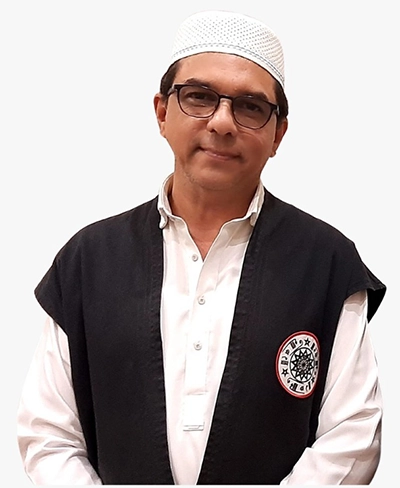
Shaykh Nishaat Ahmed Siddiqi is the Shaykh of the Ansari Qadiri Rifai Tariqa – South Africa (AQRT SA). He is actively involved in spiritual guidance, community service, interfaith engagement, and educational initiatives, serving humanity through the values of love, peace and unity.