






























![The market-builder who restrained the market [Part 2]](https://muslimviews.co.za/wp-content/uploads/2026/08/PHOTO-2026-08-25-17-16-32-360x180.jpg)
![The merchant preceding the Prophetic mission [Part 1]](https://muslimviews.co.za/wp-content/uploads/2026/08/01-360x180.jpg)






By NABEEL ALKHALIDY
When we study the history of Tafsir (Quranic interpretation), we quickly realise it was not developed in an isolated bubble.
Over the centuries, foreign concepts quietly slipped into the cracks of early explanations. To see this in action, we will look at a specific myth about the age of the Earth that early scholars accidentally ‘proved’ using the Quran itself. Believe it or not, they ended up weaving this foreign belief directly into the ayaat of the Quran.
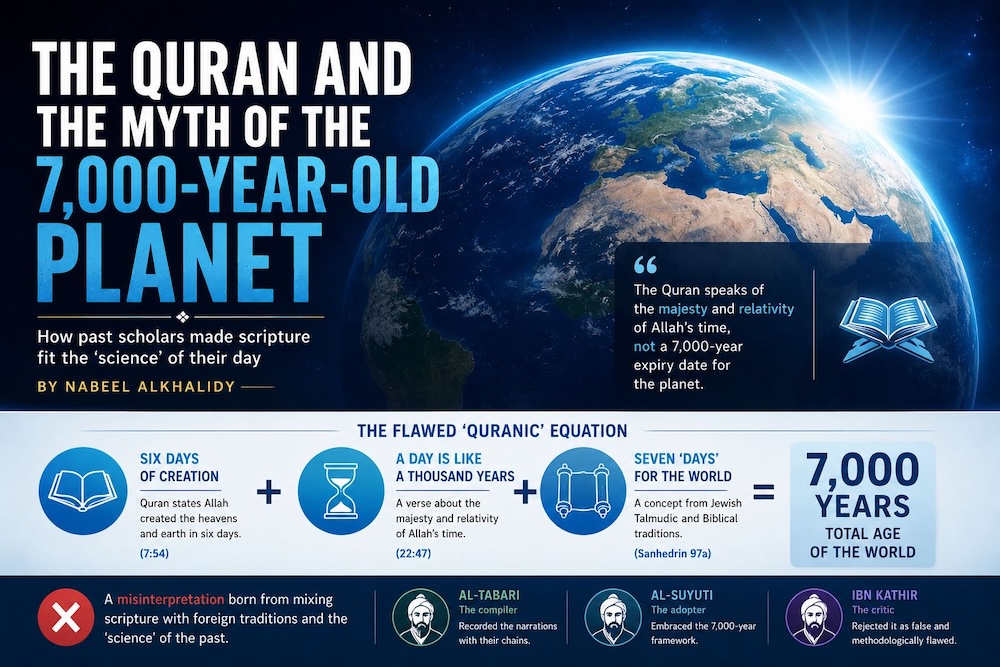
The error began when early storytellers and commentators took three entirely separate concepts – two from the Quran and one from outside traditions – and mashed them together into a mathematical formula for the lifespan of the world.
Firstly, they took the Quranic timeframe of creation:
إِنَّ رَبَّكُمُ اللَّهُ الَّذِي خَلَقَ السَّمَاوَاتِ وَالْأَرْضَ فِي سِتَّةِ أَيَّامٍ
‘Indeed, your Lord is Allah, who created the heavens and earth in six days …’ (Sura Al A‘raf, 7:54)
Next, they took a verse meant to explain the majesty and relativity of Allah’s time:
وَإِنَّ يَوْمًا عِندَ رَبِّكَ كَأَلْفِ سَنَةٍ مِّمَّا تَعُدُّونَ
‘And indeed, a day with your Lord is like a thousand years of those which you count.’ (Sura Al Hajj, 22:47)
Finally, they imported a Biblical and Talmudic concept that the total lifespan of existence is seven ‘days’.
When they put these together, they created a disastrously incorrect calculation:
Six days of creation (6,000 years) + one day for the lifespan of humanity (1,000 years) = 7,000 years total for the age of the world.
How Biblical sources influenced this interpretation
This 7,000-year timeline has absolutely nothing to do with original Islamic theology. It is a direct import from ancient Jewish eschatology.
The concept originates in the Jewish Talmud, specifically Tractate Sanhedrin 97a, which states:
‘Six thousand years shall the world exist, and one thousand, the desolate.’
This was based on the six days of creation in the Book of Genesis, followed by the seventh day of Sabbath rest.
How did it get into Islam?
Early Jewish rabbis who converted to Islam, most notably Ka‘b al-Ahbar and Wahb ibn Munabbih, were walking encyclopaedias of Biblical stories and traditions. When curious early Muslims asked them about the beginning of the world, they shared these Talmudic chronologies.
When early Muslims heard that the world was ‘seven days’ long, they immediately cross-referenced it with the Quran. The linguistic terminology matched, and the Quran also used the expressions ‘days’ and ‘a thousand years’, which led some commentators to incorrectly verify this Talmudic legend.
They assumed the Quranic verses were validating the Jewish timeline, failing to realise that the Quran mentions that ‘a day’ is like ‘a thousand years’ to illustrate the relativity of time, not to provide a mathematical multiplier for the Earth’s lifespan.
The historical record: how scholars handled it
Different scholars handled these narrations in completely different ways. Some merely compiled them, some genuinely believed them, and the most critical scholars vehemently attacked them.
Al-Tabari (d. 923 CE) – The compiler
Imam al-Tabari recorded these narrations in his monumental historical work, Tarikh al-Rusul wa al-Muluk (History of the Prophets and Kings). As an early historian, he often recorded narrations together with their chains of transmission.
حدثنا ابن حميد، قال: حدثنا يحيى بن واضح، عن سعيد بن جبير، عن ابن عباس، قال: الدنيا سبعة أيام، كل يوم كألف سنة مما تعدون
Ibn Humayd narrated to us … from Sa‘id ibn Jubayr, from Ibn Abbas, who said:
‘The world is seven days; every day is like a thousand years of what you count.’
What you will notice is that the opinion stops at Ibn Abbas, and there is no mention of where he obtained this information. Some scholars, unfortunately, linked it back to the Prophet (SAW) and therefore considered it to be revelation.
Al-Suyuti (d. 1505 CE) – The adopter
Jalal al-Din al-Suyuti, writing five centuries later, actually leaned into these narrations. He even wrote an entire treatise called The Unveiling of this Ummah Exceeding a Millennium to reassure Muslims of his era that the Day of Judgment was not about to occur, relying entirely on the 7,000-year framework. He writes:
أن عمر الدنيا سبعة آلاف سنة، وأن النبي صلى الله عليه وسلم بعث في أواخر الألف السادسة.
‘The lifespan of the world is seven thousand years, and the Prophet (SAW) was sent at the end of the sixth millennium.’
Not only did he adopt this opinion, but he also added new details and conveyed it as though it were true.
Ibn Kathir (d. 1373 CE) – The fierce critic
Imam Ibn Kathir, in contrast, aggressively attacked this calculation. In his history, Al-Bidayah wa al-Nihayah, he pointed out that applying the ‘1,000 years’ verse to the Earth’s lifespan is a gross corruption of the text. He writes:
وأما ما يذكره الإسرائيليون وأهل الكتاب من أن عمر الدنيا سبعة آلاف سنة… فهو باطل لا يعول عليه.
‘As for what the Israelites and the People of the Book mention, that the age of the world is seven thousand years … it is a falsehood that cannot be relied upon.’
You may also want to read



وقد ورد في أثر عن ابن عباس وغيره أن الدنيا سبعة أيام كل يوم كألف سنة… وهذا إسناد ضعيف.
‘There has come a narration from Ibn Abbas and others that the world is seven days, each day like a thousand years … and this chain of transmission is weak.’
Ibn Kathir identified the methodological error by challenging these weak narrations. The Imam focused heavily on the sanad (chain of transmission). If the chain tracing back to the Prophet (SAW) was broken or contained unreliable narrators, Ibn Kathir did not regard it as dependable.
Lessons for Muslim scholarship today
While Ibn Kathir’s focus on fact-checking transmitters set an important precedent for future scholars, modern scholarship needs to take the matter a few steps further.
We must recognise a difficult truth: just because a chain of narration is accepted by some scholars as technically ‘sound’ on paper does not automatically mean that the text itself is true.
Why?
Because human beings are fallible, and falsehood can spread easily. In fact, comforting lies, sensational myths and fascinating folklore often travel far more readily through communities than uncomfortable truths. A story can become so compelling that even reliable narrators pass it along, assuming someone else has already verified it.
This is where matn criticism – analysing the actual text of a narration rather than merely the list of names attached to it – becomes absolutely vital.
When we practise matn criticism, we examine the content of the narration and ask difficult questions:
• Does this text contradict the explicit and unambiguous verses of the Quran?
• Does it conflict with established and undeniable realities of the world Allah created?
If a narration claims that the Earth is only a few thousand years old, it does not matter how polished or ‘authentic’ the chain of names appears. The matn (text) itself fails the test.
If one were to investigate the age of the Earth through modern scientific inquiry alone, this myth would be dispelled without any need to examine the chain of transmission.
The big picture: an urgent need to clean the slate
We cannot stop at the question of the Earth’s age. We need a systematic and thorough examination of the entire history of Tafsir to identify and remove foreign ideas that have subtly influenced our understanding of the Quran.
When we clear away the dust of ancient folklore, the Quran shines in its purest form. It ceases to appear as a historical relic weighed down by medieval myths and returns to what it was always meant to be: an open, profound and timeless guide for humanity.
The reality is that Isra’iliyyat still contribute significantly to errors in Islamic interpretation. Because these ancient stories from the Ahlul Kitaab (People of the Book) have remained in books of commentary for centuries, many ordinary Muslims assume they are authentic Islamic beliefs.
We see this today in strange superstitions, highly specific details about the unseen, and myths about the Prophets that actually originate in corrupted ancient texts.
The Quran came to correct these very errors, clearing away the myths of the past and replacing them with pure, unadulterated truth.
To properly reflect upon the Quran, we must stop reading it through the tainted lens of the stories it came to replace.
Nabeel M A Alkhalidy is an Islamic educator and researcher based in Australia with over 15 years of experience teaching Arabic and the Quran. His research focuses on Quranic exegesis and etymology. He also developed a unique curriculum using internal Quranic tools to uncover enriched, 21st-century interpretations.