

Muslim Views
No Result
View All Result
  • News
    • All
    • Local
    • National
    • World
    Cape Town musicians rally behind displaced Palestinian composer

    Cape Town musicians rally behind displaced Palestinian composer

    Rally for solidarity with migrants ahead of planned march

    Rally for solidarity with migrants ahead of planned march

    The scholar who refused to turn Islam into an enemy: The legacy of John Esposito

    The scholar who refused to turn Islam into an enemy: The legacy of John Esposito

    The greatest monuments are not in stone, but in lives transformed

    The greatest monuments are not in stone, but in lives transformed

    Mass march to Parliament planned to combat xenophobia and Afrophobia

    Mass march to Parliament planned to combat xenophobia and Afrophobia

    How Sanef is helping journalists build mental resilience

    How Sanef is helping journalists build mental resilience

    Awqaf SA strengthens water security at Rahima Moosa Hospital

    Awqaf SA strengthens water security at Rahima Moosa Hospital

    Bo-Kaap forum reveals first steps to tackle gentrification

    Bo-Kaap forum reveals first steps to tackle gentrification

    The Sunnah as a way of being: The path to complete humanity

    The Sunnah as a way of being: The path to complete humanity

    Amaanat chief must account for R646m of payments in civil claims

    Amaanat chief must account for R646m of payments in civil claims

    • National
    • World
    • Local
  • Opinion
    • All
    • Columnists
    • Discussions with Dangor
    • Editorial
    • Guest Writer
    The nuclear leash: Washington’s deal to put Saudi back in its place

    The nuclear leash: Washington’s deal to put Saudi back in its place

    Spain’s World Cup triumph, Messi and the politics of Palestine

    Spain’s World Cup triumph, Messi and the politics of Palestine

    The myth of apolitical law

    The myth of apolitical law

    Grappling with Apartheid labels

    Grappling with Apartheid labels

    The scholar who refused to turn Islam into an enemy: The legacy of John Esposito

    The scholar who refused to turn Islam into an enemy: The legacy of John Esposito

    More than a game, or the Clash of Titans

    More than a game, or the Clash of Titans

    An empire battered, bluffing and buying time

    An empire battered, bluffing and buying time

    India’s Israeli mirror: A template for moral decline

    India’s Israeli mirror: A template for moral decline

    Notes from the launch of the School of Solidarity

    Notes from the launch of the School of Solidarity

    From green claims to verified impact through environmental risk-sharing

    From green claims to verified impact through environmental risk-sharing

  • Features
    • All
    • 1500 Years of Prophetic Legacy
    • AWQAF SA
    • General Features
    • Imam Haron
    • Tributes
    Grappling with Apartheid labels

    Grappling with Apartheid labels

    The scholar who refused to turn Islam into an enemy: The legacy of John Esposito

    The scholar who refused to turn Islam into an enemy: The legacy of John Esposito

    The greatest monuments are not in stone, but in lives transformed

    The greatest monuments are not in stone, but in lives transformed

    Legacy of educator Haji Mogamat Rashad Jedaar lives on

    Legacy of educator Haji Mogamat Rashad Jedaar lives on

    Reclaiming agency: From ritual to action Part 3

    Reclaiming agency: From ritual to action Part 3

    June 16, the Call of Islam, and the many rivers of liberation

    June 16, the Call of Islam, and the many rivers of liberation

    Reclaiming agency: From ritual to action Part 2

    Reclaiming agency: From ritual to action Part 2

    Reclaiming agency: From ritual to action Part 1

    Reclaiming agency: From ritual to action Part 1

    Goolam Hoosain Abed: The last of the famous sporting family departs

    Goolam Hoosain Abed: The last of the famous sporting family departs

    Abdullah Ibrahim crafted a magnificent new culture for South Africa

    Abdullah Ibrahim crafted a magnificent new culture for South Africa

    The hidden heritage of racial ‘passing’

    The hidden heritage of racial ‘passing’

    The Commonwealth war graves at the Mowbray Muslim Cemetery

    The Commonwealth war graves at the Mowbray Muslim Cemetery

    Honouring a chess giant: The legacy of Dr Shabier Bhawoodien

    Honouring a chess giant: The legacy of Dr Shabier Bhawoodien

    Mapping national and provincial heritage at the Mowbray Muslim Cemetery

    Mapping national and provincial heritage at the Mowbray Muslim Cemetery

    Reclaiming Nordic solidarity in South Africa’s liberation

    Reclaiming Nordic solidarity in South Africa’s liberation

  • Lifestyle
    • All
    • Arts
    • Books
    • Education
    • Food
    • Health
    • Motoring
    • Sport
    • Technology
    Cape Town musicians rally behind displaced Palestinian composer

    Cape Town musicians rally behind displaced Palestinian composer

    More than a game, or the Clash of Titans

    More than a game, or the Clash of Titans

    Help Ruqaya Ismail represent SA at the Commonwealth Fencing Championship

    Help Ruqaya Ismail represent SA at the Commonwealth Fencing Championship

    Goolam Hoosain Abed: The last of the famous sporting family departs

    Goolam Hoosain Abed: The last of the famous sporting family departs

    Abdeyah da Costa and the dihlīz of Dorp Street

    Abdeyah da Costa and the dihlīz of Dorp Street

    A mother’s taweez and the Cape’s interfaith traditions [+ video]

    A mother’s taweez and the Cape’s interfaith traditions [+ video]

    Inaugural Islamic Expo to be hosted in Cape Town

    Inaugural Islamic Expo to be hosted in Cape Town

    Imraan Buccus on faith, activism and SA’s political crisis

    Imraan Buccus on faith, activism and SA’s political crisis

    The Book of Mercy: A powerful Ramadan read on compassion in Islam

    The Book of Mercy: A powerful Ramadan read on compassion in Islam

    UpScrolled and the rise of ethical Muslim tech in a censored digital world

    UpScrolled and the rise of ethical Muslim tech in a censored digital world

  • Finance
    • All
    • Islamic Finance
    Why Shariah compliance alone cannot guarantee sound investment returns

    Why Shariah compliance alone cannot guarantee sound investment returns

    Why serious Muslim investors must look beyond basic Shariah screens today

    Why serious Muslim investors must look beyond basic Shariah screens today

    Why Mufti Taqi Usmani says cryptocurrency is not Shariah compliant today

    Why Mufti Taqi Usmani says cryptocurrency is not Shariah compliant today

    Today’s two-pot withdrawal could threaten tomorrow’s retirement security

    Today’s two-pot withdrawal could threaten tomorrow’s retirement security

    War clouds gather over the Islamic finance boom

    War clouds gather over the Islamic finance boom

    Israel and the perfect storm of global economic isolation

    Israel and the perfect storm of global economic isolation

    AI needs an ethical compass, say Islamic finance researchers

    AI needs an ethical compass, say Islamic finance researchers

    From green claims to verified impact through environmental risk-sharing

    From green claims to verified impact through environmental risk-sharing

    Amaanat chief must account for R646m of payments in civil claims

    Amaanat chief must account for R646m of payments in civil claims

    The $6 trillion shift in global Islamic Finance

    The $6 trillion shift in global Islamic Finance

  • Islam
    • All
    • Eid
    • Faith and Practice
    • Family
    • Hajj and Umrah
    • Moulood
    • Quran
    • Ramadaan
    A sound heart in a world of strangers

    A sound heart in a world of strangers

    Can our mosques become the heart of the Ummah?

    Can our mosques become the heart of the Ummah?

    Karbala – between obligation and inability

    Karbala – between obligation and inability

    16 June 1976: Qibla’s call to conscience

    Reclaiming our future – drawing lessons from Karbala and Soweto 1976

    Karbala, Gaza and xenophobia: Why history still matters today

    Karbala, Gaza and xenophobia: Why history still matters today

    Adnaan Adams (right) addressing the congregation at Masjidut Taqwa in Newfields Estate, Cape Town, on Friday, June 12. (Photo: Supplied)

    Reflecting on a khutbah and the community it seeks to serve

    The panellists at the Muslim Personal Law symposium at the University of Cape Town on June 8, clockwise from top right: Professor Fatima Seedat, Ayesha Royker, Rehema Namukose and Khensani Motlhante. (Photos: Anwar Omar)

    Advancing gender justice in Muslim Personal Law

    What do we owe the Earth?

    What do we owe the Earth?

    Hajj, human frailty and the compassion of Allah

    Hajj, human frailty and the compassion of Allah

    At Hajj we gather pebbles, but the devils remain standing

    At Hajj we gather pebbles, but the devils remain standing

  • Archives
  • Donate
Muslim Views
  • News
    • All
    • Local
    • National
    • World
    Cape Town musicians rally behind displaced Palestinian composer

    Cape Town musicians rally behind displaced Palestinian composer

    Rally for solidarity with migrants ahead of planned march

    Rally for solidarity with migrants ahead of planned march

    The scholar who refused to turn Islam into an enemy: The legacy of John Esposito

    The scholar who refused to turn Islam into an enemy: The legacy of John Esposito

    The greatest monuments are not in stone, but in lives transformed

    The greatest monuments are not in stone, but in lives transformed

    Mass march to Parliament planned to combat xenophobia and Afrophobia

    Mass march to Parliament planned to combat xenophobia and Afrophobia

    How Sanef is helping journalists build mental resilience

    How Sanef is helping journalists build mental resilience

    Awqaf SA strengthens water security at Rahima Moosa Hospital

    Awqaf SA strengthens water security at Rahima Moosa Hospital

    Bo-Kaap forum reveals first steps to tackle gentrification

    Bo-Kaap forum reveals first steps to tackle gentrification

    The Sunnah as a way of being: The path to complete humanity

    The Sunnah as a way of being: The path to complete humanity

    Amaanat chief must account for R646m of payments in civil claims

    Amaanat chief must account for R646m of payments in civil claims

    • National
    • World
    • Local
  • Opinion
    • All
    • Columnists
    • Discussions with Dangor
    • Editorial
    • Guest Writer
    The nuclear leash: Washington’s deal to put Saudi back in its place

    The nuclear leash: Washington’s deal to put Saudi back in its place

    Spain’s World Cup triumph, Messi and the politics of Palestine

    Spain’s World Cup triumph, Messi and the politics of Palestine

    The myth of apolitical law

    The myth of apolitical law

    Grappling with Apartheid labels

    Grappling with Apartheid labels

    The scholar who refused to turn Islam into an enemy: The legacy of John Esposito

    The scholar who refused to turn Islam into an enemy: The legacy of John Esposito

    More than a game, or the Clash of Titans

    More than a game, or the Clash of Titans

    An empire battered, bluffing and buying time

    An empire battered, bluffing and buying time

    India’s Israeli mirror: A template for moral decline

    India’s Israeli mirror: A template for moral decline

    Notes from the launch of the School of Solidarity

    Notes from the launch of the School of Solidarity

    From green claims to verified impact through environmental risk-sharing

    From green claims to verified impact through environmental risk-sharing

  • Features
    • All
    • 1500 Years of Prophetic Legacy
    • AWQAF SA
    • General Features
    • Imam Haron
    • Tributes
    Grappling with Apartheid labels

    Grappling with Apartheid labels

    The scholar who refused to turn Islam into an enemy: The legacy of John Esposito

    The scholar who refused to turn Islam into an enemy: The legacy of John Esposito

    The greatest monuments are not in stone, but in lives transformed

    The greatest monuments are not in stone, but in lives transformed

    Legacy of educator Haji Mogamat Rashad Jedaar lives on

    Legacy of educator Haji Mogamat Rashad Jedaar lives on

    Reclaiming agency: From ritual to action Part 3

    Reclaiming agency: From ritual to action Part 3

    June 16, the Call of Islam, and the many rivers of liberation

    June 16, the Call of Islam, and the many rivers of liberation

    Reclaiming agency: From ritual to action Part 2

    Reclaiming agency: From ritual to action Part 2

    Reclaiming agency: From ritual to action Part 1

    Reclaiming agency: From ritual to action Part 1

    Goolam Hoosain Abed: The last of the famous sporting family departs

    Goolam Hoosain Abed: The last of the famous sporting family departs

    Abdullah Ibrahim crafted a magnificent new culture for South Africa

    Abdullah Ibrahim crafted a magnificent new culture for South Africa

    The hidden heritage of racial ‘passing’

    The hidden heritage of racial ‘passing’

    The Commonwealth war graves at the Mowbray Muslim Cemetery

    The Commonwealth war graves at the Mowbray Muslim Cemetery

    Honouring a chess giant: The legacy of Dr Shabier Bhawoodien

    Honouring a chess giant: The legacy of Dr Shabier Bhawoodien

    Mapping national and provincial heritage at the Mowbray Muslim Cemetery

    Mapping national and provincial heritage at the Mowbray Muslim Cemetery

    Reclaiming Nordic solidarity in South Africa’s liberation

    Reclaiming Nordic solidarity in South Africa’s liberation

  • Lifestyle
    • All
    • Arts
    • Books
    • Education
    • Food
    • Health
    • Motoring
    • Sport
    • Technology
    Cape Town musicians rally behind displaced Palestinian composer

    Cape Town musicians rally behind displaced Palestinian composer

    More than a game, or the Clash of Titans

    More than a game, or the Clash of Titans

    Help Ruqaya Ismail represent SA at the Commonwealth Fencing Championship

    Help Ruqaya Ismail represent SA at the Commonwealth Fencing Championship

    Goolam Hoosain Abed: The last of the famous sporting family departs

    Goolam Hoosain Abed: The last of the famous sporting family departs

    Abdeyah da Costa and the dihlīz of Dorp Street

    Abdeyah da Costa and the dihlīz of Dorp Street

    A mother’s taweez and the Cape’s interfaith traditions [+ video]

    A mother’s taweez and the Cape’s interfaith traditions [+ video]

    Inaugural Islamic Expo to be hosted in Cape Town

    Inaugural Islamic Expo to be hosted in Cape Town

    Imraan Buccus on faith, activism and SA’s political crisis

    Imraan Buccus on faith, activism and SA’s political crisis

    The Book of Mercy: A powerful Ramadan read on compassion in Islam

    The Book of Mercy: A powerful Ramadan read on compassion in Islam

    UpScrolled and the rise of ethical Muslim tech in a censored digital world

    UpScrolled and the rise of ethical Muslim tech in a censored digital world

  • Finance
    • All
    • Islamic Finance
    Why Shariah compliance alone cannot guarantee sound investment returns

    Why Shariah compliance alone cannot guarantee sound investment returns

    Why serious Muslim investors must look beyond basic Shariah screens today

    Why serious Muslim investors must look beyond basic Shariah screens today

    Why Mufti Taqi Usmani says cryptocurrency is not Shariah compliant today

    Why Mufti Taqi Usmani says cryptocurrency is not Shariah compliant today

    Today’s two-pot withdrawal could threaten tomorrow’s retirement security

    Today’s two-pot withdrawal could threaten tomorrow’s retirement security

    War clouds gather over the Islamic finance boom

    War clouds gather over the Islamic finance boom

    Israel and the perfect storm of global economic isolation

    Israel and the perfect storm of global economic isolation

    AI needs an ethical compass, say Islamic finance researchers

    AI needs an ethical compass, say Islamic finance researchers

    From green claims to verified impact through environmental risk-sharing

    From green claims to verified impact through environmental risk-sharing

    Amaanat chief must account for R646m of payments in civil claims

    Amaanat chief must account for R646m of payments in civil claims

    The $6 trillion shift in global Islamic Finance

    The $6 trillion shift in global Islamic Finance

  • Islam
    • All
    • Eid
    • Faith and Practice
    • Family
    • Hajj and Umrah
    • Moulood
    • Quran
    • Ramadaan
    A sound heart in a world of strangers

    A sound heart in a world of strangers

    Can our mosques become the heart of the Ummah?

    Can our mosques become the heart of the Ummah?

    Karbala – between obligation and inability

    Karbala – between obligation and inability

    16 June 1976: Qibla’s call to conscience

    Reclaiming our future – drawing lessons from Karbala and Soweto 1976

    Karbala, Gaza and xenophobia: Why history still matters today

    Karbala, Gaza and xenophobia: Why history still matters today

    Adnaan Adams (right) addressing the congregation at Masjidut Taqwa in Newfields Estate, Cape Town, on Friday, June 12. (Photo: Supplied)

    Reflecting on a khutbah and the community it seeks to serve

    The panellists at the Muslim Personal Law symposium at the University of Cape Town on June 8, clockwise from top right: Professor Fatima Seedat, Ayesha Royker, Rehema Namukose and Khensani Motlhante. (Photos: Anwar Omar)

    Advancing gender justice in Muslim Personal Law

    What do we owe the Earth?

    What do we owe the Earth?

    Hajj, human frailty and the compassion of Allah

    Hajj, human frailty and the compassion of Allah

    At Hajj we gather pebbles, but the devils remain standing

    At Hajj we gather pebbles, but the devils remain standing

  • Archives
  • Donate
Muslim Views
Advertisement

The hidden heritage of racial ‘passing’

9 June 2026
in FEATURES, Guest Writer
Reading Time: 7 mins read
A A
The hidden heritage of racial ‘passing’

The writer’s paternal uncle, Ebrahim Ismail (second from right, back row), with some of the ‘D-Day Dodgers’. (Photo: Supplied)

Share on TwitterShare on FacebookShare on Whatsapp

The story of Ebrahim Ismail, who lived as ‘Abraham Davis’ under apartheid, reveals the complex intersections of war, race, identity and belonging in South Africa.

By ANWAR OMAR

Recently, I stumbled upon a fragile handwritten version of The Ballad of the D-Day Dodgers by my paternal uncle, whom we affectionately referred to as Ami. This had been carefully preserved over the decades. As I unfolded the ageing pages and read the fading words, I realised that this was more than a wartime song. It served as a gateway to a forgotten chapter of our family history and into a broader South African story that has largely escaped mainstream heritage narratives.

This handwritten ballad immediately brought back memories of my uncle, Ebrahim Ismail, a man who fought in the Allied forces during the Second World War in Egypt and Italy, but who later lived much of his life in apartheid South Africa under the pseudo-name Abraham Davis.

His personal journey reveals the complex intersections between war, race, identity, memory and survival in the context of twentieth-century South Africa.

Ebrahim Ismail in his military uniform during the Second World War. (Photo: Supplied)

Ebrahim Ismail and the life of ‘Abraham Davis’

As a child growing up in Salt River, I remember my uncle returning home over weekends after spending the week in Cape Town’s city centre, where he occupied an entirely different world. Under the name Abraham Davis, he worked as a co-director for the Gundelfinger shipping company, stayed in a flat at Tulbagh Square, and moved within spaces reserved exclusively for whites under South Africa’s racial order.

Yet on weekends he returned home to his family in Salt River.

He would sleep in the same room as my older brother and I, comfortably resuming his place within the family he could never publicly acknowledge within white society.

I remember how we collected him at the old River Club along the Liesbeeck River, housed within one of the area’s historic colonial-era buildings, which has since been demolished. As non-whites, we could not enter the club itself and had to wait quietly and patiently outside, almost in secret, until he emerged to join us so that we could take him home.

Looking back today, those moments reveal the deeply fractured realities of race and belonging under segregation and apartheid.

A Special Order of the Day marking the victory of the Allied forces in Italy, awarded to Ebrahim Ismail by Field Marshal H P Alexander. (Photo: Supplied)

The scars and medals of war

Another memory remains deeply etched in my mind. From time to time, my uncle would ask my older brother and I to massage his back. As children we did not give it much thought, but I remember feeling the roughness and embedded fragments and remnants of shrapnel across his back, wounds that he had sustained during the war.

Those scars were physical reminders that beneath the carefully constructed identity of ‘Abraham Davis’ was a man who had endured the brutality of battlefields far away in North Africa and Italy.

In later years I came to realise that his body itself carried a hidden archive of war. Scholars of embodied memory remind us that trauma does not only live in the mind, but settles into the body itself, inscribed in muscle and bone. Ebrahim Ismail carried this, the war and the double life, not only in his memory but in his very bodily flesh.

My uncle was also awarded the War Medal 1939–1945, Africa Star, and the Italy Star for his wartime service. These medals represent far more than ceremonial objects. They signify participation in some of the most brutal military campaigns of the twentieth century. For many South African veterans, especially those whose histories were later marginalised by apartheid, these medals remain among the few tangible forms of recognition they ever received.
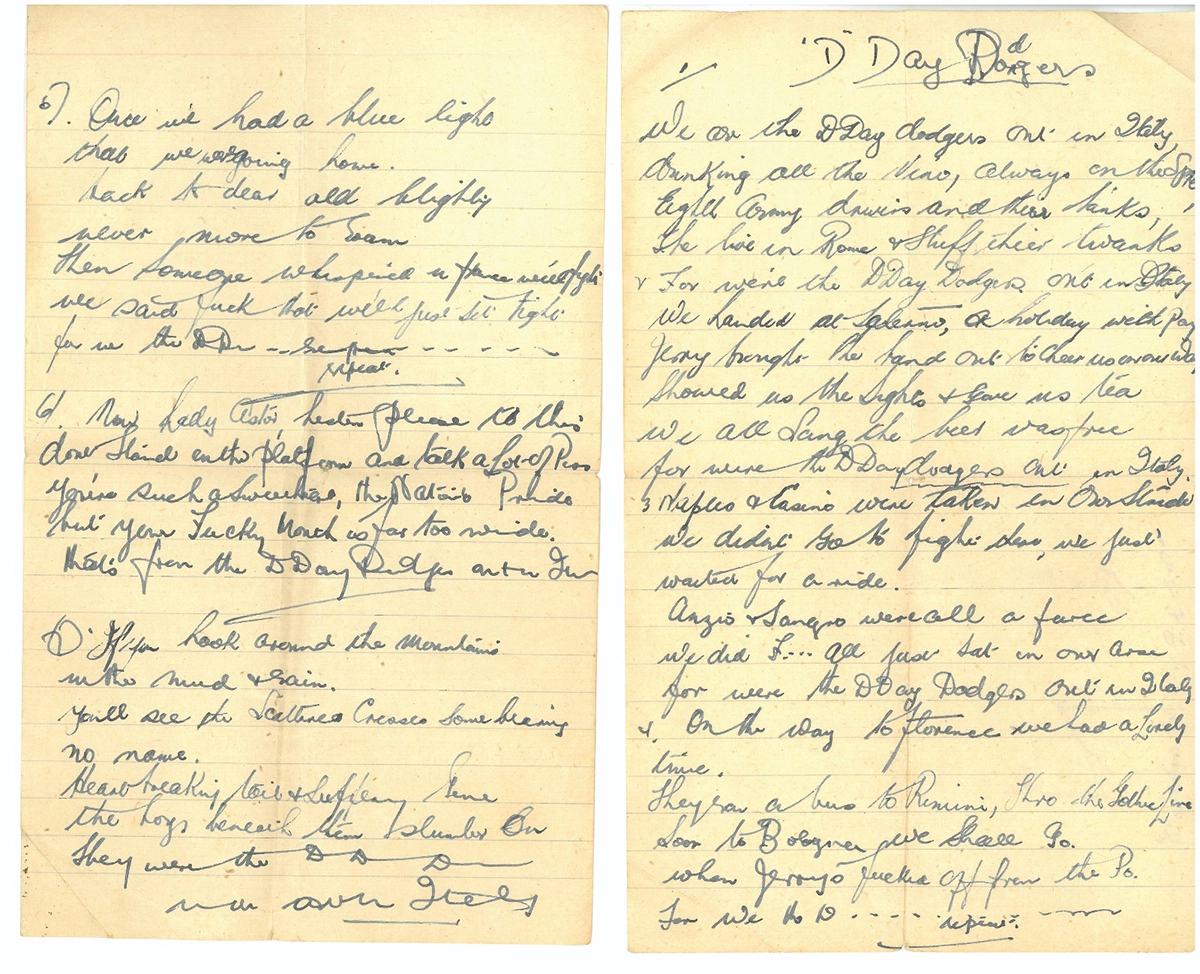
A handwritten version of The Ballad of the D-Day Dodgers preserved by Ebrahim Ismail. (Photo: Supplied)

The ‘D-Day Dodgers’

During the Second World War, ‘Abraham Davis’ served in the Allied campaign in North Africa and Italy, most likely within structures associated with the British Eighth Army. Soldiers who fought in Italy became associated with the now-famous term ‘D-Day Dodgers’.

The phrase emerged after the Allied landings in Normandy on June 6, 1944. Troops serving in Italy felt that their sacrifices were being overlooked as public attention focused almost entirely on D-Day and the liberation of France. The term ‘D-Day Dodgers’ was reportedly used sarcastically by some British politicians and commentators to imply that soldiers in Italy were somehow avoiding the ‘real war’ (Nasson, 2012).

The soldiers themselves responded with humour and irony through The Ballad of the D-Day Dodgers. Yet the reality of the Italian campaign was anything but easy. The Allied advance through Italy involved some of the harshest fighting of the war. Thousands of Allied forces, including many South Africans, fought and died in these campaigns (Nasson, 2012).

The irony embedded in the song therefore reflected a deeper frustration amongst soldiers who felt forgotten by official wartime narratives. In many ways, this sense of historical marginalisation mirrors the later erasure of many non-white South African veterans from mainstream public memory altogether.

Passing and the Cape experience

What made my Ami’s life possible was the complicated and often painful phenomenon known as ‘racial passing’. He was light of complexion as a result of the genes he inherited from his mother, Maria Vermeulen, who hailed from Robertson, and could easily pass as white. During the war, overseas military service may have enabled him to move more easily within white military structures. After returning to South Africa, he continued navigating this dual identity to access economic and social opportunities denied to non-white South Africans.

The phenomenon of racial passing has been extensively discussed by scholars whose work demonstrates that racial identities under apartheid were never fixed biological realities, but socially constructed categories constantly negotiated and contested in everyday life (Adhikari, 2005; Erasmus, 2001). Adhikari (2005) explores how many light-skinned Coloured South Africans occupied deeply ambiguous social positions within the racial hierarchy, while Erasmus (2001) highlights the fluidity and complexity of Coloured identity in the Cape.

Passing was not merely an act of deception. For many, it was a strategy of survival within an oppressive racial order that determined where one could live, work, travel, socialise, educate one’s children, and eventually be buried. Some individuals permanently severed ties with their families to sustain white identities. Others, like my uncle, moved constantly between two worlds, publicly performing whiteness while privately maintaining family, religious and cultural connections.

The writer (right) and his siblings, Imam Rashied (left) and Lutfi, with their uncle Ebrahim Ismail, affectionately referred by them as ‘Ami’. (Photo: Supplied)

Family, faith and quiet resistance

You may also want to read

IMAM HARON – Commemorating a lifetime of resistance and activism

IMAM HARON – Commemorating a lifetime of resistance and activism

18 September 2023 - Updated on 15 August 2024
Epilepsy – a brain condition characterised by seizures

Epilepsy – a brain condition characterised by seizures

26 August 2022
The spectacle of betrayal amid the ongoing Nakba: Arab regimes, genocide and the call for planetary justice

The spectacle of betrayal amid the ongoing Nakba: Arab regimes, genocide and the call for planetary justice

18 May 2025
Lyrical verse for the river of Ramadaan

Lyrical verse for the river of Ramadaan

28 March 2023 - Updated on 28 August 2024
Is there more to tell in the killing of the Imam?

Is there more to tell in the killing of the Imam?

19 May 2023 - Updated on 15 August 2024

The Global Anti-Apartheid Conference 2024

11 May 2024

Despite his ‘white’ professional life, my uncle never abandoned his family or faith. One memory remains particularly significant to me. In the early 1970s, when my older brother, Imam Rashied, approached my father with the desire to study hifz, my father simply could not afford the fees. Without hesitation, my uncle volunteered to pay for his studies. Looking back now, that gesture carried profound meaning. It was also my Ami who persuaded and supported my father financially to perform his hajj in 1967 at the age of 40. On my father’s return, my uncle flew to Johannesburg to be the first to welcome his younger brother and receive his hajj blessings.

Beneath the constructed racial identity he was compelled to perform in public, my Ami remained deeply connected to his roots, his family and his Muslim identity. In many ways, his quiet support for my brother’s hifz education and my father’s hajj represented a reclamation of self within a society that demanded concealment and fragmentation.

Politics, fear and the burden of dual identity

My Ami died on January 17, 1977, on Imam Rashied’s 18th birthday, only a few months after the Soweto uprisings of 1976, when apartheid entered one of its most volatile periods.

In September 1976 my older brother and I were detained for anti-apartheid activities, whilst at the same time my uncle’s health had begun deteriorating badly while he was bedridden at our family home in Salt River. Our arrest must have been profoundly traumatic for him.

Throughout our youth, he consistently discouraged us from becoming involved in politics. At the time, I understood this as fear of state repression. But in hindsight, I believe there was something deeper at play. My Ami had spent much of his adult life carefully navigating a fragile and dangerous dual identity. Publicly he lived as Abraham Davis within white professional society, while privately he remained Ebrahim Ismail within his family and Muslim community.

The anti-apartheid political climate of the 1970s increasingly demanded political clarity and racial positioning in ways that threatened the delicate boundaries he had spent decades constructing around his life. Our detention therefore likely represented more than simply concern for our safety. It may also have represented the terrifying possibility that the political realities of apartheid South Africa were finally closing in around him, threatening to expose, destabilise, or collapse the dual existence he had maintained since the Second World War. This must have been an immense emotional and psychological burden for him.

Seen in this light, the final years of my Ami’s life are deeply symbolic of the broader South African condition during the 1970s, a society increasingly consumed by political confrontation, racial anxiety, and moral fracture. Yet despite all these contradictions, he ultimately returned to his family, his faith, and his community.

The writer’s father, Kassiem Omar, is buried in the same grave at Mowbray Cemetery as his brother, Ebrahim Ismail. (Photo: Anwar Omar)

Burial, memory and historical irony

Today, Ebrahim Ismail is buried at the Mowbray Muslim Cemetery. His final burial place says more about belonging than the racial categories that shaped so much of his life ever could. There is a profound historical irony in this. He is buried in the same cemetery where 13 other Commonwealth soldiers, who served during the Second World War but who did not, or could not, ‘pass’ as white within South Africa’s racial order. In life, apartheid and segregation divided these men through rigid racial classifications. Some occupied white military and social spaces, while others remained confined to the subordinate racial categories imposed by the state. Yet, in death, they now rest together within the same sacred burial landscape.

The irony extends even further.

Approximately 35 years later, my own father was buried in the very same grave as his older brother, Ebrahim. In death, the artificial racial distance that apartheid demanded between ‘Abraham Davis’ and his family collapsed entirely. The brother who had spent much of his public life navigating whiteness eventually returned fully to the family and community from which he had never truly separated himself.

This layered burial history speaks powerfully to the meanings embedded within the Mowbray Muslim Cemetery itself. The cemetery is not merely a burial ground; it is a social archive of Cape Muslim history, memory, kinship, and identity. Within its burial spaces lie stories of colonialism, apartheid, migration, war, faith, class, and resistance.

The fact that Commonwealth soldiers and my father experienced radically different racial realities in life from that of my uncle, yet now share the same cemetery, foregrounds a deeper truth about both Islam and death: that the hierarchies constructed by society dissolve before mortality.

Heritage beyond official narratives

Stories such as these remain absent from official heritage discourse because they complicate simplistic racial narratives. They expose the deeply constructed nature of race under colonialism and apartheid and reveal the emotional burdens carried by families forced to navigate these artificial divisions (Adhikari, 2005; Erasmus, 2001).

South African heritage discourse often foregrounds monumental political events, famous leaders and officially recognised struggle histories. While these remain important, there are equally valuable histories embedded within the intimate experiences of ordinary families.

Conclusion

Thousands of non-white South Africans served during the Second World War, yet many of their stories remain absent from archives, museums and heritage institutions. Families across the country still carry memories, photographs, medals, handwritten songs and oral histories that have never entered mainstream public history. If heritage is about human experience and memory, then these hidden intangible stories deserve recognition alongside the grand narratives that dominate South African public history.

Anwar Omar is a South African Heritage Resources Agency (SAHRA) councillor. A founding member of the Salt River Heritage Society, Omar holds a master’s degree in Conservation and the Built Environment from the University of Cape Town (UCT).

References

Adhikari, M. (2005). Not White Enough, Not Black Enough: Racial Identity in the South African Coloured Community. Athens, OH: Ohio University Press.

Erasmus, Z. (Ed.). (2001). Coloured by History, Shaped by Place: New Perspectives on Coloured Identities in Cape Town. Cape Town: Kwela Books.

Nasson, B. (2012). South Africa at War, 1939–1945. Johannesburg: Jacana Media.

* indicates required
Choose the newsletters you'd like to receive
Advertisement

You may also want to read

The nuclear leash: Washington’s deal to put Saudi back in its place
OPINION

The nuclear leash: Washington’s deal to put Saudi back in its place

25 July 2026
Spain’s World Cup triumph, Messi and the politics of Palestine
OPINION

Spain’s World Cup triumph, Messi and the politics of Palestine

24 July 2026
The myth of apolitical law
OPINION

The myth of apolitical law

23 July 2026
Grappling with Apartheid labels
FEATURES

Grappling with Apartheid labels

23 July 2026
The scholar who refused to turn Islam into an enemy: The legacy of John Esposito
Guest Writer

The scholar who refused to turn Islam into an enemy: The legacy of John Esposito

23 July 2026
More than a game, or the Clash of Titans
Guest Writer

More than a game, or the Clash of Titans

17 July 2026 - Updated on 19 July 2026
July 2026

July 2026

FILE SIZE : 9 MB
Download
Advertisement

Latest News

The nuclear leash: Washington’s deal to put Saudi back in its place

25 July 2026

A sound heart in a world of strangers

24 July 2026

Spain’s World Cup triumph, Messi and the politics of Palestine

24 July 2026

Cape Town musicians rally behind displaced Palestinian composer

24 July 2026

Rally for solidarity with migrants ahead of planned march

23 July 2026

The myth of apolitical law

23 July 2026
Advertisement
Advertisement
Next Post
16 June 1976: Qibla’s call to conscience

16 June 1976: Qibla’s call to conscience

Dignity in solidarity: A Qurbani story from Atlantis

Dignity in solidarity: A Qurbani story from Atlantis

Imran Khan and the Islamophobia industry that buried him

Imran Khan and the Islamophobia industry that buried him

Cape Town’s religious leaders call for united response to crime

Cape Town’s religious leaders call for united response to crime

ABOUT MUSLIM VIEWS
About Us
Archives
Terms & Conditions
Privacy Policy
Contact Us
Donate to Muslim Views
NEWS
Local
National
World
OPINION
Columnists
Discussion with Dangor
Editorial
Guest Writers
FEATURES
AWQAF SA
Imam Haroon
Tributes
FINANCE
Islamic Finance
ISLAM
Eid
Faith and Practice
Family
Hajj and Umrah
Moulood
Quraan
Ramadaan
FEATURES
Arts
Books
Education
Food
Health
Motoring
Sport
Technology

© Muslim Views 2026. All Rights Reserved

Design by: Rashaad Sallie

Loading...
No Result
View All Result
  • NEWS
    • Local
    • National
    • World
  • OPINION
    • Columnists
    • Discussions with Dangor
    • Editorial
    • Guest Writer
  • FEATURES
    • AWQAF SA
    • Imam Haron
    • Tributes
    • 1500 Years of Prophetic Legacy
  • LIFESTYLE
    • Arts
    • Books
    • Education
    • Food
    • Health
    • Motoring
    • Sport
    • Technology
  • FINANCE
    • Islamic Finance
  • ISLAM
    • Eid
    • Faith and Practice
    • Family
    • Hajj and Umrah
    • Moulood
    • Quran
    • Ramadaan
  • ARCHIVES
  • DONATE