























About 150 people of different faiths walked silently through Stellenbosch carrying five white shrouds inscribed with the names of 23 000 Palestinian children killed in Gaza. The procession drew on years of Palestine solidarity in this Boland town.
By ANWAR OMAR
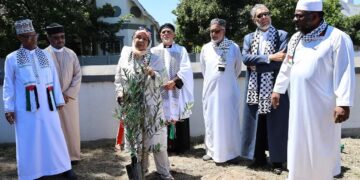
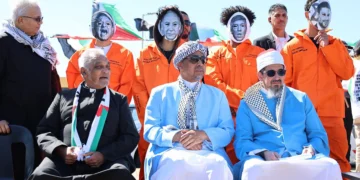
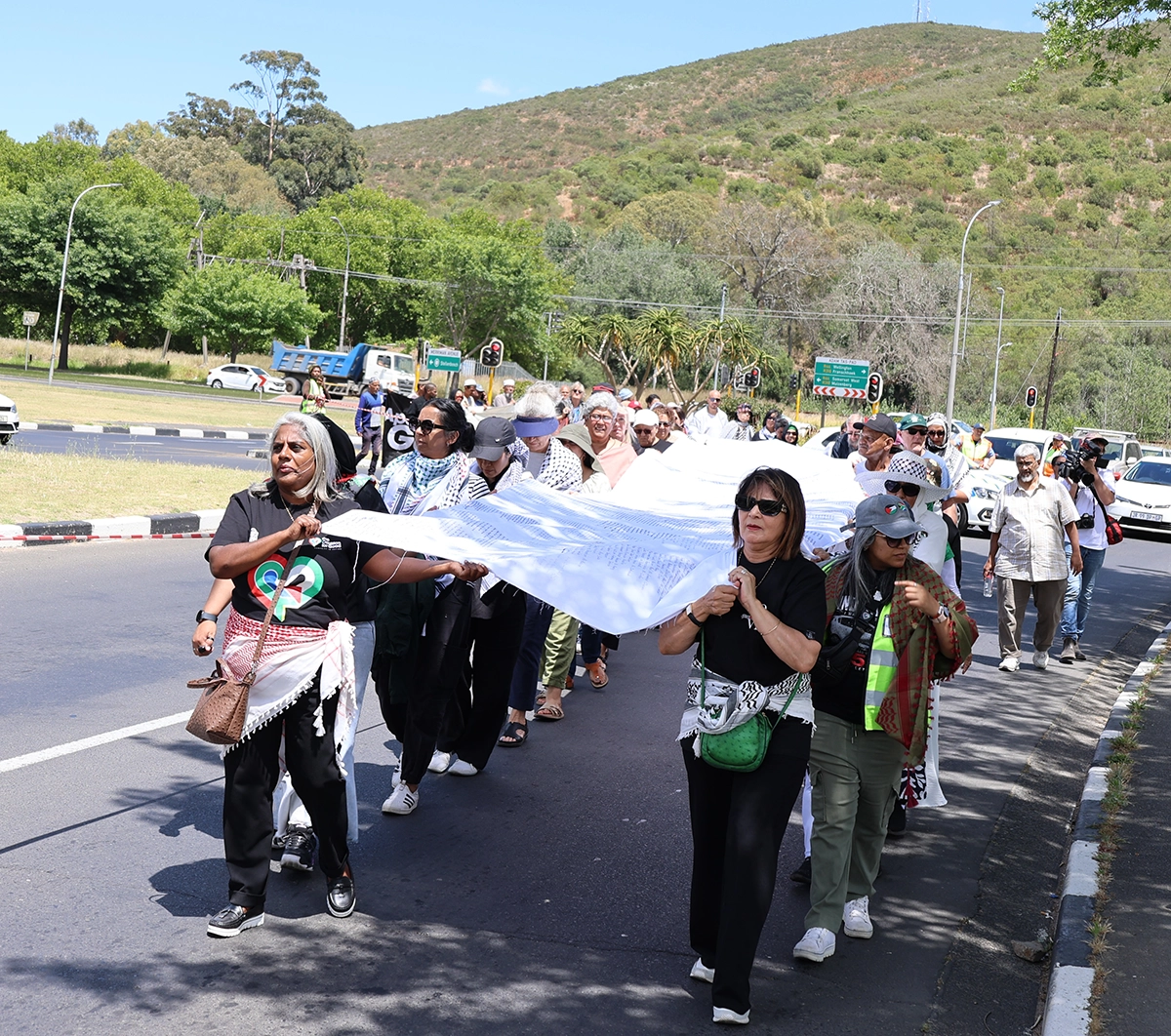
On the morning of Saturday, November 21, about 150 people of different faiths gathered at St Mary’s on Die Braak and walked silently through central Stellenbosch to St Nicholas Catholic Church on Paul Kruger Road.
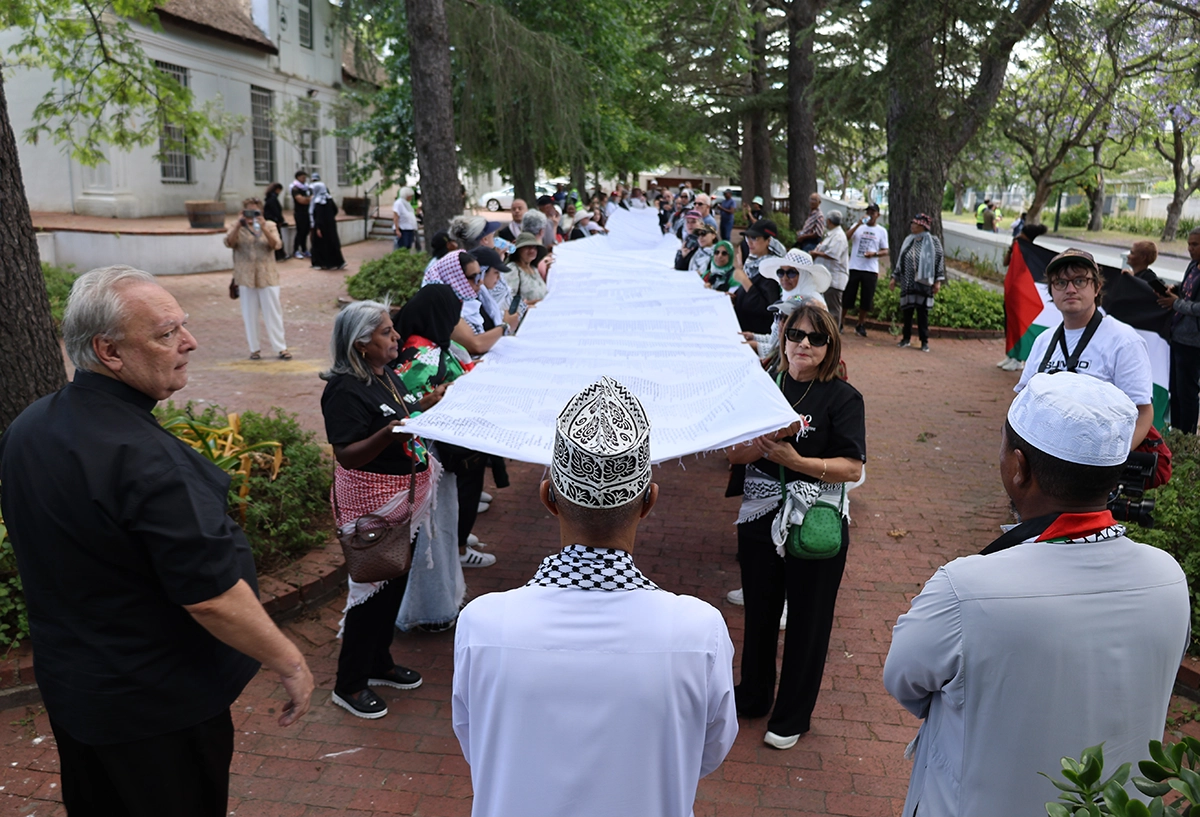
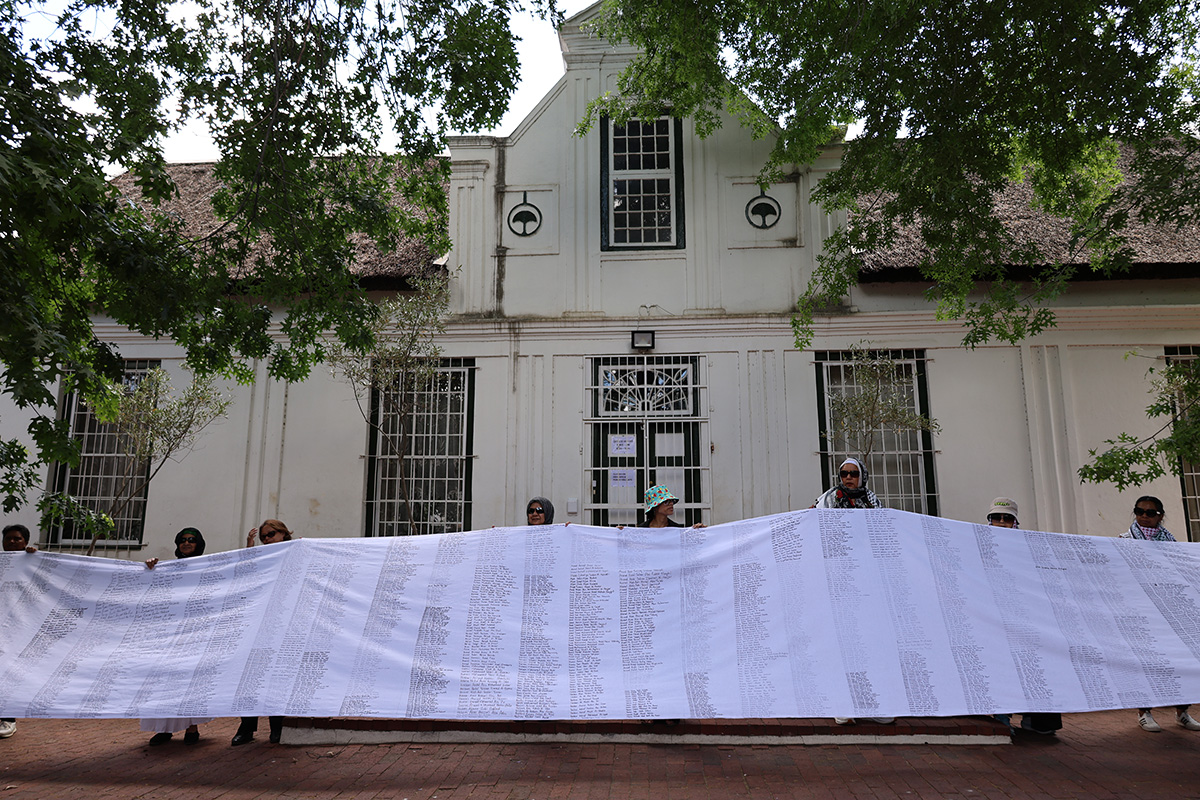
They carried five white burial shrouds, 90 metres of cloth in all, inscribed by hand with the names of 23 000 Palestinian children killed in Gaza. It was a deliberately quiet act, the latest in a solidarity movement that has grown in this town for seven years, from student vigils on the Rooiplein to weekly pickets on Die Braak.

A silent procession
Each name, the organisers said, represents “a child, a family, and a stolen future.” Their invitation went out to people of all denominations and set the tone in a single line: “We gather not in anger, but in profound, prayerful solidarity.”
The shrouds hold only the children whose deaths have been documented, the organisers point out. Many thousands more are still believed to lie under the rubble. The aim was simply to be seen carrying the names: those who walked were asked to “hold the silence so that their names may be seen, their loss not forgotten, and the sacred dignity of every human life honoured.”
The white burial cloth is familiar across the traditions that walked together on Saturday. In Muslim burial practice it is the kafan; in Christian practice it recalls the linen of the tomb. Images from Gaza have made it painfully familiar too: parents carrying small bodies wrapped in white.
From Cape Town to Stellenbosch
The shrouds carried in Stellenbosch belong to a broader initiative. In recent months, the Know Their Names project has had members of the public writing children’s names by hand onto several 20-metre shrouds at venues across the Cape. These have included Claremont Main Road Mosque, al-Jamiah, Central Methodist Church on Greenmarket Square and other churches. The Palestine Solidarity Campaign (PSC) South Africa says 23 000 children are represented in the names.
Gonda Perez of Mothers4Gaza, one of the organisers, has said the Cape Town shroud was inspired by Priests Against Genocide. The idea comes from an international Children’s Shroud movement that is reported to have begun in Italy. In June 2026, mourners in Milan carried a 27-metre shroud bearing 18 457 names. In September 2026, an interfaith coalition that included Doctors Against Genocide and Priests Against Genocide unveiled a 100-metre shroud with more than 20 000 handwritten names at the UN Church Centre in New York.
Seven years of solidarity in Stellenbosch
Organised solidarity at Stellenbosch University dates back to the end of 2018, when the Palestinian Solidarity Forum (SU PSF) was registered. The secular, human-rights student society draws parallels with South Africa’s history of dispossession and backs the non-violent Boycott, Divestment and Sanctions (BDS) campaign. Its debates on the Rooiplein have at times grown heated, a sign of a deeply divided campus.
The 2024 Senate vote
On April 30, 2024, the SU Senate rejected a motion titled “Genocide and Destruction of Scholarship and Education in Gaza” by 101 votes to 80, with 18 abstentions. The motion called for a ceasefire, humanitarian access and the return of all captives. The vote drew national attention and set Stellenbosch apart from UCT, UWC and Nelson Mandela University, which had backed a ceasefire.
Anti-genocide students kept up the pressure. On May 2, Student Action for Palestine (SA4P) handed the rectorate a memorandum calling for an academic boycott. Two days later, the PSF petitioned the Senate for a permanent ceasefire and an academic boycott. That month, International Relations Minister Naledi Pandor spoke on campus as SA4P’s guest.
Staff speak out, and the town joins
In June 2025, more than 200 members of the university community signed a letter calling on SU to condemn Israel’s actions in Gaza, arguing that it carries “a special moral responsibility” given its apartheid history. Academics also urged it to suspend ties with Israeli institutions at risk of complicity in rights violations.
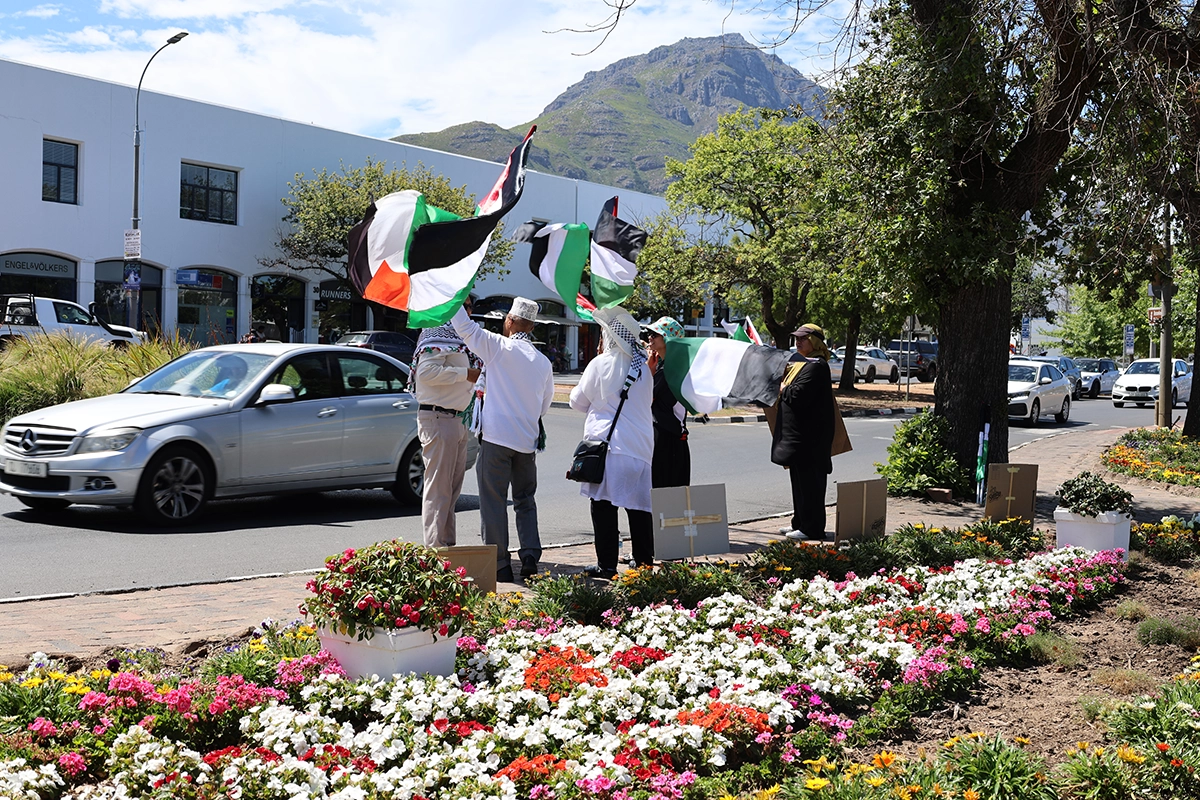
Solidarity also moved into the town. On May 24, 2025, Stellenbosch 4 Palestine held the first of its weekly pickets on the pavement at Die Braak, inviting people of all faiths and backgrounds to stand together peacefully.
From Die Braak, in silence
Saturday’s procession began on the same Braak and moved between two of the town’s prominent churches. There were no placards and no demands, only the shrouds and their names. That made it open to people who had never joined a march, and harder to dismiss as one more protest, in a town whose university is still debating its own silence.
On the day
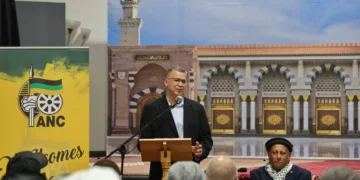
Before the walk set off from St Mary’s on Die Braak, the gathering heard from a representative of Mothers4Gaza, Irene Knight, who explained why the names matter:
“We wanted to acknowledge the children that were killed over the last three years in the genocide, and we wanted to make their names visible. We do this in remembrance of the children and we walk in silence. We walk with sadness and solemnity as we remember why we are walking.”

The walk followed a three-kilometre route from St Mary’s on Die Braak and walked silently through central Stellenbosch to St Nicholas Catholic Church on Paul Kruger Road, where the walkers gathered at its grotto of Our Lady of Lourdes.
You may also want to read


The grotto recalls the cave at Lourdes in France, where in 1858 Bernadette Soubirous reported visions of the Virgin Mary and a spring was uncovered. Lourdes has drawn pilgrims seeking healing ever since.
Here, in front of a shrine to healing, Christian and Muslim clergy spoke.
The Reverend Canon Enrico Heuvel of St Mary’s on Die Braak pointed out that the next day the church would celebrate the Feast of Christ the King. The scripture for that Sunday, he said, spoke directly to what the walkers had done:
“Whatever you did for one of the least of these brothers and sisters of mine, you did for me. Many people will say, ‘But what has this got to do with us? It happens on the other side of the world.’ It does impact. We are all children of Almighty God.”
Imam Shaakier Vermeulen of Stellenbosch’s Goejjatul Islam Mosque reminded the gathering what it had taken to defeat apartheid. “One of the most important reasons we overcame apartheid was the relationship between the churches and the clergy. They worked together,” he said.
The struggle in Palestine, he insisted, “is not a religious issue”:
“The Christians are going through the same struggles that the Muslims are going through. And it is not only Muslims that are being killed, but people of other faiths are also being killed in Gaza and in Palestine. So, like how we came together today as people of different faiths, we must keep on this effort and struggle in whatever we can do against oppression throughout the world.”
Between the speeches, poets read at the grotto. Iman Omar introduced her poem with something she noticed on the walk: “children playing freely in a park, while we carried a shroud of thousands of names of children who will never have that freedom to walk and to play.” Iman Omar also asked the gathering to hold space for South Africa’s own unfinished struggles, on land that has itself been gentrified: “We are fighting for them, but we are also fighting for our own freedoms that are not completely liberated yet.”
The poem, La Adala La Salaam (“No justice, no peace”), moved between Arabic and English. Each time the Arabic refrain was called out, the gathering answered with its English meaning:
“You can reduce our numbers but our voices will increase.
You can lock us up and build big walls but we’ll still take to the streets.”
The Reverend Leon Klate, minister of the Pniel Congregational Church, said his denomination had taken a specific stance in solidarity with Palestine. He linked the walk to the Gospel account of the massacre of the innocents, “a night when children were slaughtered and killed because of the hope that was about to be born.”
“So when we stand today in silence, remembering all those children that have been slaughtered and killed, their names will never be forgotten.”
Imam Dr Rashied Omar of Claremont Main Road Mosque had also addressed the crowd when one of the shrouds was displayed in Cape Town on October 7. At the grotto he spoke to “people of faith and people of conscience,” gathered from different faiths and backgrounds but united in grief for the children of Gaza and in solidarity with their families.
“Every name written on the shroud belongs to a very precious child, a child who deserved to be safe, to play and, most of all, to have grown up surrounded by love and care. So we grieve for each one of them, and for all the years that they have lost and should have had.”
Of the walk itself, he said: “As we have walked together through a little part of Stellenbosch, we have allowed our silence to express our grief.” He closed with a prayer that the children “will never be forgotten,” and that “our remembrance move us to protect the living and to work for a just and a lasting peace.”
The speakers wanted the walk to be a beginning rather than an end. As Canon Heuvel put it at the grotto: “Let this not end here.”


