

























![The market-builder who restrained the market [Part 2]](https://muslimviews.co.za/wp-content/uploads/2026/08/PHOTO-2026-08-25-17-16-32-360x180.jpg)
![The merchant preceding the Prophetic mission [Part 1]](https://muslimviews.co.za/wp-content/uploads/2026/08/01-360x180.jpg)









When sacred space becomes a spiritual test
A powerful reflection on Umrah, exploring how sacred spaces can become spiritual tests when faith is disconnected from the suffering of the Ummah and a world shaped by injustice and global conflict.
By ADNAAN ADAMS
THERE is a common assumption that being in Makkah or Madinah almost guarantees spiritual elevation, that mere proximity to the sacred will naturally produce clarity, humility, and transformation.
This assumption needs to be treated with greater caution. For sacred space, while profoundly significant, does not automatically transform the self. If approached uncritically, it can give rise to a subtle spiritual trap, the belief that being physically close to the sacred is enough, even when the deeper work of ethical awareness and responsibility remains insufficiently cultivated.
In these blessed lands, while the world trembles under the weight of injustice, from Gaza to Lebanon, and the escalating US–Israel war with the Islamic Republic of Iran, it is possible to retreat into a form of insulated piety. A piety that feels sincere, yet risks becoming detached. One performs ṭawaaf, stands in prayer, weeps in dua, yet remains insufficiently affected by the condition of the Ummah.
The Qur’an does not permit such a disconnection. It affirms that ‘the believers are but a single brotherhood’ (Sura Al-Hujurat, 49:10), and reminds humanity that it was created in diversity ‘so that you may know one another’ (Sura Al-Hujurat, 49:13). These verses establish a clear ethical framework in which the inner life and the social world are inseparably linked. Faith is not confined to what one holds inwardly; it must find expression in how one lives, relates, and responds to others in the world. This is the spiritual trap, when inward devotion is experienced as sufficient, even while outward responsibility remains unrealised.
A journey formed by disruption
My own ʿUmrah, between March 29 and April 17, 2026, unfolded within this tension.
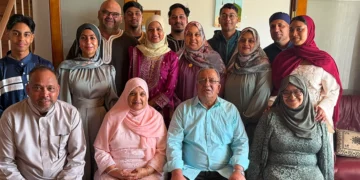
From the outset, the journey was marked by uncertainty. Flights were cancelled amid escalating conflict. For some in our family of eighteen, this was a moment to reconsider. For others, it deepened resolve, to find alternative routes and continue. The trip had been two years in the making. For my wife, it carried a deeply personal return, reuniting with her 77-year-old mother in Makkah after 35 years. Siblings gathered again in sacred space. There was nostalgia, memory, and devotion.
You may also want to read


This deeply personal journey was inseparable from a fractured global context – Gaza under bombardment, Lebanon in fragility, and Masjid al-Aqsa closed for an extended period and the unjustified war with the Islamic Republic of Iran. The personal and the political were not parallel realities, they intersected, often uncomfortably.
Holding the inner and the outer together
Islamic ethics does not recognise a split between the inward and the outward. The Qur’an consistently binds belief (īmān) with action (ʿamal), pairing faith with responsibility. What one carries in the heart must find expression in how one responds to the world. This is where intentionality (niyyah) becomes decisive. Without intention, worship risks becoming routine. With intention, even the simplest acts acquire ethical weight. A dua that consciously carries the pain of Gaza, Lebanon, and currently the Islamic Republic of Iran, or the oppressed everywhere, is no longer private, it becomes a form of moral witnessing. A janāzah in absentia (ṣalāt al-ghāʾib), when performed with awareness, affirms that loss anywhere in the Ummah concerns us all.
These are not grand gestures. They are subtle, disciplined acts that keep the connection between the sacred and the social alive and create a deeper connection with the Ummah.
Proximity and veiling
Even in close proximity to the sacred, a distance can remain. During this ʿUmrah, the Kaʿbah itself was partially veiled, surrounded by 3m-high barriers due to maintenance. Access was restricted, the Ḥajar al-Aswad, the Hij’r Ismaeel, and the Multazam unseen. One could perform the rites, yet not encounter what one had long imagined. It became difficult not to read this symbolically. Physical nearness does not automatically translate into spiritual clarity. One can stand close, yet remain inwardly preoccupied. The veiling of the Kaʿbah gestures, perhaps, to another kind of veiling, the subtle barriers of the self, habit, our assumptions, our comforts, even the rewards we seek in acts of devotion. In this sense, the journey required a deliberate shift, from seeking a personal spiritual experience to cultivating a conscious awareness that connects one’s worship to the realities and responsibilities of the wider Ummah.
Rethinking the Ummah
The idea of the Ummah, so often invoked, requires renewed seriousness. It cannot remain a rhetorical comfort. If it is to retain meaning, it must be lived as a moral relationship, one that binds individuals across geography into a shared ethical concern.
From the deep South, distance can create the illusion of detachment. The Qur’anic framing of brotherhood resists this. There is no meaningful ‘far’ within the idea of the Ummah, only differing levels of attentiveness and response. To take the Ummah seriously is to allow its condition to shape one’s consciousness, even in sacred space.
Towards a more conscious devotion
To move beyond the spiritual trap is not to diminish devotion, but to deepen it. It requires that worship (ʿibadah) be undertaken with deliberate intention, that it remains connected to the condition of others. It requires that the sacred unsettles as much as it comforts. And it requires that one returns from Umrah not with a sense of completion, but with a heightened sense of responsibility. The journey, then, is not resolved in Makkah or Madinah. It continues beyond them.
For the true measure of sacred proximity is not how close one stands, but how clearly one sees, and how responsibly one responds.
Adnaan Adams is the Founder and Director of The Muslim Thinker. He can be reached via email: info@themuslimthinker.org or WhatsApp: 083 687 0559.