








































![The market-builder who restrained the market [Part 2]](https://muslimviews.co.za/wp-content/uploads/2026/08/PHOTO-2026-08-25-17-16-32-360x180.jpg)
![The merchant preceding the Prophetic mission [Part 1]](https://muslimviews.co.za/wp-content/uploads/2026/08/01-360x180.jpg)












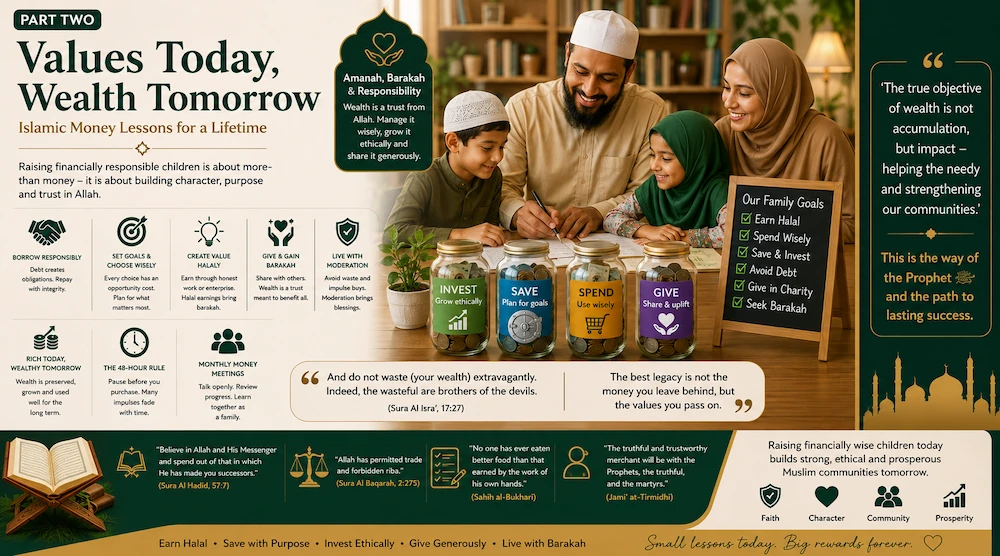
Teaching children about money does not end with earning, saving and investing. It also means helping them develop lifelong habits of responsible borrowing, ethical entrepreneurship, generosity and wise stewardship. In the second of the two-part series, MOHAMED JAFFER explores how Muslim parents can nurture financially responsible children guided by timeless Islamic values.
Parents should be their children’s first financial institution by demonstrating responsible lending. If a bicycle costs R2 000 and the child has managed to save only R1 000, parents might lend the remaining amount under a simple repayment agreement, such as R20 each month from future earnings.
The objective is not to burden children with debt but to teach that borrowing creates obligations. They learn that every financial commitment carries responsibilities, and that repayment is part of personal integrity.
This lesson also provides an opportunity to distinguish between ethical financing and interest-based lending. Islam permits trade and partnership but firmly prohibits riba because it can exploit borrowers and widen inequality. Children should understand that borrowing should be approached carefully and only when genuinely necessary.
The Prophet Muhammad ﷺ regularly sought refuge from overwhelming debt, reminding Muslims that financial obligations should never be taken lightly. He would supplicate: ‘O Allah, I seek refuge in You from sin and heavy debt.’ (Sahih al-Bukhari)
Opportunity cost and goal-based saving
Every financial decision involves choosing one option over another. Parents can help children understand this by asking simple questions such as: ‘You have R100. Would you rather buy sweets today or save towards a soccer ball next month?’
Children quickly discover that every purchase means giving up another possibility. This understanding of opportunity cost helps develop thoughtful decision-making instead of impulsive spending.
You may also want to read






Goal-based saving strengthens this lesson. Parents can encourage children to paste pictures of the bicycle, sports equipment, holiday destination or educational item they are saving towards onto their savings jars. Linking money to meaningful aspirations transforms saving from a sacrifice into a purposeful journey.
Islam similarly encourages believers to think beyond immediate gratification. The Quran repeatedly calls on people to consider the consequences of their choices and to prepare responsibly for the future while placing their trust in Allah.
Encourage entrepreneurship and value creation
Children are naturally curious, creative and resourceful. These qualities can be nurtured through simple entrepreneurial activities such as selling homemade lemonade, baking cookies, growing plants, washing neighbours’ cars or producing handmade greeting cards.
These experiences teach an important financial lesson: income grows not only by working harder but also by creating value for others.
Entrepreneurship also develops confidence, resilience, communication skills and problem-solving abilities — qualities that benefit children throughout their lives.
The Prophet Muhammad ﷺ himself earned his livelihood through honest trade before receiving revelation, establishing commerce as a noble profession when conducted with integrity.
He also said: ‘The truthful and trustworthy merchant will be with the Prophets, the truthful, and the martyrs.’ (Jami’ at-Tirmidhi)
Parents should therefore emphasise that success in business depends not only on profit but also on honesty, transparency and fairness. Children should learn that every business venture must be built upon halal earnings, truthful dealings and respect for customers.
Embed giving, gratitude and barakah
Perhaps the most distinctive feature of Islamic financial education is teaching children that wealth exists to benefit others as well as themselves.
Rather than merely encouraging charitable giving, parents can allow children to decide where the money in their Give jar should go every few months. They might choose to support an orphan, contribute to the local masjid, assist a feeding programme or help a struggling family.
Making these decisions themselves helps children appreciate the real impact of generosity.
Allah says: ‘You will never attain righteousness until you spend from that which you love.’ (Sura Aal ‘Imran, 3:92)
Giving should also be linked to gratitude. Children who recognise every blessing as a gift from Allah become less likely to measure success solely by possessions.
Parents can introduce another important Islamic concept: barakah. Two families may earn identical incomes, yet one experiences contentment, generosity and stability while the other constantly struggles despite having more. Islam teaches that true prosperity is not measured only by numbers but also by the blessing that Allah places in wealth earned and spent lawfully.
Differentiate being rich from being wealthy
Many children assume that wealth simply means having lots of money.
Parents can explain the difference through simple examples. A child who immediately spends R1 000 may appear rich for a day, while another who saves, invests responsibly and gives in charity is laying the foundations for lasting wealth.
True wealth is measured not only by income but by wise stewardship, long-term planning and financial resilience.
The Prophet ﷺ reminded Muslims that richness is not merely material abundance. He said: ‘Richness is not having many possessions. Rather, true richness is the richness of the soul.’ (Sahih al-Bukhari; Sahih Muslim)
This perspective helps children avoid defining success purely through consumption.
Curb impulse purchases through moderation
Modern advertising encourages instant gratification, making self-control an increasingly valuable life skill.
One practical strategy is the ‘48-hour rule’. When children want to buy something unexpectedly, encourage them to wait two days before making the purchase. Many desires fade once emotions settle.
Parents can use this opportunity to discuss the Quranic prohibition of wastefulness.
Allah says: ‘Indeed, the wasteful are brothers of the devils.’ (Sura Al Isra’, 17:27)
Teaching moderation protects children from emotional spending and encourages thoughtful financial choices that will benefit them throughout adulthood.
Hold monthly family money meetings
Money should never become a forbidden subject within the family.
A monthly discussion lasting 15 to 30 minutes can review earnings, spending, savings, investments, charitable giving and future goals. Children should be encouraged to celebrate achievements, discuss setbacks and learn from mistakes without embarrassment.
These conversations foster openness, accountability and collective responsibility.
Parents who regularly discuss finances also prepare their children to manage household budgets, understand financial priorities and appreciate the importance of consultation in family decision-making.
Raising financially responsible Muslims
The greatest financial inheritance parents can leave their children is not necessarily wealth itself, but the wisdom to earn it ethically, manage it responsibly and share it generously.
A child who learns to earn before spending, save before buying, invest wisely before consuming, avoid unnecessary debt, distinguish between halal profit and prohibited riba, and give regularly in charity receives an education that many adults never acquire.
These lessons also contribute to one of the higher objectives of Islamic law (maqasid al-Shariah): the protection and responsible stewardship of wealth (hifz al-mal). Financial literacy therefore becomes far more than a practical life skill. It becomes an act of worship, enabling Muslims to fulfil their obligations towards Allah, their families and society.
Ultimately, parents will be remembered less for the wealth they leave behind than for the values they instil. Children who understand honesty, gratitude, discipline, generosity and trustworthiness are equipped not only to build financial security, but also to become ethical custodians of Allah’s blessings.
Mohamed Jaffer is the founder and principal financial planner at Mojaff Financial Services and Mojaff Legacy. A former analytical chemist, corporate business planner and business manager, he holds a B.Compt and postgraduate qualifications in financial planning, estate planning and risk management. Jaffer is currently completing an Advanced Diploma in Estates and Trust Administration.