









![Does ta’wīl mean interpretation or fulfilment? A Quranic reassessment [+video]](https://muslimviews.co.za/wp-content/uploads/2026/10/Tawil-Kaskas-360x180.webp)












![Why becoming a wealthy Muslim is commendable in Islam [+videos]](https://muslimviews.co.za/wp-content/uploads/2026/09/Muslim-Trade-Business-1-360x180.webp)



A thoughtful reflection on Umrah, exploring how this spiritual journey connects with ethical responsibility and justice in a time of global crisis.
By PROFESSOR ASLAM FATAAR
Spiritual renewal and moral responsibility in a time of war
In a time marked by the devastation of Gaza and a widening West Asian war shaped by the United States–Israel imperial axis against Iran, many of us are asking how to live our dīn with integrity amidst overwhelming suffering.
This moment presses upon us a familiar but demanding question: how do we hold together our personal acts of devotion with our ethical responsibilities toward the Ummah?
This question arises not from doubt about the value of ʿUmrah, but from a desire to think more carefully about what our acts of worship ask of us in times of crisis. ʿUmrah remains a deeply meaningful act of ʿibādah, a journey of nearness, humility, and renewal. For many, it is precisely through such journeys that the heart is softened and reoriented toward what matters most.
The Qurʾān calls believers to stand firmly for justice, even when it is difficult and demands moral clarity. This call is not separate from acts of worship. It is through worship that the believer is formed as one who is attentive, responsive, and ethically awake. Spiritual renewal and moral responsibility are therefore not distinct paths, but part of a single ethical orientation.
At the same time, the present moment invites a deeper reflection on how such renewal relates to the suffering of others. Across parts of the Middle East and West Asia, the realities of war, constraint, and uneven political response form a complex moral landscape. These conditions do not negate the value of sacred journeys, but they do call for greater awareness of how our devotional lives are situated within broader social and political worlds.
The question, then, is not whether one should or should not undertake ʿUmrah. Rather, it is how our acts of devotion participate in shaping the kind of ethical subjects we become, and how they orient us, in both small and large ways, toward justice, compassion, and responsibility in a world marked by fracture and loss.
Devotion and the ethical call of the Ummah
At the heart of our dīn lies a deep interweaving of inward purification and outward responsibility. Acts of ʿibādah are not isolated rituals, but practices that shape the moral orientation of the believer. The Prophetic teaching that the believers are like one body, such that the pain of one part is felt by all, reminds us that spiritual life is always connected to the condition of others.
In times of relative calm, the rhythm of personal devotion carries a certain ease and coherence. In moments of intense and visible suffering, however, that rhythm invites a more conscious attentiveness. The question is not one of permissibility, since ʿUmrah remains a valid and meritorious act. Rather, it is a question of ethical attunement: how our acts of worship resonate with the realities we witness.
There is a long-standing Islamic understanding that worship refines the self in ways that extend beyond the individual. It cultivates care, solidarity, restraint, and a sense of accountability before Allah. In this way, devotion forms the believer into one who can respond more fully to injustice and human suffering.
Sacred journeys within a complex moral landscape
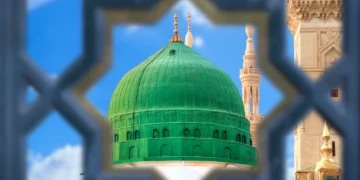
Performing ʿUmrah offers a powerful opportunity for spiritual renewal. The sacred precincts of Makkah and Madīnah draw the believer into a space of humility, reflection, and nearness to Allah. For many, this journey becomes a source of strength, clarity, and renewed purpose.
At the same time, the contemporary organisation of Hajj and ʿUmrah unfolds within highly structured institutional and economic systems. These systems form part of a wider global landscape, shaped by shifting political alignments, economic flows, and uneven responses to ongoing conflict and injustice.
To recognise this context is not to diminish the sincerity of individual intention. Intention remains foundational in Islam. Rather, it is to acknowledge that our acts of devotion are not entirely separate from the worlds in which they take place. They are situated within broader networks of meaning, material exchange, and political reality.
This recognition fosters a more thoughtful reflection on how we engage, including how our participation influences broader systems, sometimes even physically. It invites us to think about how our ethical commitments extend beyond mere intention to include awareness of context, consequences, and accountability.
Reorienting devotion in a time of crisis
In reflecting on sacred practice today, the distinction between Hajj and ʿUmrah remains significant. Hajj, as a farḍ obligation, carries a clear duty within the Sharīʿah. Its fulfilment remains a priority for those who are able. ʿUmrah, by contrast, as a non-compulsory act, opens a wider space for ethical reflection in relation to timing, intention, and context.
This reflection, however, need not be framed as a tension between devotion and responsibility. Rather, it invites us to consider how acts of ʿibādah participate in the formation of the ethical self. The sacred journey is not only a movement across space, but a process of becoming. It refines intention, disciplines desire, and cultivates a deeper awareness of one’s responsibilities.
The Qurʾānic call to stand firmly for justice takes root not only in public action but in the inner life of the believer. Personal piety and spiritual renewal are among the means through which the believer is shaped to respond to the condition of the Ummah. In this sense, to be steadfast in justice is both an inward and outward orientation.
You may also want to read


From this perspective, those who undertake ʿUmrah in this moment may do so as part of their ethical striving, seeking renewal and strength in the sacred precincts. The journey can deepen one’s commitment to justice, compassion, and accountability.
At the same time, others may feel called to defer the journey, directing their energies toward forms of worship and action that respond more immediately to others’ suffering, including sustained duʿāʾ, material support, advocacy, and embodied solidarity.
What becomes important is not a singular prescription, but a shared attentiveness. The question is how our acts of devotion, wherever they are performed, shape us into subjects who are responsive to suffering, alert to injustice, and committed to the dignity of others.
In this way, ʿibādah and ethical responsibility are drawn into closer relation. Devotion becomes not only an inward turning toward Allah, but an outward orientation toward justice, dignity, and care in the world.
These reflections are offered in humility and with respect for the diversity of understandings within our community. Through careful thought, sincere intention, and open-hearted dialogue, we may deepen our collective capacity to hold together spiritual depth and moral responsibility.
May Allah guide us to what is most pleasing to Him, accept our acts of worship, and make us among those who embody justice, compassion, and steadfastness.
Professor Aslam Fataar is a Research and Development Professor in Higher Education Transformation at Stellenbosch University and editor of the forthcoming book, Prophet Muhammad ﷺ at 1500: His Prophetic Legacy, Ethical Vision and Contemporary Resonance, published by the Prophetic Legacy Commission and Awqaf-SA, Cape Town.