
















![The market-builder who restrained the market [Part 2]](https://muslimviews.co.za/wp-content/uploads/2026/08/PHOTO-2026-08-25-17-16-32-360x180.jpg)
![The merchant preceding the Prophetic mission [Part 1]](https://muslimviews.co.za/wp-content/uploads/2026/08/01-360x180.jpg)





‘From Cape Town to Gaza, the cry is the same: freedom, dignity, and justice. Palestine must be supported, with all the clarity and commitment that our own history demands.’
By PROFESSOR ASLAM FATAAR
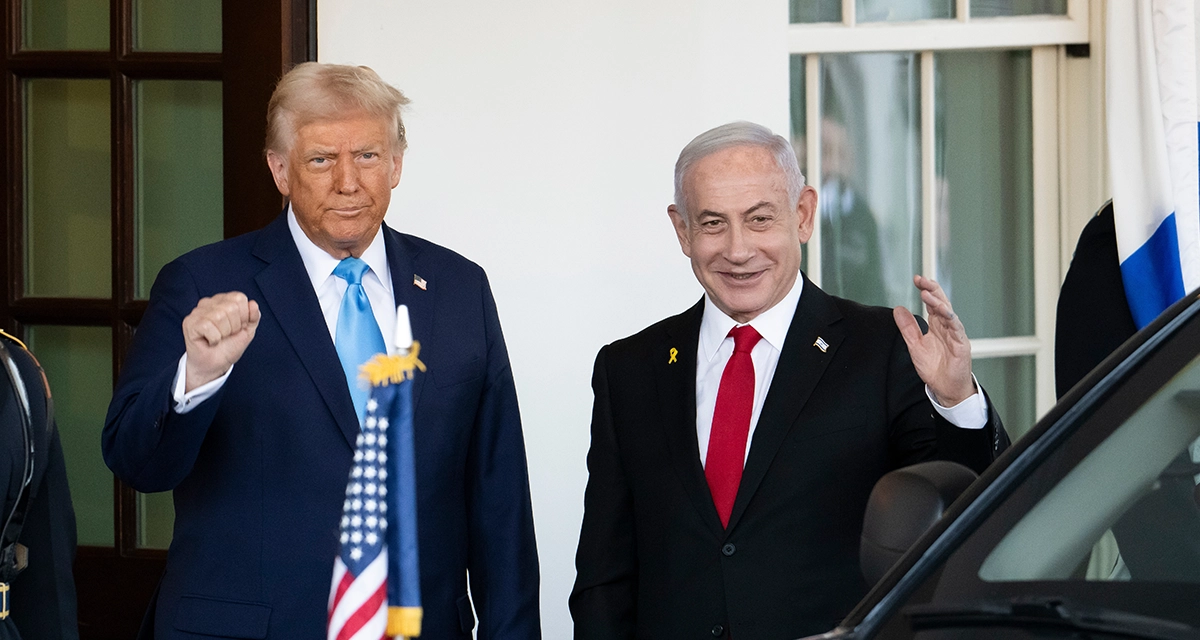
The Trump plan for Gaza is presented as a route to stability, but in reality, it institutionalises domination. It solidifies external control, denies sovereignty, and links humanitarian relief to submission. From Cape Town, South Africa, with our history of anti-apartheid struggle, we must reject this disgrace and build strategic solidarity for Palestine.
The plan is based on 20 key points. Each presents a vision of Gaza as a peaceful enclave rather than a free homeland. It starts by declaring Gaza a ‘terror-free zone’, demanding full demilitarisation, the destruction of tunnels and weapons, and the permanent exclusion of Hamas or other groups from governance.
In return, Israel commits to a phased withdrawal, overseen by an International Stabilisation Force made up of the Unites States and Arab countries, and ‘vetted Palestinian’ police. This foreign-led security arrangement leaves Palestinians without agency while external forces decide their future.
A transactional hostage–prisoner exchange forms the core of the plan. All Israeli hostages, alive or dead, are to be returned in exchange for a limited prisoner release: 250 life-sentence detainees and 1700 Gazans arrested after October 7, 2023, including women and children. Amnesty is offered only to Hamas members who renounce resistance and hand in their weapons. Those unwilling to comply are promised ‘safe passage’ out of Gaza, a thinly veiled mechanism for exile.
Aid and reconstruction depend on acceptance of these terms. The plan promises immediate relief and the rebuilding of infrastructure, hospitals, and bakeries, but only under international supervision and only once the agreement is signed. Gaza’s governance is handed over to a technocratic Palestinian committee overseen by a ‘Board of Peace’ chaired by Donald Trump, with figures like Tony Blair suggested as members. This arrangement turns Gaza’s administration into an experiment in external supervision, with foreign elites controlling the conditions of daily life and development.
The plan devotes several points to economic pacification. A ‘Trump economic development plan’ and a special economic zone are promised, framed as opportunities for jobs and investment. In truth, these proposals substitute market dependency for political freedom. Development becomes a tool of pacification: commerce without sovereignty, rebuilding without reparations, growth without justice.
Even ideology is targeted. An interfaith dialogue process is proposed to reshape ‘mindsets’ of Palestinians and Israelis toward ‘co-existence’. This is presented as reconciliation, but functions as social engineering, in other words, an effort to reframe occupation as a benign partnership, while the structural violence of dispossession goes unchallenged.
Finally, the plan dangles a conditional promise of Palestinian statehood. It suggests that once Gaza is fully demilitarised, the Palestinian Authority reformed, and redevelopment advanced, the ‘conditions’ may exist for self-determination. This distant horizon is designed to pacify calls for sovereignty while indefinitely postponing justice.
You may also want to read



South Africa’s history demands a different response. Our freedom was achieved not through conditional deals with apartheid but through global solidarity, boycotts, and pressure that made apartheid unsustainable.
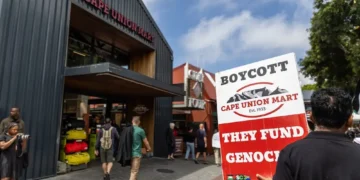
The same strategy must be applied today. Diplomatic rupture with Israel is essential. Boycott, divestment, and sanctions must be implemented more deeply in our investment behaviour and everyday consumer choices, as well as in educational institutions, unions, sports organisations, religious institutions, and pension funds.
Legal action through the International Criminal Court (ICC) and the International Court of Justice (ICJ) must continue until accountability is secured. Humanitarian aid must be unconditional, flowing directly to Palestinians without any political interference or manipulation.
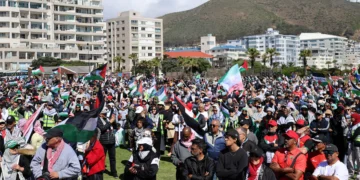
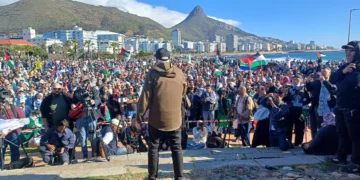
Solidarity must continue in marches, pickets, and acts of public witness. Our resistance should be rooted in the everyday spaces where communities come together and learn. Schools, universities, churches, mosques, youth centres, and civic organisations must carry forward the stories of Palestinian dispossession and occupation alongside the struggles unfolding in Sudan and Congo, the exploitation of workers worldwide, and the fight for climate justice.
These global struggles resonate directly with the realities of inequality, housing injustice, and violence in our own communities. By weaving together the local and the global, we cultivate a solidarity that is not episodic but strategic, rooted in shared resistance to domination and exploitation. Such connections strengthen both the moral foundation and the political force of our collective struggles.
We must also challenge political actors who align themselves with Zionist frameworks. The Democratic Alliance’s obsession with ‘efficiency’ mirrors the managerial language of the Trump plan — governance reduced to control, surveillance, and order, while justice is sidelined.
The Patriotic Alliance’s faux populism positions itself as the champion of the marginalised, yet its pro-Zionist stance aligns it with power rather than with oppressed peoples. Both parties betray moral clarity.
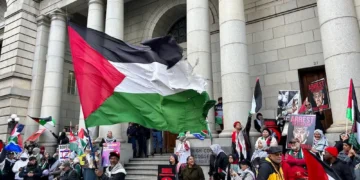
The Trump plan seeks to turn genocide into policy. South Africa, and Cape Town in particular, must respond with clarity and courage. Solidarity means diplomatic rupture, economic boycott, and principled mobilisation rooted in our communities. It means refusing to accept external tutelage, forced pacification, and hollow promises of future statehood.
From Cape Town to Gaza, the cry is the same: freedom, dignity, and justice. Palestine must be supported, with all the clarity and commitment that our own history demands.
Aslam Fataar is a Research Professor in Higher Education in the Department of Education Policy Studies, Stellenbosch University.