
















![The market-builder who restrained the market [Part 2]](https://muslimviews.co.za/wp-content/uploads/2026/08/PHOTO-2026-08-25-17-16-32-360x180.jpg)
![The merchant preceding the Prophetic mission [Part 1]](https://muslimviews.co.za/wp-content/uploads/2026/08/01-360x180.jpg)




![South Africans have key role in the struggle against Apartheid Israel + [videos]](https://muslimviews.co.za/wp-content/uploads/2025/10/Francesca-Albanese.webp)

By YASEEN BARDIEN
‘You forcibly remove people from their land, destroy their homes, confine them to given areas and you replace them with settlers. This is the essence of settler colonialism.’
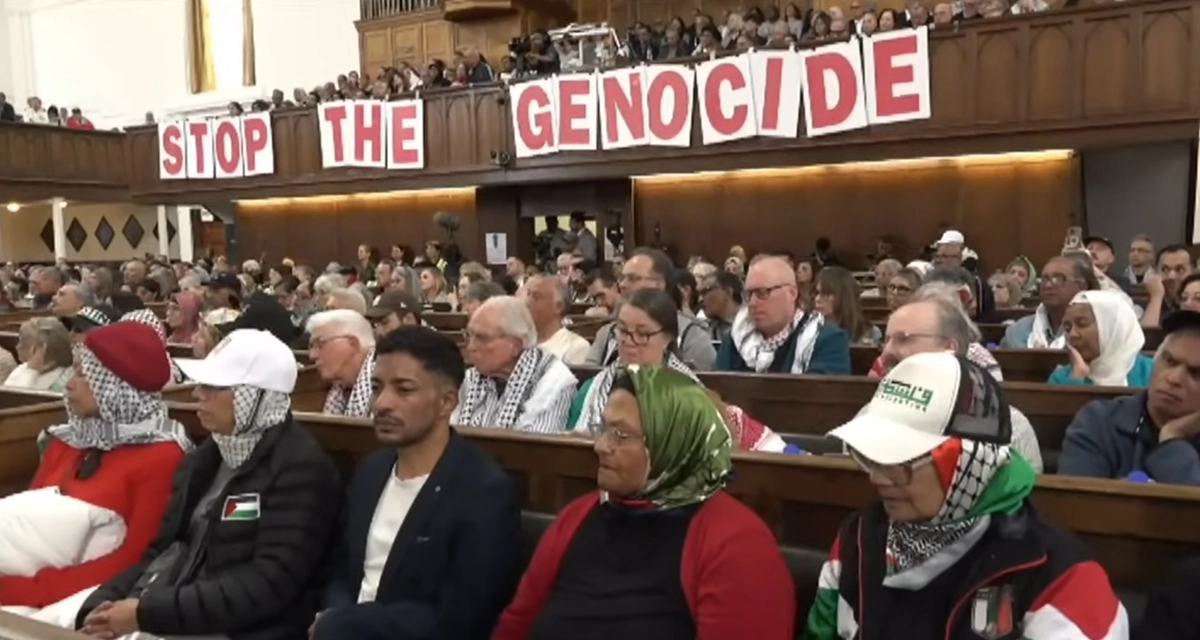
This powerful statement encapsulated the direct and hard-hitting address to a packed Groote Kerk in Cape Town on Sunday October 26 by the UN Special Rapporteur on the Occupied Palestinian Territories, Francesca Albanese.
In South Africa as a guest of the Nelson Mandela Foundation, the Cape Town event was jointly hosted by the Palestine Solidary Committee (PSC) and the Groote Kerk.
Joined on stage by the PSC’s Martin Jansen and Jaamia Galant, Albanese began by expressing her gratitude to the crowd. She went on to highlight global complicity in the oppression of the Palestinians and urged South Africans to strengthen the boycott of Israeli products.
While commending South Africa for approaching the International Court of Justice (ICJ) to declare Israel’s killings in Gaza a genocide, she was critical of the coal that was exported by this country to fuel Israel’s war crime.
When asked why oppression and genocide of the Palestinians had been allowed to continue since 1948, Albanese reminded the audience that it was important to be clear about historical datelines.
‘Apartheid in this country did not start in 1948, other than on paper. The crimes against the Palestinians in the land that was once called Palestine, even on the maps, didn’t start in 1948.’
Alluding to the Balfour Declaration of 1917, she declared: ‘The British should be spoken about in the history books as the nation that had the tendency to give away lands that were never theirs to give. And this happened in South Africa, and this happened in Palestine.
‘So, the crimes against the Palestinian people started even before Israel existed.’
Given the history of British complicity in the crimes against the Palestinians, she turned to the present and pointed out the gall to name a former UK Prime Minister as a joint administrator of Gaza.
‘The only place I would like to see Tony Blair is in The Hague. So, I wish him a long life, a healthy life, so that it gives us all the time to put the papers together to take him to the Hague for our brothers and sisters in Iraq.’
Albanese said Israel has continued to do what has been doing for over seven decades – taking land and dispossessing the Palestinians – because the international community has always allowed it to do so with impunity.
Key factors to be taken note of, she pointed out, were the economic and financial interests that are sustaining the genocide, describing them as being ‘profitable’ for the superpowers who have not condemned Israel.
‘The unlawful occupation of Palestine has been profitable for private actors, companies and even universities who have for 57 years contributed to strangle the Palestinians, to help Israel displace them.’
‘You forcibly remove people from their land, destroy their homes, confine them to given areas and you replace them with settlers. This is the essence of settler colonialism.’
Albanese called out Israeli forces who have shown brutality to women and children in Palestine. ‘This is a collective crime and has been enabled because no one has respected the law,’ she says.
The right to resistance
Albanese said that while Palestinians have a right to defend themselves against their occupiers, she urged them to not mirror the occupiers’ violence, condemning the targeting of civilians.
She was, however, clear about the right to resist when questioned about it.
‘Yes, the Palestinians have a right to defend themselves from the occupier. This right does not include targeting civilians. But an unlawful act of the resistance doesn’t delegitimise the right to resist. You have a right to resist until you enjoy your freedom.’
She added that the world was quick to condemn acts against civilians by the resistance but ‘the acts of an unlawful occupation keep on piling up and the architects and executioners of those crimes must be held accountable. But they are not.’
In this light, she declared, the argument the West has used that Israel has a right to defend itself is spurious.
On attacks against civilians, she also made a clear distinction as far the illegal settlers are concerned.
‘Settlers are part of the occupation force. They are civilians who go around killing Palestinians.’
Albanese also pointed out how terminology had been shaped by the post 9-11 era.
‘Every freedom fighter, now more than ever, is considered a terrorist on a global scale. This is the language that even states in the global majority are using.’
Albanese went on to draw parallels between South Africa and Palestine, both of which have a rich history showing resistance against their oppressors for liberation. She also reminded the audience that Apartheid in South Africa was not ended by South Africans alone. She called on South Africans to continue their support of the Palestinian struggle.
‘We need to help them (Palestinians), as others have helped the South African people to bring down Apartheid.’
In emphasising a practical and effective form of action, Albanese strongly endorsed the BDS campaign, stressing that it should be wide-ranging – from governments to consumers.
‘If you are a consumer, you boycott. If you are a business, you divest. And if you are a civil servant, you find a way to make sure that the government cuts ties with the Apartheid state of Israel.’
She said, as consumer, one should be conscious of what one ‘puts into a grocery basket while shopping’.
Albanese then challenged all South Africans: ‘Are you still drinking Coke? Are you still using Air B&B? Wherever I go in this country I see people drinking Coca-Cola. So stop drinking Coca-Cola and then blame the government.’
Continuing to boycott Israeli goods, including food and other imported goods, was an act of solidarity and resistance.
‘When shopping,’ Albanese said, ‘one should make ethical choices.’
Albanese: ‘Are you still drinking Coke?’
She expressed frustration towards the South African government supplying coal to Israel. She did, at the same time, acknowledge that the government was under threat due to those who ‘call the shots’ in the economic and financial scheme of things.
Prosecute SA nationals
Albanese questioned why South African nationals who fought in the Israeli occupation force were able to act with impunity.
She said that those who served the occupation forces must be considered as suspects and investigated.
‘The police need to investigate them. If there is evidence that they have committed crimes, they need to be prosecuted. And if the judges conclude that they have (committed crimes), they must be convicted.’
You may also want to read

![Islamic finance at the first African G20 [+video]](https://muslimviews.co.za/wp-content/uploads/2025/11/B20-Part-1-120x86.webp)


She added that this applied to South African nationals as well as ‘Israelis who come here to recover from the massacres’, adding with a broad hint of sarcasm, ‘massacring another people is tiring, actually.’
Prosecute South Africans who serve the IOF
In response to a comment that South Africa was doing little to prevent the genocide, she expressed her disagreement.
She commended South Africa for taking the lead in challenging Israel at the International Court of Justice (ICJ).
‘I wouldn’t say that South Africa hasn’t done anything. South Africa has done something important. Bringing the case to the court of justice has been enormous. South Africa went alone and risked repercussions from the United States and others.
Albanese voiced concerns that the crisis in Palestine could have wider consequences beyond the region, suggesting that it could happen elsewhere.
‘What’s happening in Palestine will not stay there. All the weapons that have been tested will be used against us next.’
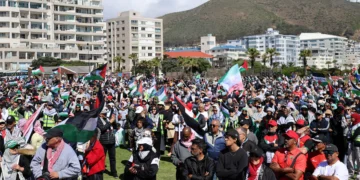
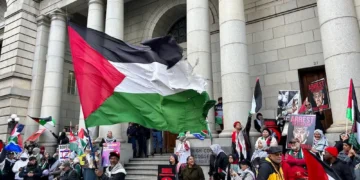
As her address came to a close, the crowd – which number over 1 000 in the church and 500 in the square outside – rose in applause. Albanese’s words resonated deeply, reminding them that through solidarity, freedom can be achieved.
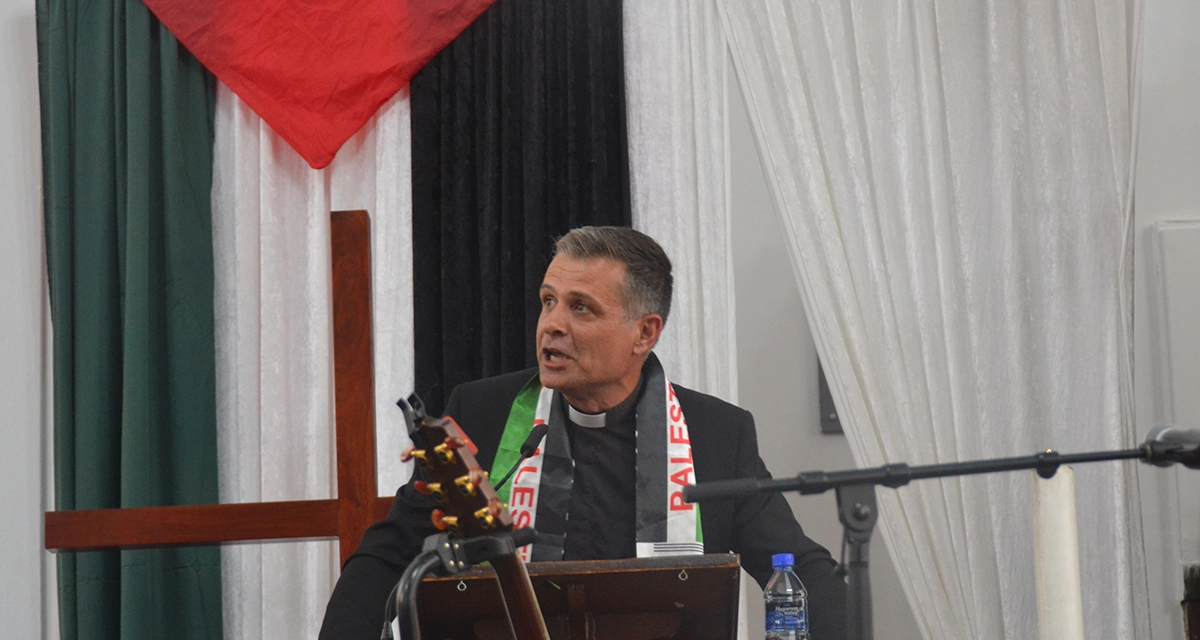
Earlier, the pastor of the Groote Kerk, Ds Riaan de Villiers, welcomed the church’s ‘interfaith partners, friends and all who are gathered in this historic space.’
In a stirring opening address, he said the Groote Kerk had stood for over 360 years ‘bearing witness to the story of our nation and our soul.’
Ds de Villiers declared: ‘This is not just a building of worship; it also stands on ground that still carries the echoes of slavery, colonialism and Apartheid. From these very streets that surround us, people were once sold, silenced and displaced. Any yet, by grace, the same ground now becomes for us a place of truth telling, healing and hope. We gather here today in this building because history itself calls us here to remember, to repent and to rebuild.’
He added that those who had gathered were people of conscience ‘united by a by a shared longing for justice and human dignity. We come here believing that the suffering of one people diminishes the humanity of us all.
‘Today, our hearts turn especially towards our Palestinian brothers and sisters, whose cries for freedom and safety echo across the world.
‘Our solidarity here today is also an act of faith. It is also a declaration that no nation, no people should live under occupation or fear; that peace without justice can never be peace at all.’
Welcoming Francesca Albanese, Ds de Villiers said: ‘She has been a beacon of light and courage, calling us and the world back to human rights and international law. May this historic space become a place of courageous compassion, a place where truth is spoken, where wounds are tended and where hope is born for all who long for freedom.’