















![The market-builder who restrained the market [Part 2]](https://muslimviews.co.za/wp-content/uploads/2026/08/PHOTO-2026-08-25-17-16-32-360x180.jpg)
![The merchant preceding the Prophetic mission [Part 1]](https://muslimviews.co.za/wp-content/uploads/2026/08/01-360x180.jpg)






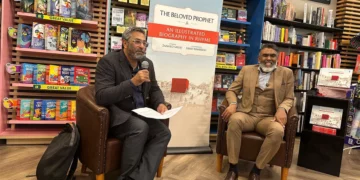
Politics and Peril: The South African Crisis is a new book by academic and columnist Imraan Buccus. Part memoir but mainly political analysis, the book weaves together personal experience with a critical account of South Africa’s ongoing crisis.
Drawing on influences from luminaries in South Africa and global thinkers such as Frantz Fanon, Ali Shariati and others, Buccus examines how the promise of liberation gave way to corruption, inequality and repression.
In this edited extract from Politics and Peril: The South African Crisis, IMRAAN BUCCUS explores how Islam shaped his political activism during apartheid and beyond.
MYentry into politics was inseparable from my search for meaning within Islam. I was raised in a religious Muslim home, and as a young boy I found myself wrestling with what my faith had to say about the world beyond our doorstep. This was a world scarred by poverty, racial exclusion and the brutal injustices of apartheid. I wanted to know whether religion had anything to offer a young person growing up under such conditions.
As a teenager, I approached our local imam and asked what Islam’s position was on the oppression of Black people. His answer was abrupt and unsettling: he dismissed the matter as ‘kufr politics’.
That response stayed with me. It suggested that something vital was absent from the way religion was being taught. The disjuncture between the moral universe of the Qur’an and the harsh realities around me felt too stark to ignore.
My father, despite having only a primary school education, recognised my unease. He introduced me to Fuad Hendricks, then editor of Al Qalam, a national Muslim newspaper whose political outlook differed sharply from the conservative religious currents dominant in my community. Through Hendricks, I encountered a strikingly different articulation of Islam, one grounded in justice and solidarity with the downtrodden. He spoke of the Prophet (SAW) as someone who confronted injustice, stood with the marginalised and challenged oppression. For the first time, I experienced a version of Islam that spoke directly to the world I inhabited.
Hendricks urged me to attend the Muslim Youth Movement’s Islamic Training Programme in December 1989. That weekend proved decisive. It was there that I was first introduced to the writings of Ali Shariati, whose work wove together religion and radical social theory. Shariati gave intellectual language to convictions that had been forming within me for years: that striving for justice is itself a religious act. Resistance to oppression cannot be separated from spiritual devotion is what I learnt from reading Shariati.
You may also want to read


The programme also brought me into contact with leading activists in the Muslim community, among them Na’eem Jeenah and Shamima Shaikh. Na’eem, in particular, left a lasting imprint on my political consciousness. During one discussion he remarked, ‘My spirituality is heightened when I am toyi-toying.’ It was a simple but profoundly clarifying insight. In that statement, I was able to see how my faith connected to the political reality of the time. Collective struggle, solidarity and even the embodied act of marching became expressions of faith.
One of the most powerful memories from that period is meeting Ahmed Kathrada shortly after his release from 26 years in prison. Kathrada attended a gathering hosted by the Muslim Youth Movement. As he entered the hall, young people broke into song and formed a moving guard of honour, toyi-toying him into the room. Later, I found myself standing beside him during the Maghrib prayer. To pray shoulder to shoulder with a man who had sacrificed so much and who had emerged from prison with dignity and humility intact was electrifying. In that moment, political struggle and faith converged for me.
Yet the weekend was not without its tensions. Alongside its energising ideas were stark reminders of fractures within the Muslim community: gender hierarchies, racial prejudice and class fractures. These were not marginal issues as they reflected the broader social terrain shaping South African Islam in the final years of apartheid. Even so, the Muslim Youth Movement created a rare space in which young people like myself could imagine an Islam that was intellectually vibrant and uncompromisingly committed to justice.
Looking back, that period marked a turning point. It was when my political identity found its anchor in my religious identity. Islam ceased to be merely a collection of private rituals and became a framework for understanding and challenging the world. It offered moral clarity and emotional discipline. It insisted that neutrality in the face of injustice was untenable. It taught me that spiritual and political life were not competing domains, but intertwined responsibilities.
That insight shaped the trajectory of my life. It informed my activism, my academic work and my enduring commitment to working-class struggles in South Africa. It reframed solidarity not simply as a political stance, but as a moral obligation. And it grounded my conviction that the pursuit of justice, however complex and painful, is itself a lived expression of faith.
Dr Imraan Buccus is research fellow at UJ’s Institute for Advanced Study (JIAS), editor of Al Qalam and research associate at ASRI. Politics and Peril: The South African Crisis is published by African Perspectives and is available at Exclusive Books, Baitul Hikmah, Clarkes and Sherwood Books.