




















![The market-builder who restrained the market [Part 2]](https://muslimviews.co.za/wp-content/uploads/2026/08/PHOTO-2026-08-25-17-16-32-360x180.jpg)
![The merchant preceding the Prophetic mission [Part 1]](https://muslimviews.co.za/wp-content/uploads/2026/08/01-360x180.jpg)







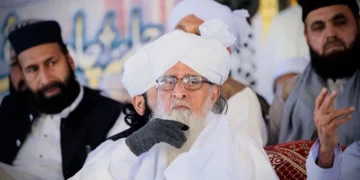
Speaking in Cape Town, Iran’s Deputy Foreign Minister Dr Saeid Khatibzadeh defended Tehran’s resistance strategy, the US-Iran MOU and Iran’s decision to close the Strait of Hormuz.
By ANWAR OMAR
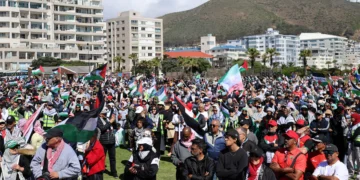
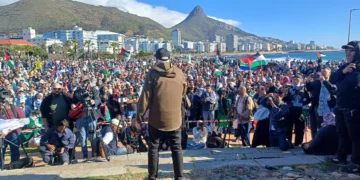
On June 17 the United States and Iran signed a long-awaited Memorandum of Understanding (MOU). Three days later, on June 20, Iran’s Deputy Minister of Foreign Affairs, Dr Saeid Khatibzadeh, presented his country’s perspective on the agreement during a public address at Islamia College in Lansdowne, Cape Town.
The timing was not accidental. He was there to do what Tehran has been doing with disciplined intent since signing the 14-point MOU on 15 June: to shape the narrative to the rest of the world, in particular the Global South.
The MOU, signed by President Trump and Iranian Parliament Speaker Mohammad Bagher Ghalibaf, was supposed to formally end months of US-led aerial bombardments, open the Strait of Hormuz, lift a naval blockade on Iranian ports, and set a 60-day timeline for a final deal, including a $300 billion reconstruction fund.
Khatibzadeh wasted no time defining Iran’s position. He told the audience that, for his country, victory lay in denying its enemies and aggressors their objectives of hegemony and dominance. He said they had failed badly to achieve any of their goals, and that this was why he was standing before the audience as victorious as any nation could be.
He said Iran had decided to change the course of history through ultimate resilience because it had no other option — not only for its own civilisation and not only for the Muslim world, but for the sake of all humanity. He said Iran had sought to show rogue and bullying powers that they could not, through naked force, change the destiny of Iran or the region.
By the time the evening ended, this rationale had also become the justification for closing the Strait of Hormuz.
South Africa-Iran relations
Ambassador Khatibzadeh started his presentation by saying that he had come to report on what he described as the most important juncture in the history of the Middle East, of his country, of the Islamic Ummah and, he added, even of international politics.
He explained that South Africa and Iran share several common diplomatic positions, including the ICJ genocide proceedings against Israel, BRICS membership, and a shared critique of Western sanctions as coercion, which makes this event both strategically and symbolically important for Tehran.
Khatibzadeh said South Africa had been at the frontline, adding that those who confined the issue to Muslims were, in fact, downgrading the importance of a human issue.
Drawing on the apartheid parallel, he endorsed a one-state solution for Palestine, saying that, because of the experience of apartheid, Iran also subscribed to a one-state solution instead of a two-state solution.
The hall responded with a standing ovation. For Iran, the audience was not merely receptive. It was validation.
A personal account
Katibzadeh related his personal account of events during the first round of negotiations last June. He described how he was present at the negotiations in Oslo last June, together with representatives of the Norwegians and Omanis in indirect negotiations with the Americans. He explained how negotiations were at an advanced stage to the extent that they were about to negotiate the final steps of the deal.
He described how the Iranian delegation travelled back to Tehran, arriving there at midnight, and how he was made aware of the Israeli aggression by his wife at 3am that same morning. According to him, while the US was negotiating with them, it was coordinating with Israel behind the scenes in one of the most coordinated covert operations against another sovereign country.
He said their off-duty commanders had been assassinated in the middle of the night, some together with their families and neighbours. He described them as having been slaughtered and assassinated, and said war crimes had been committed by what he called the genocidal regime of Israel and the reckless administration of the United States.
This resulted in the escalation of war. According to Katibzadeh, the aggression began with a demand for unconditional surrender, using the same language associated with the bombing of Hiroshima and Nagasaki. He said Iran, guided by Imam Khamenei, decided to exercise ultimate resistance and did so. Within less than a week, he said, Iran received a request for an unconditional ceasefire, adding that he knew this because he had been personally involved in some of those negotiations.
He described how Iran hit back at Israel in Tel Aviv for the first time since the Second World War, against a country possessing hundreds of nuclear warheads. He said Iran responded with whatever it could and struck Israel at its heart, after which Israel requested an unconditional ceasefire.
A deal built on disputed ground
It is important to understand that the latest MOU is only a framework, not a resolution. Its 14 points establish a ceasefire, a 60-day negotiation window, and sequenced commitments: Iran to facilitate toll-free passage through Hormuz for 60 days; the US to remove its naval blockade within 30 days, issue oil export waivers, and unfreeze $24 billion in Iranian funds. What the MOU does not do is resolve the nuclear question. Iran’s enrichment programme, its stockpile, and its IAEA and UN Security Council status are all deferred. Down-blending of enriched uranium under IAEA supervision is listed only as the minimum agreed position.
Almost immediately, the 60-day clock ran into trouble. The Switzerland talks were called off on Friday, just 24 hours before the event at Islamia, with Vice President Vance cancelling his trip. Khatibzadeh said Iran was ready to move forward step by step, if the other party demonstrates the same seriousness and that the US must ensure Israel abides by the MOU’s terms. The conditions, he implied, were not yet met.
The Lebanon Problem
The most serious unresolved tension is the gap between the MOU’s text and events on the ground. Clause 1 commits both parties to “an immediate and permanent end to military operations on all fronts, including Lebanon,” and to respect for Lebanese sovereignty. Within days of signing, Israeli forces struck Hezbollah infrastructure in southern Lebanon. Netanyahu was candid about the divergence: he and Trump, he said publicly, “do not always see eye to eye.”
Khatibzadeh’s response was notable for its candour. Trust, he told the audience, was not the operative concept. He said trust was not an issue between Iran and the United States, or between any country and what he described as the United States as an empire without borders. For that reason, he said, anything was possible.
He added that the only thing that could change the course of history was for the opposing side to understand that Iran’s means of defence existed and that deterrence had been revived. He said Iran had shown that it was no longer restrained, measured or predictable. If Iran could close the Strait of Hormuz, he said, then it could play other cards as well, because Iran was not a country without cards.
You may also want to read


Within hours of those words being spoken, Iran played that card, by closing the Strait of Hormuz to all vessel traffic, citing the US’s “clear bad faith and breach of its commitment to implement the first clause of the memorandum of understanding” and “continuous and relentless violations of the ceasefire by the Zionist regime in southern Lebanon.” The IRGC warned all vessels to stay clear. The statement was unambiguous: this was “the first step,” with further measures threatened if the aggression continued.
The US response was contradictory. Vance told Fox News that “the straits really are open.” US Central Command stated that commercial traffic had in fact increased on Saturday. US intelligence assessed, according to the Washington Post, that Netanyahu was likely to continue striking Lebanon regardless of the effect on nuclear negotiations. Trump had chastised Israel earlier in the week, saying it did not have to knock down an apartment house every time it was looking for somebody.
But the strikes did not stop. Lebanese civil defence reported 29 killed in the south on Saturday alone, including 16 in Nabatieh.
Diplomatically, threads remained. Iran’s foreign ministry confirmed its delegation would still travel to Switzerland. Pakistan confirmed its Prime Minister Shahbaz Sharif and Field Marshal Asim Munir would also attend as mediators. But the Hormuz announcement hung over all of it.
The Greater Israel project
On Israel’s broader regional ambitions, described by an audience member as a “Greater Israel” project requiring a military defeat, not merely diplomatic containment, Khatibzadeh was explicit. Israel had systematically built an aerial corridor through Syria and Iraq toward Iran. The war, he argued, had disrupted that architecture.
He said Iran had spoiled Israel’s geo-strategic ambitions to become the hegemon of the region. While there was no guarantee that this defeat would be permanent, he said what was guaranteed was Iran’s readiness to continue its resistance with the help of God.
The war started. The MOU followed. And now, five days after signing, the Strait is closed again.
Is the agreement already broken?
Dr Khatibzadeh left the hall with a standing ovation. On the global stage, Iran’s military was closing the world’s most consequential shipping lane. The Strait of Hormuz carries around 20 percent of the world’s seaborne oil trade; even the announcement of a potential closure drives volatility. A sustained closure would dwarf any reconstruction fund in terms its economic impact.
The MOU gave Iran the American acknowledgement in writing, that its campaign failed and its reconstruction must be funded.
What Dr Khatibzadeh brought to Cape Town on Saturday night was the narrative of resistance, the claim that Iran’s endurance has already rewritten the terms of engagement with America.